Page loaded successfully. Showing biography for Harry Otto Becker.
Harry Otto Becker BIOGRAPHY
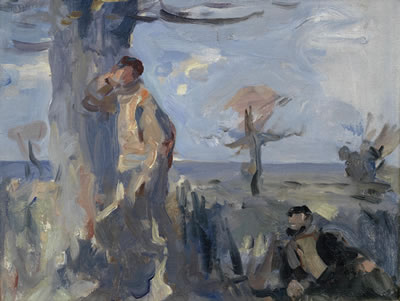
1865 Colchester, Essex, England - 1928 Ipswich, England. Known for: Portrait, figure, rural genre painting.
Harry Otto Becker (1865-1928). Born at 8 Eld Lane, Colchester, Essex in 1865, youngest of four sons of the five children of Dr Charles Otto G Becker, a doctor of medicine, and his wife Henrietta who,... Read full biography
Harry Otto Becker (1865-1928). Born at 8 Eld Lane, Colchester, Essex in 1865, youngest of four sons of the five children of Dr Charles Otto G Becker, a doctor of medicine, and his wife Henrietta who, with their eldest son 15 year old Charles Becker, were born in Germany and naturalized English.... Read full biography
Harry Otto Becker (1865-1928). Born at 8 Eld Lane, Colchester, Essex in 1865, youngest of four sons of the five children of Dr Charles Otto G Becker, a doctor of medicine, and his wife Henrietta who, with their eldest son 15 year old Charles Becker, were born in Germany and naturalized English. Harry studied at the Royal Academy Schools in Antwerp and after 1884 finished his training in the studio of Carolus Duran, a portrait painter, in Paris. He then returned to East Bergholt, Suffolk and... Read full biography
Harry Otto Becker (1865-1928). Born at 8 Eld Lane, Colchester, Essex in 1865, youngest of four sons of the five children of Dr Charles Otto G Becker, a doctor of medicine, and his wife Henrietta who, with their eldest son 15 year old Charles Becker, were born in Germany and naturalized English. Harry studied at the Royal Academy Schools in Antwerp and after 1884 finished his training in the studio of Carolus Duran, a portrait painter, in Paris. He then returned to East Bergholt, Suffolk and from 1886 until 1894 Becker lived at the Minories, Colchester after which he moved to London where he had a studio until 1913 during which time he made various trips to East Anglia, Kent and Holland. He was a member of Ipswich Fine Art Club form 1890.... Read full biography
Harry Otto Becker (1865-1928). Born at 8 Eld Lane, Colchester, Essex in 1865, youngest of four sons of the five children of Dr Charles Otto G Becker, a doctor of medicine, and his wife Henrietta who, with their eldest son 15 year old Charles Becker, were born in Germany and naturalized English. Harry studied at the Royal Academy Schools in Antwerp and after 1884 finished his training in the studio of Carolus Duran, a portrait painter, in Paris. He then returned to East Bergholt, Suffolk and from 1886 until 1894 Becker lived at the Minories, Colchester after which he moved to London where he had a studio until 1913 during which time he made various trips to East Anglia, Kent and Holland. He was a member of Ipswich Fine Art Club form 1890. He exhibited at the Alpine Club Gallery, Birmingham Royal Society of Artists, Beaux Art Gallery, Glasgow Institute... Read full biography
Artist Biography
Biography page for Harry Otto Becker ((1865 - 1928)), known for Portrait, figure, rural genre painting. Showing 2 biographical entries and 0 sample artworks.
Harry Otto Becker - Artist Info
About Harry Otto Becker
Biography from the Archives of askART
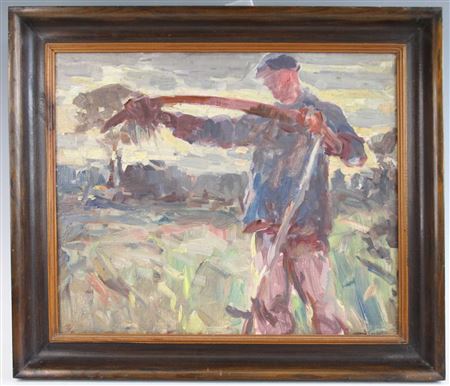 Harry Otto Becker (1865-1928)
Born at 8 Eld Lane, Colchester, Essex in 1865, youngest of four sons of the five children of Dr Charles Otto G Becker, a doctor of medicine, and his wife Henrietta who, with their eldest son 15 year old Charles Becker, were born in Germany and naturalized English. Harry studied at the Royal Academy Schools in Antwerp and after 1884 finished his training in the studio of Carolus Duran, a portrait painter, in Paris. He then returned to East Bergholt, Suffolk and from 1886 until 1894 Becker lived at the Minories, Colchester after which he moved to London where he had a studio until 1913 during which time he made various trips to East Anglia, Kent and Holland.
He was a member of Ipswich Fine Art Club form 1890. He exhibited at the Alpine Club Gallery, Birmingham Royal Society of Artists, Beaux Art Gallery, Glasgow Institute of the Fine Arts, Coupil Gallery, Liverpool Walker Art Gallery, London Salon, Manchester City Art Gallery, New Gallery, Royal Society of Portrait Painters, Royal Academy, Royal Society of British Artists, Redfern Gallery, Royal Hibernian Academy, Royal Institute of Painters in Water Colour and the Royal Scottish Academy, his exhibits at the Royal Academy included Sixty Miles to London 1889 and A Clover Field-Evening 1897. He married in 1902, Georgina Mary Waddington, a 35 year old artist when living at 71 Dieppe Road, Fulham and from 1913 they lived at Wenhaston, Suffolk. About 1926 they moved to Hinton, Darsham, Suffolk where he remained until his death in 1928. They were in very poor circumstances, relying on Georgina's small income from her position teaching art at a local school. Harry produced a series of posters for London Underground and his work was obsessive producing thousands of drawings in pencil, charcoal, red chalk, or pen and ink. He died at Ipswich in 1928, aged 62 and his wife died in 1957, aged 81.
Information provided by Tony Copsey, author and researcher of artists in Suffolk County, England.Biography from Reeman Dansie
Harry Becker was born in Colchester in 1865 to German parents Henrietta and Charles. His father Charles, who served as a field surgeon in various campaigns including Crimea, was drafted to Colchester in 1856 and there they settled. Charles became a well-respected GP, and Harry, along with his six siblings, grew up in the town. From 1884 to 1902 the family lived at The Minories—now an exhibition space that has operated as a gallery since the 1950s.
Becker began his formal artistic training at the age of fourteen when he enrolled at the Royal Academy of Fine Arts in Antwerp. He narrowly missed working with Vincent Van Gogh, who enrolled the year after Becker left. He completed his studies with a scholarship to the fashionable Bushey School of Art under Hubert von Herkomer before joining the Paris studio of Carolus-Duran. This atelier encouraged rapid, direct work from life, avoiding overworking a piece in order to retain the freshness of the initial sketch. It was a method embraced by the studio’s most celebrated student, John Singer Sargent, and by Becker himself, who learned to capture the essence of his subject with remarkable brevity. Adrian Bell later recalled visiting Becker’s widow Georgina in the 1940s and admiring a small oil painting, only to be told he had spent longer looking at the work than it had taken Becker to paint it!
After his studies, Becker returned to Colchester and, from 1888, kept a studio at Valley Farm, Flatford, in the heart of Constable Country. In 1894 he made the necessary move to London to be closer to galleries and exhibitions, though he continued to make frequent forays back to East Anglia as well as Kent and made annual trips to Holland in search of agricultural subjects for his work. In 1902 he married fellow artist Georgina Waddington, whom he had met at the Bushey School of Art, and they settled into a studio home in West Kensington. Their daughter Janet was born the following year.
During the next decade Becker’s reputation rose steadily. His first solo exhibition, held in 1905 at the Baillie Gallery, consisted entirely of lithographs on an agricultural theme. Print runs were strictly limited to thirty-five impressions, and several editions sold out completely. He was soon widely acknowledged as a master printmaker and, alongside Brangwyn, Nevinson, and Augustus John, became a founder member of the Senefelder Club, established to promote lithography. Becker was also at the forefront of contemporary painting, exhibiting with the New English Art Club alongside Sickert, Orpen, Steer, and other leading lights; at the Salon des Indépendants in Paris; and at the New Association of Artists. In 1911, his painting Dutch Peasant Women Gathering Potatoes was named one of the Royal Academy’s pictures of the year.
A year later he achieved a career-defining moment with an exhibition at the Meryon Gallery in London’s Mayfair. Its success led to a fortnight-long extension, and thirteen works from the show were selected for inclusion in William Beach Thomas’s ‘The English Year’, which also featured contributions from Alfred East and George Clausen.
Yet in the midst of his artistic fruition, Becker suffered a series of personal and professional events that would unbalance him. The deaths of his young son in 1909 and of his father in 1910 were followed by the haunting collapse of a major commission for mural designs for Selfridges’ central hall. Gordon Selfridge questioned the accuracy of Becker’s depictions of scythes—an affront to an artist committed to absolute truth in representation. Becker refused to alter his designs, and the commission was lost. Then, in 1911, intense media coverage of a court case concerning the annual Earls Court Fun Fair—whose noise had for years jangled his nerves and made work difficult—cast him in the newspapers as a killjoy. These painful events, coupled with rising anti-German sentiment in pre-war Britain, to which Becker was always particularly sensitive, weighed heavily on him. Ultimately, it was Becker’s own discomfort with the commercialism and self-promotion required by the London art world that led him, in 1912, to relocate permanently to the countryside.
At the age of forty-eight, Becker, Georgina, and Janet moved to Wenhaston in Suffolk’s Blyth Valley. Here he embraced a more reclusive life, dedicating himself wholly to his work and developing a style shaped by isolation from outside influence. He immersed himself in the cycle of the agricultural season, rising early, often at 5am, to accompany plow teams into the fields, synchronizing his swift, focused mark-making with the rhythmic actions of the farm workers. Although his productivity remained remarkable, exhibitions and sales slowed markedly. He showed several pieces at the Venice International Exhibition in 1913 and intermittently with the Royal Society of British Artists and the Royal Scottish Academy. With the exception of a couple of London Underground commissions for lithographic posters, sales almost entirely dried up. The cost of sending work to London became prohibitive, and the risk was demonstrated in 1914 when fifteen lithographs bound for the Leicester Galleries were destroyed when a railway truck rode over the parcel.
Becker became almost wholly reliant upon wages, which Georgina brought in from an art teaching job she secured at St. Felix School, Southwold, and from the support of a few local patrons, most notably the Loftus family of Southwold. Harry also grew increasingly disinclined to part with his work; he wrote, “I think it’s so disheartening to give away your pictures, because then they’re hung on the walls and nobody ever looks at them again." Materials were scarce, and Becker used whatever he could scratch together, working on scraps of card, the backs of his wife’s students’ work, greaseproof paper, and even old sacking.
His best works were produced during these richly creative Suffolk years, which continued until his death from pneumonia in 1928. He was almost forgotten until Adrian Bell selected Becker’s drawings to illustrate the 1948 edition of his best-selling farming trilogy. When Georgina died in 1958, the majority of Becker’s works passed to the Loftus family, who continued to champion his legacy through numerous exhibitions.
Becker’s career narrowly preceded a revolution in traditional agricultural methods; he chronicled the daily grind of man and horse, unchanged for centuries, with brilliant immediacy and free from the sentimentality that traditionally accompanied rural subjects. His work has since become synonymous with the literature, music, and social anthropology of East Anglian rural life. Becker’s ability to capture the essence of the Suffolk countryside—with consummate command across a range of media, refined during his years of self-imposed exile—firmly establishes him within the East Anglian artistic tradition, an artist of substance from the same soil as Constable and Crome.