Page loaded successfully. Showing biography for Henry Darger.
Henry Darger BIOGRAPHY

1892 Chicago, Illinois - 1973 Chicago, Illinois. Known for: Naive mixed-media, outsider artist.
Known as a proto-typical Outsider Artist, Henry Darger did works on paper of fantasy subjects in naive style to create a wide range of images evoking childhood on an extremely simplistic level. His... Read full biography
Known as a proto-typical Outsider Artist, Henry Darger did works on paper of fantasy subjects in naive style to create a wide range of images evoking childhood on an extremely simplistic level. His first retrospective was held in 1998 and was organized by the Museum of American Folk Art in New... Read full biography
Known as a proto-typical Outsider Artist, Henry Darger did works on paper of fantasy subjects in naive style to create a wide range of images evoking childhood on an extremely simplistic level. His first retrospective was held in 1998 and was organized by the Museum of American Folk Art in New York. He was born in Chicago to a father of German ancestry who worked as a tailor, and a mother, originally from Wisconsin, who died of infection at the age of thirty-five with another child when Henry... Read full biography
Known as a proto-typical Outsider Artist, Henry Darger did works on paper of fantasy subjects in naive style to create a wide range of images evoking childhood on an extremely simplistic level. His first retrospective was held in 1998 and was organized by the Museum of American Folk Art in New York. He was born in Chicago to a father of German ancestry who worked as a tailor, and a mother, originally from Wisconsin, who died of infection at the age of thirty-five with another child when Henry was four years old. He lived with his father for awhile and then at age eight, was sent to a Catholic boys home while attending public school. His behavior was odd; he grew to only five-feet three inches; and he made such disruptive noises that his... Read full biography
Known as a proto-typical Outsider Artist, Henry Darger did works on paper of fantasy subjects in naive style to create a wide range of images evoking childhood on an extremely simplistic level. His first retrospective was held in 1998 and was organized by the Museum of American Folk Art in New York. He was born in Chicago to a father of German ancestry who worked as a tailor, and a mother, originally from Wisconsin, who died of infection at the age of thirty-five with another child when Henry was four years old. He lived with his father for awhile and then at age eight, was sent to a Catholic boys home while attending public school. His behavior was odd; he grew to only five-feet three inches; and he made such disruptive noises that his peers named him "Crazy," something that stayed with him throughout his life. His "oeuvre" was only discovered in 1973... Read full biography
Artist Biography
Biography page for Henry Darger ((1892 - 1973)), known for Naive mixed-media, outsider artist. Showing 2 biographical entries and 0 sample artworks.
Henry Darger - Artist Info
About Henry Darger
Biography from Galerie St. Etienne
Henry Darger (1892-1973) is in many respects the prototypical "outsider" artist: a recluse who created a startling imaginary world in his rented room, unbeknownst to anyone but himself. Between approximately 1910 and 1921, Darger wrote what is believed to be the longest novel in existence, which he called The Story of the Vivian Girls in What is Known as the Realms of the Unreal or the Glandelinian War Storm or the Glandico-Abbiennian Wars, as Caused by the Child Slave Rebellion (for short, In the Realms of the Unreal). This 15,145-page saga documents a protracted war between an empire of evil, child-slave-owning "Glandelinians" and the "Christian nations," led by the angelic Vivian sisters.
Upon concluding the novel, Darger devoted the remainder of his life to illustrating it, producing several hundred elongated watercolors that tell his story in a manner reminiscent of mural-sized comic strips.
An obsessive-compulsive accumulator of news reports and popular illustration, the artist synthesized from these elements a complex pictorial narrative of suppressed sexuality, graphic violence and improbable idealism.
Darger's artistic legacy, discovered shortly before his death by his landlord, Nathan Lerner, has gradually won a devoted following both within and beyond the field of "outsider" art. By inserting innocent-looking children (culled from coloring books, comic strips and fashion advertisements) into often grisly battle scenes and by equipping many of these children (regardless of gender) with penises, Darger created jarring juxtapositions that unwittingly expose the faux naiveté of mid-20th century American popular culture. This aspect of his work has struck a particularly responsive chord with contemporary audiences, accustomed as they are to such postmodern techniques as appropriation and recontextualization.
Although some might be inclined to view Darger's work ironically, it is clear that the artist took his subject seriously. The war between the Abbiennians and the Glandelinians is nothing less than a global struggle between good and evil, reflecting on one level a battle being waged within Darger's soul, and on another mirroring the destructive course of modern history. It is the complex interplay between fantasy and reality in Darger's Realms that makes his opus so compelling.Biography from Christie's New York, Rockefeller Center
 Known as a proto-typical Outsider Artist, Henry Darger did works on paper of fantasy subjects in naive style to create a wide range of images evoking childhood on an extremely simplistic level. His first retrospective was held in 1998 and was organized by the Museum of American Folk Art in New York.
He was born in Chicago to a father of German ancestry who worked as a tailor, and a mother, originally from Wisconsin, who died of infection at the age of thirty-five with another child when Henry was four years old. He lived with his father for awhile and then at age eight, was sent to a Catholic boys home while attending public school. His behavior was odd; he grew to only five-feet three inches; and he made such disruptive noises that his peers named him "Crazy," something that stayed with him throughout his life.
His "oeuvre" was only discovered in 1973 after his landlord Nathan Lerner placed him in a nursing home. Lerner uncovered a staggering trove of drawings, collages, watercolors and manuscripts that the artist had created over the course of approximately 50 years. His major work is a fifteen-thousand page written and illustrated story entitled The Story of the Vivian Girls" in what is known as the "Realms of the Unreal, of the Glandeco-Angelinian War Storm, caused by the Child Slave Rebellion. He also wrote an eight-volume autobiography consisting of 5,084 hand-written pages as well as a nine-year-long study of the weather.
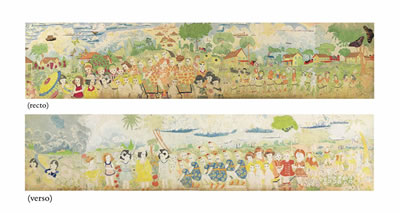
A major work, "While inside they await developments"... is a large-scale double-sided watercolor of collaged paper from his epic tale, an imagined war between two fictional groups of young girls, the Angelinian and the Glandelinians. As can be seen in the following three works (lots 71-73), Darger's protagonists (and their male accomplices) are shown in innumerable situations, from sweet interior scenes of children playing to the most violent and gruesome tortures.
In addition to Darger's bold use of color, jarring compositional designs and intricate methods of working, his subject matter speaks to a contemporary art world that is fixated on children or child-like imagery. Contemporary artists such as Takashi Murakami and Yoshimoto Nara regularly depict children, with a Dargeresque undercurrent of mystery and foreboding.
Darger has recently been the subject of major exhibitions, including a traveling retrospective that was shown at the American Museum of Folk Art in 1997 and Disasters of War: Francisco de Goya, Henry Darger, Jake and Dinos Chapman at P.S. 1/MoMA in 2000-2001. There have also been a number of major monographs published recently, including Henry Darger: Art and Selected Writings (Rizzoli, 2000) and Henry Darger: In The Realms of the Unreal (Abrams: 2001).
He was put in an asylum for feeble minded children, and in 1909 at age fifteen escaped from Lincoln, Illinois back to Chicago where he worked as a dishwasher and hospital janitor. He was a fanatic Catholic, walking to mass several times a day, and was obsessed by talk of the weather. He was also a superb mimic who sometimes carried on elaborate conversations with himself, playing the role of several characters.
In 1910, he began a fantasy epic that eventually filled 15,145 single-spaced, legal-size pages bound into fifteen volumes and occupied forty years of his life. It was a long story about young girls in jeopardy, and he later illustrated the tale in over three-hundred pictures, a project that filled his apartment so full that he had only room to sleep in an armchair.
These writings and drawings were salvaged by Nathan Lerner, photographer and designer for the Chicago Institute of Design, who was Darger's landlord and who realized the potential value. He had Darger's paintings and writings photographed and catalogued. Lerner and his wife handled the publicity, and the first public exhibition was at the Hyde Park Art Center in 1977.
Source:
Christie's New York