Page loaded successfully. Showing biography for Henry Jay MacMillan.
Henry Jay MacMillan BIOGRAPHY

1908 Wilmington, North Carolina - 1991 Wilmington, North Carolina. Known for: Portrait, landscape and military paintings, teaching.
Wilmington born artist Henry Jay MacMillan (1908-1991) Henry Jay Macmillan was born on January 13, 1908.1 His parents were Jane Meares Williams (1882-1964)2 and Henry Jay Macmillan Sr. (1879-1920)3.... Read full biography
Wilmington born artist Henry Jay MacMillan (1908-1991) Henry Jay Macmillan was born on January 13, 1908.1 His parents were Jane Meares Williams (1882-1964)2 and Henry Jay Macmillan Sr. (1879-1920)3. Jane and Henry married on Nov 9, 1905.4 By 1920, Henry was in the automobile business. 5. Jane’s... Read full biography
Wilmington born artist Henry Jay MacMillan (1908-1991) Henry Jay Macmillan was born on January 13, 1908.1 His parents were Jane Meares Williams (1882-1964)2 and Henry Jay Macmillan Sr. (1879-1920)3. Jane and Henry married on Nov 9, 1905.4 By 1920, Henry was in the automobile business. 5. Jane’s obit says that Henry Sr. went into business with Bruce B. Cameron just before he died and Mrs. Macmillan continued as an active partner afterwards until the 1940s. 6. Henry Jay had two sisters Jane... Read full biography
Wilmington born artist Henry Jay MacMillan (1908-1991) Henry Jay Macmillan was born on January 13, 1908.1 His parents were Jane Meares Williams (1882-1964)2 and Henry Jay Macmillan Sr. (1879-1920)3. Jane and Henry married on Nov 9, 1905.4 By 1920, Henry was in the automobile business. 5. Jane’s obit says that Henry Sr. went into business with Bruce B. Cameron just before he died and Mrs. Macmillan continued as an active partner afterwards until the 1940s. 6. Henry Jay had two sisters Jane MacMillan (1910-1981)7 who married J. Laurens Wright in 19318 and Helen MacMillan Lane (1914-1987) who was also an artist.9 Helen married John Crabtree Lane at St. Pauls Episcopal Church in August Georgia on Nov 23, 1944. According to Claude Howell “this... Read full biography
Wilmington born artist Henry Jay MacMillan (1908-1991) Henry Jay Macmillan was born on January 13, 1908.1 His parents were Jane Meares Williams (1882-1964)2 and Henry Jay Macmillan Sr. (1879-1920)3. Jane and Henry married on Nov 9, 1905.4 By 1920, Henry was in the automobile business. 5. Jane’s obit says that Henry Sr. went into business with Bruce B. Cameron just before he died and Mrs. Macmillan continued as an active partner afterwards until the 1940s. 6. Henry Jay had two sisters Jane MacMillan (1910-1981)7 who married J. Laurens Wright in 19318 and Helen MacMillan Lane (1914-1987) who was also an artist.9 Helen married John Crabtree Lane at St. Pauls Episcopal Church in August Georgia on Nov 23, 1944. According to Claude Howell “this was a sad day for me – and later for Helen.”10. Henry MacMillan apparently attended the New York School of Fine and Appli... Read full biography
Artist Biography
Biography page for Henry Jay MacMillan ((1908 - 1991)), known for Portrait, landscape and military paintings, teaching. Showing 2 biographical entries and 0 sample artworks.
Henry Jay MacMillan - Artist Info
About Henry Jay MacMillan
Biography from the Archives of askART
 Wilmington born artist Henry Jay MacMillan (1908-1991) Henry Jay Macmillan was born on January 13, 1908.1 His parents were Jane Meares Williams (1882-1964)2 and Henry Jay Macmillan Sr. (1879-1920)3
Jane and Henry married on Nov 9, 1905.4 By 1920, Henry was in the automobile business. 5
Jane’s obit says that Henry Sr. went into business with Bruce B. Cameron just before he died and Mrs. Macmillan continued as an active partner afterwards until the 1940s. 6
Henry Jay had two sisters Jane MacMillan (1910-1981)7 who married J. Laurens Wright in 19318 and Helen MacMillan Lane (1914-1987) who was also an artist.9 Helen married John Crabtree Lane at St. Pauls Episcopal Church in August Georgia on Nov 23, 1944. According to Claude Howell “this was a sad day for me – and later for Helen.”10
Henry MacMillan apparently attended the New York School of Fine and Applied Art (nowParsons School of Design), including the Paris branch. In the December 12, 1926 society page, a piece states that Henry is in New York, studying art, although he will be home for the holidays. 11 He apparently graduated from that Paris branch in 1929.12 I have emailed Parsons to ask if they have any info on him. As of 3/12/14, they have not replied.
He definitely was in Europe in 1929: On dec 18, 1929 Henry traveled from Cherbourg France to New York, New York with his mum and sister Helen. The family are listed as residing in Wilmington.13
An earlier newspaper account said that the MacMillan women (both daughters), went to France in September 1929.14 This December trip may be when he returned after graduating from the Paris branch of Parsons. Although just to confuse issues, another record has him traveling from Southampton to New York on the SS George Washington, arriving March 2, 1929 by himself.15
He seems to have ended up back in Wilmington in the summer, because the newspaper reports he was leaving in August 1929 to go with his uncle, H. C. Foard, to New York.16 A bio of MacMillan states he worked as an interior designer in the New York area and in Washington, DC for seven years. 17
This statement does not seem to hold up to scrutiny: he seems to be absent from the record for much of the early 1930s. In the 1930 census, Mr. MacMillan was listed as living in East Orange New Jersey, with his aunt, Catherine Foard. The then 22 year old MacMillan was working as an interior decorator for the retail merchant. 18 The census was taken in April 1930. Then Henry seems to mostly disappear out of the record. He is not in the Wilmington city directories until the 1936 one. He is not listed in the 1930 and 1932 Orange NJ directories (the only ones on ancestry.com). He is not listed in 1931 Manhattan City Directory (the only one on Ancestry) or the 1933 Brooklyn one (the only one on ancestry.com), there is no Queens city directory for that period online. And he is not in the 1931-1935 Washington DC city directory.19
He could possibly live in Maryland or Virginia if he is working in DC. He might live somewhere else in the NY metropolitan area. He and Helen are both involved in the Art League of New York and both live at 696 Madison Avenue in New York City, doing art classes in 1933-1934. 20
And Henry is reported as returning to New York in January 1934 with sister Helen after spending the holidays at home.21 But he does not seem to be gone for 7 years: In October 1940, when MacMillan registered for the draft, he was listed as self-employed, lived with his mother at 118 South 4th Street. According to the 1940 census, Henry lived in Wilmington in 1935. And city directories place MacMillan in Wilmington from the mid-1930s. 22
Claude Howell’s journal entries suggest he was here, too, at least part of the time. In an April 5, 1936 diary entry, Claude Howell states “Elizabeth Bridgers and I, wanting something to do tonight, stopped in to see Henry and Helen MacMillan who are both home this winter painting.” 23
Later, Claude states “Helen MacMillan is home from New York where she was studying at the Art Student’s League. I called on her tonight. Peggy Hall is also home from Washington. She has been studying at Studio House all winter. She and Henry came in and we discussed palettes....Henry’s portrait of Margaret Graham is an exciting piece of work.”24 There is also a reference to ‘henry” in February, April, June 193725
Claude Howell’s journal also says that Henry spent the summer of 1937 “studying...with Boardman Robinson in Colorado Springs.”26
In November, Howell and MacMillan went to Southport to paint 27
Howell mentions MacMillan repeatedly in 1938.28 For example, Claude helps them moved to the beach cottage in May 1, 1938. Although the 1940 census incorrectly lists his mother as Helen, it’s the family since they live at 118 S 4th Street.
1 Henry has no job listed.29
MacMillan had his first NY “one-man show...at the no. 10 Gallery.....” in November 1941. 30 On October 16, 1940, along with all the other men in the county between the ages of 21 and 35, Henry registered for the draft.”31
On 31 July 1942, MacMillan was inducted into the United States Army, and sent to Fort Bragg, along with 80 other men from New Hanover County. 32 By November 1942, Henry had been at Fort Belvoir long enough to get a chance to come back to Wilmington for a weekend visit. Henry had been sent to train at Corps of Engineers Replacement Training Center.33
At the center, MacMillan would have likely received 12 weeks training, including specialist training for the topographic unit. 34
MacMillan wrote to Claude Howell in October, 1942. Claude reported in his journal that “A letter came from Henry MacMillan this week.... He is at Fort Belvoir still and does not have a minute in which to paint.”35
Claude reported on November 17, 1942, “Henry MacMillan has been home from the army this weekend and it has not changed him one iota. I doubt if anything could. Now that he has been assigned to the Art Project at Fort Belvoir I am wondering is his painting will be changed. There is a possibility that his work will have a bit more life in it.”36
Later, in January 1944, Claude reported “I was given enough watercolor paper at Christmas to last at least a year....the rest was the paper, Italian I think, which Henry MacMillan sent to me from Sicily. Everyone thinks this is a riot since I had tried and tried unsuccessfully for several months to get some to send to him being such that in the midst of a war watercolor paper would be next to impossible to find.” 37 Apparently, after the war, Mr. MacMillan studied at the Art Students League in NY, taught at Parsons School of Design and then returned to Wilmington in 1956.
38 He died here in 1991. This information again seems to be contradicted by the known record. The Art Students League’s records only show MacMillan there in the 1930s. An article in Bill Reaves Block book has Henry J. MacMillan ushering in the June 1946 wedding of W. D. MacMIllan and Emma Woodward. The article lists out of town guests, and does not include Henry in that category. Claude Howell’s scrapbooks show that Henry was in Wilmington July 7, 1947, inviting people over to meet Lt. Col Thomas L. Crystal Jr, and Mrs. Crystal, the Lt. Col was Henry’s commanding officer during the war.39
So it seems like MacMillan was in Wilmington after the war for at least some stretch of time. Still, the 1948 Manhattan City Directory lists Henry at 333 E 30th Street in NY. 40
Also, a manifest for the Queen Mary arriving from Southhampton England in New York on August 28, 1950 has MacMillan and his mother coming into port and their home address is S. 4 th Street.41 On the other hand, Terry’s research showed that he wasn’t in the city directories from 1946-1956. 42
In 1960, Mr. MacMillan was Chairman of the New Hanover County Local Committee of the North Carolina Confederate Centennial Commission.43 In 1973, Mr. MacMillan gave the Museum his collection of soldier art. Over the years, Mr. Macmillan and his estate donated more than 300 objects to Cape Fear Museum’s collection.
1 The National Archives Southeast Region; Atlanta, GA; Records of the Selective Service System, 1926-1975; Record Group: RG 147; Class: RG147, North Carolina World War II Draft Registration Cards; Box Number: 230 2 “Deaths and Funerals: Mrs Henry Jay MacMillan,” Start-News, p. 4-A Feb 2, 1964 3
“Deaths and Funerals: Mrs Henry Jay MacMillan,” Start-News, p. 4-A Feb 2, 1964 North Carolina State Board of Health, Bureau of Vital Statistics. North Carolina Death Certificates. Microfilm S.123. Rolls 19-242, 280, 313-682, 1040-1297. North Carolina State Archives, Raleigh, North Carolina. Lists MacMillan as an auto dealer, born on december 30, 1879, died on October 21, 1920. He died of cerebral thrombosis with complication of malaria? 4
“Deaths and Funerals: Mrs Henry Jay MacMillan,” Start-News, p. 4-A Feb 2, 1964
5 MacMillan household, S 4th street, Year: 1920; Census Place: Wilmington Ward 4, New Hanover, North Carolina; Roll: T625_1312; Page: 1A; Enumeration District: 106; Image: 1150. Father Henry listed as a auto dealer, aged 40. 6
“Deaths and Funerals: Mrs Henry Jay MacMillan,” Start-News, p. 4-A Feb 2, 1964 7
“Deaths” Mrs. Jane MacMillan Wright, Star News Feb 20, 1981. Says born Jan 31, 1919, died Feb 18, 1981* (calculated from date of paper 8http://srvrodweb.nhcgov.com/results.asp Jane MacMillan married John Laurens Wright, December 19, 1932
9 Ancestry.com. North Carolina, Death Indexes, 1908-2004 [database on-line]. Provo, UT, USA: Ancestry.com
Operations, Inc., 2007. Born 7 Mar 1914, died April 18, 1987
10 Claude Howell scrapbook, 1997.055.XXXX 1944-1946
11 Wilmington Norning Star, SEcond Edition, Sunday Dec 12, 1926 page 2
12 William Whitehead, “introduction” MacMillan Booklet, “A Retrospective Exhibition 1926 through 1974 of the Work of Henry Jay Macmillan
1313 Year: 1929; Arrival: New York, New York; Microfilm Serial: T715; Microfilm
Roll: 4646; Line: 27; Page Number: 107. arrived form Cherbourg on the Olympic
14 Wilmington Sunday Star, Sept 22, 1929, p. 14
15 New York, Passenger Lists, 1820-1957
16 Wilmington Morning Star, August 2, 1929, p. 6
17 William Whitehead, “introduction” MacMillan Booklet, “A Retrospective Exhibition 1926
through 1974 of the Work of Henry Jay Macmillan
18 1930; Census Place: East Orange, Essex, New Jersey; Roll: 1329; Page: 1B; Enumeration
District: 0368; Image: 143.0; FHL microfilm: 2341064
19 ancestry.com
20 records from Art League of New York. sent in 2014
21 Wilmington Morning Start, January 10, 1934 p. 10
22 see terry’s list
23 Claude Howell, journal 1935-1937
24 Claude HOwell journal, entry for June 11, 1936
25 Claude Howell Journal entry for Feb 5, 1937, April 26, 1937, June 14, 1937
26 claude howell journal entry Sept 17, 1937
27 Claude Howell journl etnry Nov 6, 1937
2828 January 7 (the macmillans), Henry by name: March 7, 19, april 3, april 5, april 6,
29 1940; Census Place: Wilmington, New Hanover, North Carolina; Roll: T627_2951; Page:
12B; Enumeration District: 65-26.
30 New York Times, Sunday November 23, 1941
31 “America’s Young Men Register for Draft Today: New Hanover County Ready For Big Task,” Wilmington Morning Star, October 16, 1940, p. 1 Henry Jay MacMillan’s draft card, dated 10/16/1940 lists MacMillan as self employed, living on 4th street.
32 “80 Men from New Hanover Leave For Army Induction” Wilmington Morning Star, July 31, 1942, p. 8
33 Wilmington Morning Star, November 17, 1942 “Henry J. MacMillan has returned to Fort Belvoir, VA., after spending a few days with his morhter.” And “Visits Mother” Private Henry Jay MacMillan arrived today from the Corps of Engineers Replacement Trianing center at Fort Belvoir, VA.” 11-21-1942 “N” Bill Reaves Block Book, Volume 9, 4th Street South.
34 Paul K. Walker, “The Engineer Replacement Training Center, Fort Belvoir, VA” p. 73 pdf from internet
35 Claude Howell Journal, vol 4, 1942-1944, October 24, 1942 entry
36 ibid, Nov 17, 1942 entry.
37 ibid, Jan , 1944 entry
38 William Whitehead, “introduction” MacMillan Booklet, “A Retrospective Exhibition 1926
through 1974 of the Work of Henry Jay Macmillan
39 Claude Howell Scrapbook, 1947
40 New York, New York, City Directory, 1948, Ancestry.com. U.S. City Directories, 1821-1989 [database on-line]. Provo, UT, USA: Ancestry.com Operations, Inc., 2011.
Original data: Original sources vary according to directory. The title of the specific directory being viewed is listed at the top of the image viewer page. Check the directory title page image for full title and publication information.
41 Inbound passengers on the Queen Mary from Ancestry.com, leaving Southhampton August 23, 1950 and arriving New York, August 28, 1950 Source Citation -- Year: 1950
Description Day or Roll Number: Roll 7879
Source Information:
Ancestry.com. New York, Passenger Lists, 1820-1957
42 Henry is always listed as residing at 118 South 4th Street
First: 1936 (p.270)
1938 (p.278) First as Artist
1943 (p.418)- 1945 (p.190) United States Army
1946 - 1955 NOT LISTED
1956 (p.198) - 1965 (p.265) Commercial Artist, back at 118 S. 4th
1966 - 1967 NOT LISTED (Street Index p.10 for tenants)
1968 (p.307) - 1985 (p.342) Artist, back at 118 S. 4th
1986 (p.393) - 1993 (221) Retired, 118 S. 4th
43 The North Carolina Confederate Centennial Commission Newsletter, October 1960, Volume
1, No. 4, p. 2
Submitted by: Jack SaleBiography from the Archives of askART
The following is courtesy of Lake High:
Henry Jay MacMillan
(1908 1991)
Henry Jay MacMillan was born in Wilmington, NC in 1908, and after his extensive travels to Europe and his work in New York and Washington, D.C., he died in Wilmington in 1991. In 1956 after a career in teaching art and interior design, Henry MacMillan had returned to his native Wilmington, NC and lived in the family home that his grandfather had built in 1889. It was in that very house that his grandmother, Jane Williams, first introduced him to fine art.
His grandmother, who had studied botany, wood carving and china-painting, combined both botany and painting into designs of North Carolina wild flowers painted on plates which she fired in her own kiln. Her love of art was passed on to her two children, one of whom became Jane MacMillan, the mother of Henry. And Jane MacMillan passed her love of art on to her two children, Helen MacMillan Lane and Henry Jay MacMillan, both of whom became professional artists.
In the early 1920s Elisabeth Chant, artist and teacher, moved her studio into the old Hart Winery building, which was across the street from the MacMillan's home. One of Miss Chant's aims was to found an art colony and the influence she had on Henry MacMillan, who started studies under her direction at the young age of 13, was profound.
At the age of 18, MacMillan attended the New York School of Fine and Applied Art (now the Parson's School of Design). For the next three years he studied architecture and interior design both in New York and in the Paris branch of that school. He graduated from the Paris branch in 1929. For the next seven years he worked as an interior designer for architects and decorators in Washington and New York, all the while keeping an interest in fine art. Plus, he studied at the Colorado Springs Fine Arts Center and the Woodstock School in Woodstock, New York.
He also studied under Yasuo Kuniyoshi (whose influence can be seen in his delicate flower paintings), George Bridgeman, A. Woelfle and J. Smith. Given his strong background in varied painting techniques, Henry MacMillan has produced major works in watercolor, tempera and oil glazes.
His work was exhibited at the New York World's Fair in 1939, and he had his first one-man show at Gallery 10 in New York two years later. The art critics in New York were favorable and the exposure gained him a commission from the Sperry Corporation to paint a mural in the Rockefeller Center.
MacMillan was inducted into the United States Army in August 1942. In 1943, he was sent to North Africa and then to Sicily. After the Normandy landing in 1944 he was called on to paint the hedgerows being used by the Germans as natural defenses. It seemed as if the photographs taken of them failed to tell the whole story and artistic renderings actually served the army better. Colonel Thomas Crystal, recognizing MacMillan's talent, assigned him a jeep and a driver and detached him from service status so that he could paint military activities for the remainder of the war.
MacMillan followed the movement of the 19th Corps Headquarters and recorded its progress through France, Belgium, and Holland and back into Germany, finally stopping at the town of Barby in April of 1945. Even though it was commonplace for such paintings to become the property of the Army, MacMillan was allowed to keep them and return home with all of his military paintings. In 1973 he donated an extensive collection of war scenes done in watercolor and pen and ink from the European theater to the Cape Fear Museum. Asked why all the pictures of war scenes he answered, "Why did I paint all these pictures of the European front during World War Two? Because I am an artist, and artists paint what they see."
But Henry MacMillan was more than an artist; he was also a teacher and a promoter of art and history. After the war he studied at the Art Student's League in New York and for 10 years after World War Two he was an instructor of painting and drawing at his old alma mater, Parson's School of Design in New York.
Before the war in 1938 he had campaigned to have the Works Projects Administration in Washington build an art museum in Wilmington, North Carolina. When it opened in November of 1939, he was named head of the art school of the Museum. His artist mother, Jane MacMillan, who had encouraged him and lent him lifelong support, became the first President of the Museum. Henry MacMillan himself later joined the Board of Directors of the St. Johns Museum of Art and, in keeping with his historical interest he also became president of the Lower Cape Fear Historical Society.
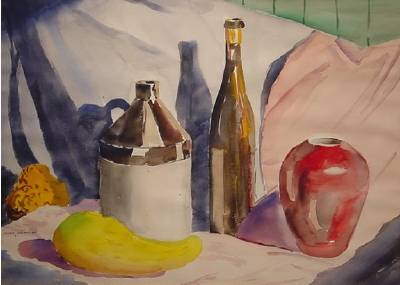
While in North Carolina Henry MacMillan worked as a portraitist as well as a painter of landscapes and the still lifes so beloved by Southerners.
MacMillan has had his work exhibited at group shows throughout the nation with one-man shows being held at the Mint Museum in Charlotte, NC, at Duke University, the North Carolina Museum of Art in Raleigh, and at the St. John's Museum of Art, which held retrospectives of his work in both 1970 and 1975.
MacMillan is listed in Ray Davenport's Art Reference and Price Guide and Mantel Fieldings' Dictionary. His work is in the permanent collection of the Cape Fear Museum and the Louise Wells Cameron Museum in Wilmington, North Carolina.