Page loaded successfully. Showing biography for Hermann Georg Plattner.
Hermann Georg Plattner BIOGRAPHY
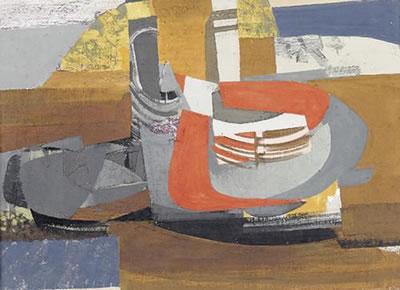
1909 Bern, Switzerland - 1997. Known for: Geometric and abstract expressionist painting, teaching, screen print, collage.
Hermann Plattner was born in Bern and attended elementary schools from 1916 to 1929 with a high school diploma at the Realgymnasium in Bern. From 1929 to 1932, studies followed at the Philosophical... Read full biography
Hermann Plattner was born in Bern and attended elementary schools from 1916 to 1929 with a high school diploma at the Realgymnasium in Bern. From 1929 to 1932, studies followed at the Philosophical Faculty of the University of Bern. He qualified as a drawing teacher from 1932 to 1935 at the Bern... Read full biography
Hermann Plattner was born in Bern and attended elementary schools from 1916 to 1929 with a high school diploma at the Realgymnasium in Bern. From 1929 to 1932, studies followed at the Philosophical Faculty of the University of Bern. He qualified as a drawing teacher from 1932 to 1935 at the Bern School of Applied Arts. With his brother he took courses at the Académie de la Grande Chaumière* in Paris with Charles Blanc and Fernand Léger as well as at the Heymann Academy in Munich. In the years... Read full biography
Hermann Plattner was born in Bern and attended elementary schools from 1916 to 1929 with a high school diploma at the Realgymnasium in Bern. From 1929 to 1932, studies followed at the Philosophical Faculty of the University of Bern. He qualified as a drawing teacher from 1932 to 1935 at the Bern School of Applied Arts. With his brother he took courses at the Académie de la Grande Chaumière* in Paris with Charles Blanc and Fernand Léger as well as at the Heymann Academy in Munich. In the years 1935 to 1937 he undertook study trips to Italy, southern France, Holland and Belgium. The non-representational painting by Max von Mühlenen and Jacques Villon became a significant stimulus for him. During World War II, Plattner was active in the Swiss... Read full biography
Hermann Plattner was born in Bern and attended elementary schools from 1916 to 1929 with a high school diploma at the Realgymnasium in Bern. From 1929 to 1932, studies followed at the Philosophical Faculty of the University of Bern. He qualified as a drawing teacher from 1932 to 1935 at the Bern School of Applied Arts. With his brother he took courses at the Académie de la Grande Chaumière* in Paris with Charles Blanc and Fernand Léger as well as at the Heymann Academy in Munich. In the years 1935 to 1937 he undertook study trips to Italy, southern France, Holland and Belgium. The non-representational painting by Max von Mühlenen and Jacques Villon became a significant stimulus for him. During World War II, Plattner was active in the Swiss army. From 1946 to 1976 he was a full-time drawing teacher at the Städtisches Gymnasium Kirchenfeld Bern. With his artist colleague We... Read full biography
Artist Biography
Biography page for Hermann Georg Plattner ((1909 - 1997)), known for Geometric and abstract expressionist painting, teaching, screen print, collage. Showing 1 biographical entries and 0 sample artworks.
Hermann Georg Plattner - Artist Info
About Hermann Georg Plattner
Biography from the Archives of askART
 Hermann Plattner was born in Bern and attended elementary schools from 1916 to 1929 with a high school diploma at the Realgymnasium in Bern. From 1929 to 1932, studies followed at the Philosophical Faculty of the University of Bern. He qualified as a drawing teacher from 1932 to 1935 at the Bern School of Applied Arts. With his brother he took courses at the Académie de la Grande Chaumière* in Paris with Charles Blanc and Fernand Léger as well as at the Heymann Academy in Munich.
In the years 1935 to 1937 he undertook study trips to Italy, southern France, Holland and Belgium. The non-representational painting by Max von Mühlenen and Jacques Villon became a significant stimulus for him. During World War II, Plattner was active in the Swiss army. From 1946 to 1976 he was a full-time drawing teacher at the Städtisches Gymnasium Kirchenfeld Bern.
With his artist colleague Werner Witschi, he traveled to Venice, Ravenna, Paris, Le Havre, Hamburg and Duisburg from 1951 to 1958, to Istanbul in 1959, to Berlin, Antwerp, London, Boulogne-sur-Mer, le Havre and from 1960 to 1961 Rome. For his family background, Hermann Plattner was a cross-border commuter between the German-Swiss and the French-speaking cultures.
Hermann Plattner's work contains oil paintings, watercolors, drawings as well as screen prints and collages. Plattner probably learned precise work from the traditional representational style of painting by Charles Blanc and Heymann, but he did not find his own way in it. Back in Bern, he made new friends with Paul Klee and Bernhard Geiser, the author of the catalog of the graphic work by Pablo Picasso.
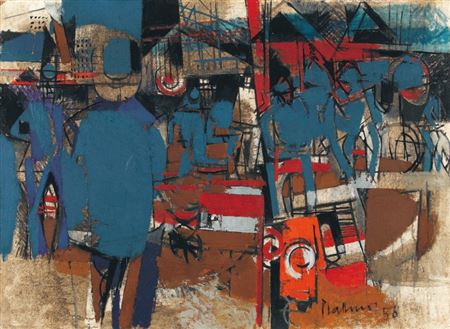
With the styles of Cubism* and Surrealism*, he discovered new perspectives. The initially representational representations of people, objects and landscapes gave way to geometric shapes in flat abstraction around 1950. From 1952, he tried to express the relationship between shape and color in collages* at a distance from the natural model.
From the pure painting found in the 1960s, Plattner developed a process in the 1970s in which he did not directly translate sketched pictures of nature into paintings. He only kept them in mind in order to bring them from the picture memory to the canvas in color field arrangements. With the division of surfaces and colors by a line structure, non-objective compositions were created.
"With his works, Hermann Plattner makes an important contribution in the field of cubist and lyrical-abstract image conception, particularly in dealing with figure and non-objectivity, memory and analysis, space and time, gesture, color and form."
Works by Plattner are in public collections in the city of Bern, the canton of Bern and in the Kunstmuseum Bern; A ceramic mosaic from 1961 on the northern outer wall of the PTT building Viktoriaplatz 1 in Bern; The mural Ichthys, from 1966, in mineral paint on concrete, in the lecture hall of the Thomaskirche, Bern-Liebefeld.
Source:
Website of PeoplePill ID, 2020
* For more in-depth information about these terms and others, see AskART.com. Glossary http://www.askart.com/AskART/lists/Art_Definition.aspx