Page loaded successfully. Showing biography for Hobson Lafayette Pittman.
Hobson Lafayette Pittman BIOGRAPHY
1899/1890 Epworth, North Carolina - 1972 Bryn Mawr, Pennsylvania. Known for: Still-life florals, interiors, landscape painting.
Hobson Pittman was born near Epworth, North Carolina. (There is conflicting information about his birth year, as Who's Who 1947 cites 1899 while Who's Who 1966 cites 1900). In 1906, his family moved... Read full biography
Hobson Pittman was born near Epworth, North Carolina. (There is conflicting information about his birth year, as Who's Who 1947 cites 1899 while Who's Who 1966 cites 1900). In 1906, his family moved to Tarboro, North Carolina, where he studied art from 1912 to 1916 at the Rouse Art School. In 1918,... Read full biography
Hobson Pittman was born near Epworth, North Carolina. (There is conflicting information about his birth year, as Who's Who 1947 cites 1899 while Who's Who 1966 cites 1900). In 1906, his family moved to Tarboro, North Carolina, where he studied art from 1912 to 1916 at the Rouse Art School. In 1918, he moved to Pennsylvania to continue his studies at Pennsylvania State College and Carnegie Institute. He later studied at Woodstock, New York, and in Europe in 1928. He exhibited extensively,... Read full biography
Hobson Pittman was born near Epworth, North Carolina. (There is conflicting information about his birth year, as Who's Who 1947 cites 1899 while Who's Who 1966 cites 1900). In 1906, his family moved to Tarboro, North Carolina, where he studied art from 1912 to 1916 at the Rouse Art School. In 1918, he moved to Pennsylvania to continue his studies at Pennsylvania State College and Carnegie Institute. He later studied at Woodstock, New York, and in Europe in 1928. He exhibited extensively, including the Pennsylvania Academy of the Fine Arts, the Corcoran Gallery in Washington, D.C., the Virginia Museum of Fine Arts, the Art Institute of Chicago, and the Santa Barbara Museum of Art. He was a renowned teacher at various institutions:... Read full biography
Hobson Pittman was born near Epworth, North Carolina. (There is conflicting information about his birth year, as Who's Who 1947 cites 1899 while Who's Who 1966 cites 1900). In 1906, his family moved to Tarboro, North Carolina, where he studied art from 1912 to 1916 at the Rouse Art School. In 1918, he moved to Pennsylvania to continue his studies at Pennsylvania State College and Carnegie Institute. He later studied at Woodstock, New York, and in Europe in 1928. He exhibited extensively, including the Pennsylvania Academy of the Fine Arts, the Corcoran Gallery in Washington, D.C., the Virginia Museum of Fine Arts, the Art Institute of Chicago, and the Santa Barbara Museum of Art. He was a renowned teacher at various institutions: Pennsylvania State University, Philadelphia Museum School, the Pennsylvania Academy of the Fine Arts, and Bryn Mawr College.... Read full biography
Artist Biography
Biography page for Hobson Lafayette Pittman ((1899/1890 - 1972)), known for Still-life florals, interiors, landscape painting. Showing 3 biographical entries and 0 sample artworks.
Hobson Lafayette Pittman - Artist Info
About Hobson Lafayette Pittman
Biography from the Archives of askART
 Hobson Pittman was born near Epworth, North Carolina. (There is conflicting information about his birth year, as Who's Who 1947 cites 1899 while Who's Who 1966 cites 1900). In 1906, his family moved to Tarboro, North Carolina, where he studied art from 1912 to 1916 at the Rouse Art School. In 1918, he moved to Pennsylvania to continue his studies at Pennsylvania State College and Carnegie Institute.
He later studied at Woodstock, New York, and in Europe in 1928. He exhibited extensively, including the Pennsylvania Academy of the Fine Arts, the Corcoran Gallery in Washington, D.C., the Virginia Museum of Fine Arts, the Art Institute of Chicago, and the Santa Barbara Museum of Art. He was a renowned teacher at various institutions: Pennsylvania State University, Philadelphia Museum School, the Pennsylvania Academy of the Fine Arts, and Bryn Mawr College.
Pittman was honored with a retrospective exhibition at the North Carolina Museum of Art in 1963, and, after his death in 1972, at the Pennsylvania State University, and in 1973, at the Pennsylvania Academy of the Fine Arts. The artist's work may be found in many public collections, some of which are the Metropolitan Museum of Art and the Whitney Museum of American Art in New York, the Philadelphia Museum of Art, and the Butler Institute of American Art.
Sources:
Newman Galleries
Who's Who in American Art, 1947
Who's Who in American Art, 1966Biography from Charleston Renaissance Gallery
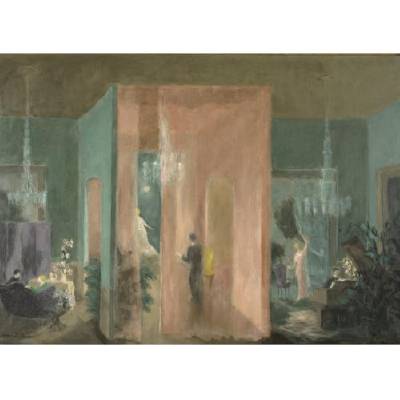
Hobson Pittman was once dubbed the poet-painter. His atmospheric landscapes and softly lit interior views of stately Victorian homes, which he painted and drew throughout his career, evoke the remembered warmth and beauty of his native North Carolina. Though he spent most of his professional life in the Northeast, Pittman was raised in Tarboro and could trace his family roots back to Surry County, Virginia, where his ancestor Thomas Pitman (name later changed to Pittman), a Royalist fleeing Oliver Cromwell's reign, had settled in 1649.
Hobson Lafayette Pittman, the last of eight children, was born to Thomas's descendent Biscoe Pittman and Martha Alice Walston on January 14, 1900, at Epworth, a cross-roads community in eastern North Carolina consisting of the Pittman general store and post office, a church built by the Pittman's, and Biscoe's home. Biscoe was a successful merchant, who made regular buying trips to Norfolk, Baltimore, and New York. In 1906 he turned the store over to his eldest son to devote more of his attention to a housing construction business which he had started in Tarboro, ten miles away.
Hobson was six years old when the family moved. Unlike his brothers and sisters who had been sent to boarding school near Greensboro, North Carolina, Hobson attended Tarboro Elementary School on the Common. By the age of ten he had begun to take an interest in sketching and painting.
Upon graduating from high school in 1918, Pittman set out for Philadelphia to further his art education. He took a room in the house of Miss Sarah Carter in suburban Philadelphia, which remained his home, off and on, for the next twenty years. He attended Pennsylvania State College (now Pennsylvania State University) for the 1921-1922 school year, Carnegie Institute of Technology in Pittsburgh, 1925-1926, and Columbia University in New York City, 1926-1928.
In 1920 and for eleven years following Pittman spent summers at Woodstock, the artists' colony in Ulster County, New York. He studied with Albert Heckman and associated with artists Yasuo Kuniyoshi, Eugenie Gershoy, the sculptor John B. Flannagan, Lucile and Arnold Blanch, Ernest Feine, and John Carroll, among others.
Some years later Kuniyoshi described the rigors of Woodstock training when he wrote, "We used to be taught to paint outdoors directly. It was in the style of the Impressionistic school and we never believed any other way than painting out in the field in the broiling sun. We used to go out sketching with a few friends. Always carrying a great big paint box, tripod and canvas. Walking miles to find place to work of interest, sometimes we walked from Willow to Woodstock."
Pittman's work shares various similarities to that of some of his Woodstock friends. The soft textures of his painted surfaces was a trademark of his teacher Heckman. The weightless, dreamy quality of his figures also characterizes much of Kuniyoshi's work, while Pittman's use of bright light falling upon a figure from an unseen source is a distinguishing trait of Gershoy's paintings and lithographs.
In 1931 Pittman began a long association with Friends Central Country Day School in Overbrook, a Philadelphia suburb, where he was Director of Art until 1957. During summer vacations he taught at Pennsylvania State College. As recognition of his teaching skills grew, he was asked to teach at the prestigious Philadelphia Museum of Art (1945), and four years later he was elected to the faculty of the Pennsylvania Academy of the Fine Arts, one of the nation's oldest and most distinguished art institutions.
His distinguished teaching career is not indicative of want of talent, for Pittman's paintings and drawings garnered numerous honors as well. They include the following: Honorable Mention, Golden Gate International Exposition, San Francisco, 1939; the J. Henry Schiedt Memorial Prize, Pennsylvania Academy of the Fine Arts, 1944, and the William A. Clark prize, Corcoran Gallery of Art, Washington, D.C., 1947. Pittman received a Gugenheim Foundation Fellowship in 1956, and in 1960 he was honored with the title Distinguished Artist of Pennsylvania by the Pennsylvania Academy of the Fine Arts.
Pittman's art won him many patrons on Philadelphia's main line. He settled amidst this loyal following when in 1950 he purchased and renovated an old carriage house in Bryn Mawr for his home and studio. Named "Silver Beach" by Pittman, the house was filled with Florentine bronzes, 14th-century wooden madonnas, bronze Buddha heads, and primitive African carvings, all picked up on his many trips to Europe, which he made regularly beginning in 1928. The house was surrounded by two acres of formal gardens. Friends were accustomed to visiting these beautifully groomed enclosures without disturbing Pittman. Pittman bequeathed his home to Bryn Mawr College with the provision that it be maintained as a gallery and be open to the public for a period of twenty-five years.
Late in the 1960s Pittman developed what would be a fatal illness. Through the ensuing years he continued to paint and teach several classes until lack
of strength compelled him to stop. He died in 1972.
Cynthia Seibels
Copyright 1990 Robert M. Hicklin Jr., IncBiography from The Johnson Collection
HOBSON LAFAYETTE PITTMAN (1899-1972)
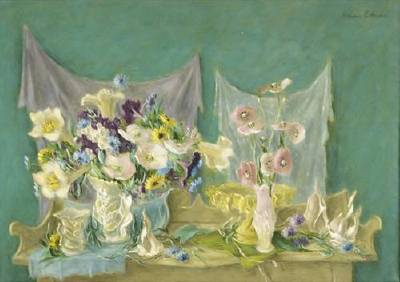
Hobson Pittman is highly regarded for his mystical and slightly mysterious landscapes and interiors which were enhanced by his preferred medium, pastel. He gained widespread recognition from reproductions of his paintings in Life magazine. He was on friendly terms with Clare Boothe and Henry Luce, the head of Time-Life and owners of Mepkin Plantation near Charleston, South Carolina. Pittman visited them there and painted a majestic scene of the grounds when it was in full flower.
Pittman was born in Epworth, North Carolina, a crossroads town in the eastern part of the state dominated by his family’s general store, home, and the church they had built. When he was six years old the family moved to nearby Tarboro, and soon afterward he displayed an interest in art. He studied at the local Rouse Art School from 1912 until 1916. After graduation from high school he attended Pennsylvania State College, 1921–1922; the Carnegie Institute of Technology, in Pittsburgh, 1925–1926, and Columbia University, in New York, 1926–1928. Beginning in 1920, and for the ensuing eleven years, he spent his summers in Woodstock, New York, a thriving art colony in upstate New York, where both Birge Harrison and Alfred Hutty resided seasonally.
As a teacher Pittman was much in demand. Starting in 1931 he took the position of Director of Art at the Friends Central Country Day School, located in a Philadelphia suburb. He remained there for twenty-six years and during summers he taught at such places as Pennsylvania State College, the Philadelphia Museum of Art, and the Pennsylvania Academy of the Fine Arts. He lived in an old carriage house in Bryn Mawr surrounded by two acres of formal gardens.
A critic once called Pittman a poet-painter because of the nostalgic haze that typifies his still lifes, landscapes, and in particular, interiors. His use of pastel augmented this sensibility. Indoor scenes—such as his series of Charleston drawing rooms that appeared in Life—recall earlier, more elegant times and are characterized by a quasi-surrealist sense of absence: no people and empty chairs.
For Pittman both nature and museums were important sources of inspiration, as he once indicated: “It is difficult for an artist to put into words how he feels about his work, but I firmly believe in the keenest observations of nature and a constant study and reflection of the museum at large. These are the best teachers. It is the assimilation of all this that one uses as a painting vocabulary, but be reminded that a personal translation should take place. The artist ‘sees’ his way and there is a difference between an artist and a painter.”
The Johnson Collection, Spartanburg, South Carolina
thejohnsoncollection.org