Page loaded successfully. Showing biography for Hussein Bicar.
Hussein Bicar BIOGRAPHY
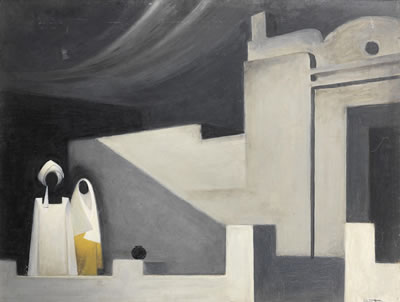
1912 Alexandria, Egypt - 2002. Known for: Painting.
As an artist, Bicar was considered a tour de force of talent; teacher, illustrator, painter, poet and musician, Bicar embraced the arts in their totality achieving renown in many of the fields he... Read full biography
As an artist, Bicar was considered a tour de force of talent; teacher, illustrator, painter, poet and musician, Bicar embraced the arts in their totality achieving renown in many of the fields he applied his trade to. Born in 1913 in Alexandria, Egypt, he graduated from Fine Arts College in 1933,... Read full biography
As an artist, Bicar was considered a tour de force of talent; teacher, illustrator, painter, poet and musician, Bicar embraced the arts in their totality achieving renown in many of the fields he applied his trade to. Born in 1913 in Alexandria, Egypt, he graduated from Fine Arts College in 1933, and subsequently from the Ahlia School for Painting. He taught at, and eventually headed the Painting Department of the Faculty of Arts at Qena at 1955. He was a founder of the Helwan Wax Museum. In... Read full biography
As an artist, Bicar was considered a tour de force of talent; teacher, illustrator, painter, poet and musician, Bicar embraced the arts in their totality achieving renown in many of the fields he applied his trade to. Born in 1913 in Alexandria, Egypt, he graduated from Fine Arts College in 1933, and subsequently from the Ahlia School for Painting. He taught at, and eventually headed the Painting Department of the Faculty of Arts at Qena at 1955. He was a founder of the Helwan Wax Museum. In 1944, Bicar began his career in journalism when he became, with Ahmad Sabry, Mustapha Amin and Ali Amin, one of the founding fathers of the prestigious Akhbar el-Youm newspaper, doing drawings often accompanied by his own poetrys. His painting "The... Read full biography
As an artist, Bicar was considered a tour de force of talent; teacher, illustrator, painter, poet and musician, Bicar embraced the arts in their totality achieving renown in many of the fields he applied his trade to. Born in 1913 in Alexandria, Egypt, he graduated from Fine Arts College in 1933, and subsequently from the Ahlia School for Painting. He taught at, and eventually headed the Painting Department of the Faculty of Arts at Qena at 1955. He was a founder of the Helwan Wax Museum. In 1944, Bicar began his career in journalism when he became, with Ahmad Sabry, Mustapha Amin and Ali Amin, one of the founding fathers of the prestigious Akhbar el-Youm newspaper, doing drawings often accompanied by his own poetrys. His painting "The Eighth Wonder", depicting the transportation of the temple of Ramses II to Abu Simbel is widely regarde... Read full biography
Artist Biography
Biography page for Hussein Bicar ((1912 - 2002)), known for Painting. Showing 1 biographical entries and 0 sample artworks.
Hussein Bicar - Artist Info
About Hussein Bicar
Name variants
Hussein Bikar
Biography from Bonhams Bond Street
As an artist, Bicar was considered a tour de force of talent; teacher, illustrator, painter, poet and musician, Bicar embraced the arts in their totality achieving renown in many of the fields he applied his trade to. Born in 1913 in Alexandria, Egypt, he graduated from Fine Arts College in 1933, and subsequently from the Ahlia School for Painting.
He taught at, and eventually headed the Painting Department of the Faculty of Arts at Qena at 1955. He was a founder of the Helwan Wax Museum. In 1944, Bicar began his career in journalism when he became, with Ahmad Sabry, Mustapha Amin and Ali Amin, one of the founding fathers of the prestigious Akhbar el-Youm newspaper, doing drawings often accompanied by his own poetrys. His painting "The Eighth Wonder", depicting the transportation of the temple of Ramses II to Abu Simbel is widely regarded as a classic of modern Egyptian painting.
In his later years, Bicar was better known for painting portraits, particularly of women. He also wrote criticism and taught for many years at Cairo's Fine Arts Academy, where he advised students that the eye alone cannot catch the complex feelings in a painting. "You must think to understand," he said. "You must go beyond the surface."
Bicar was honored with several awards including, the Golden Medal of Honor from the Industrial and Agriculture Exhibition in 1949, the Medal of Arts and Science in 1967, Gamal Abdel Nasser Prize in 1975, the State of Merit Award in 1978, the Merit Medal in 1980, and shortly before his death in 2000, Mubarak Award. Adept at drawing for children, Bicar also became a foreign correspondent who wrote and illustrated stories of his travels. He produced sketches of news and feature subjects when photography was not common in his homeland. In his later years, Bicar was better known for painting portraits, particularly of women. He also wrote criticism and taught for many years at Cairo's Fine Arts Academy. Bicar's distinction as an artist lies in the economy and terseness of his compositions; his ability to apply pure and simple lines to landscape and anatomy was central to the sense enigma and quiet mystery surrounding his paintings.