Page loaded successfully. Showing biography for Ithell Colquhoun.
Ithell Colquhoun BIOGRAPHY

1906 Shillong, Eastern Bengal - 1988 Cornwall, England. Known for: Painting, surrealism, botanics and gender issue themes.
Margaret Ithell Colquhoun was born in Shillong, Eastern Bengal and Assam, British India, the daughter of Henry Archibald Colebrooke Colquhoun and Georgia Frances Ithell Manley. Colquhoun was educated... Read full biography
Margaret Ithell Colquhoun was born in Shillong, Eastern Bengal and Assam, British India, the daughter of Henry Archibald Colebrooke Colquhoun and Georgia Frances Ithell Manley. Colquhoun was educated in Rodwell, near Weymouth, Dorset before attending Cheltenham Ladies' College. She became... Read full biography
Margaret Ithell Colquhoun was born in Shillong, Eastern Bengal and Assam, British India, the daughter of Henry Archibald Colebrooke Colquhoun and Georgia Frances Ithell Manley. Colquhoun was educated in Rodwell, near Weymouth, Dorset before attending Cheltenham Ladies' College. She became interested in occultism aged 17, after reading Aleister Crowley's Abbey of Thelema. Colquhoun gained admission to the Slade School of Art* in London in October 1927, and was taught by Henry Tonks and Randolph... Read full biography
Margaret Ithell Colquhoun was born in Shillong, Eastern Bengal and Assam, British India, the daughter of Henry Archibald Colebrooke Colquhoun and Georgia Frances Ithell Manley. Colquhoun was educated in Rodwell, near Weymouth, Dorset before attending Cheltenham Ladies' College. She became interested in occultism aged 17, after reading Aleister Crowley's Abbey of Thelema. Colquhoun gained admission to the Slade School of Art* in London in October 1927, and was taught by Henry Tonks and Randolph Schwabe. While at the Slade, she joined G.R.S. Mead's Quest Society, and in 1930 published her first article, "The Prose of Alchemy", in the society's journal. In 1929, Colquhoun received the Slade's Summer Composition Prize for her painting Judith... Read full biography
Margaret Ithell Colquhoun was born in Shillong, Eastern Bengal and Assam, British India, the daughter of Henry Archibald Colebrooke Colquhoun and Georgia Frances Ithell Manley. Colquhoun was educated in Rodwell, near Weymouth, Dorset before attending Cheltenham Ladies' College. She became interested in occultism aged 17, after reading Aleister Crowley's Abbey of Thelema. Colquhoun gained admission to the Slade School of Art* in London in October 1927, and was taught by Henry Tonks and Randolph Schwabe. While at the Slade, she joined G.R.S. Mead's Quest Society, and in 1930 published her first article, "The Prose of Alchemy", in the society's journal. In 1929, Colquhoun received the Slade's Summer Composition Prize for her painting Judith Showing the Head of Holofernes, and in 1931 it was exhibited in the Royal Academy. Despite her studies at the Slade, Colquhoun was... Read full biography
Artist Biography
Biography page for Ithell Colquhoun ((1906 - 1988)), known for Painting, surrealism, botanics and gender issue themes. Showing 1 biographical entries and 0 sample artworks.
Ithell Colquhoun - Artist Info
About Ithell Colquhoun
Biography from the Archives of askART
 Margaret Ithell Colquhoun was born in Shillong, Eastern Bengal and Assam, British India, the daughter of Henry Archibald Colebrooke Colquhoun and Georgia Frances Ithell Manley. Colquhoun was educated in Rodwell, near Weymouth, Dorset before attending Cheltenham Ladies' College. She became interested in occultism aged 17, after reading Aleister Crowley's Abbey of Thelema.
Colquhoun gained admission to the Slade School of Art* in London in October 1927, and was taught by Henry Tonks and Randolph Schwabe. While at the Slade, she joined G.R.S. Mead's Quest Society, and in 1930 published her first article, "The Prose of Alchemy", in the society's journal.
In 1929, Colquhoun received the Slade's Summer Composition Prize for her painting Judith Showing the Head of Holofernes, and in 1931 it was exhibited in the Royal Academy. Despite her studies at the Slade, Colquhoun was primarily a self-taught artist.
In 1931, after leaving the Slade, Colquhoun moved to Paris, where she established a studio. She was introduced to surrealism there, in 1931 reading Peter Neagoe's essay What is Surrealism?, and her interest in the movement was deepened in 1936 when she saw Salvador Dalí lecture at the International Exhibition of Surrealism in London.
Colquhoun's first solo exhibition was at the Cheltenham Art Gallery in 1936; a solo exhibition at the Fine Art Society in London followed in the same year. In 1937 she joined the Artists' International Association, and in the late 1930s she became increasingly associated with the surrealist movement in Britain, writing three articles for the London Bulletin in 1938 and 1939, visiting André Breton in Paris in 1939, and joining the British Surrealist Group* in the same year. Also in 1939, she exhibited with Roland Penrose at the Mayor Gallery, showing 14 oil paintings and two objects.
After only a year as a member of the British Surrealist Group*, Colquhoun was expelled in 1940, due to her refusal to comply with E.L.T. Mesens' demands that the surrealists should not be members of any other groups, which Colquhoun felt would interfere with her studies of occultism. This led to Colquhoun's exclusion from other exhibitions organised by the British surrealists, but she continued to work with surrealist principles.[6]
In 1946, Colquhoun bought a studio near Penzance in Cornwall, and divided her time between there and London; in 1957 she moved to Paul, Cornwall.
Colquhoun died in 1988. She left the copyright in her works to The Samaritans, her occult work to the Tate, and her other art to the National Trust. In 2019, the Tate acquired the National Trust's holdings of Colquhoun's works.
Though only formally involved with the surrealist movement in England for a few years, Colquhoun first gained her reputation as a surrealist*, and identified as a surrealist for the rest of her life. She used many automatic techniques, which were described in André Breton's first surrealist manifesto as a defining feature of surrealism, and invented several automatic techniques herself.
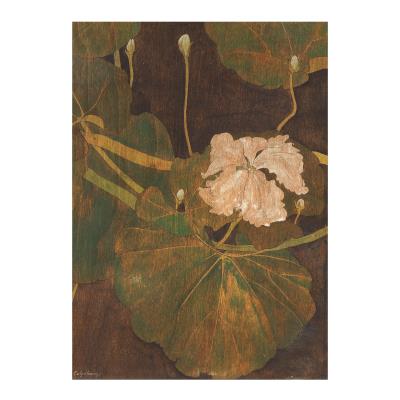
Colquhoun had an early interest in biology, and studies of plants and flowers were a recurring theme in her art throughout her life. Many of her early notebooks contained very detailed drawings of plants, and her early works included a series of enlarged images of flora, occupying the full canvas and painted almost photographically.
Colquhoun's work also often explored themes of sex and gender. Her early work often depicts powerful women from myth and Bible stories, such as Judith Showing the Head of Holofernes 1929, and Susanna and the Elders 1930 – both of which are likely homages to Artemisia Gentileschi's works on the same themes. Dawn Ades sees Colquhoun's treatment of gender as responding to the masculine and patriarchal themes in the art of other surrealists – for instance, where other surrealists drew landscapes as women, Colquhoun's Gouffres Amers 1939 shows a male body as a landscape.
Stylistically, some her works have been described as "macabre" and sinister." In 1939, she created the work Tepid Waters (Rivières Tièdes) which was displayed at her solo exhibition at the Mayor Gallery the same year. The work was political in content, referring to the Spanish Civil War.
In the 1940s, Colquhoun began to create works exploring the themes of consciousness and the subconscious. Her interest in psychology and dreams also attached her to the Surrealism movement.
She used a wide range of materials and methods, such as decalcomania, fumage, frottage and collage. Colquhoun went further, developing new techniques such as superautomatism, stillomancy, parsemage, and entoptic graphomania, writing about them in her article "The Mantic Stain".
Three works which stand out during the 1940s are The Pine Family, which deals with dismemberment and castration, A Visitation which shows a flat heart shape with multi-coloured beams of light and Dreaming Leaps, a homage to Sonia Araquistain.
Throughout the 1960s and 1970s, Colquhoun turned her attention towards collages rather than painting. The last retrospective of her work was held at the Newlyn Orion Gallery in 1976, which showed a large number of collages, many of which were according to Ratcliffe inspired by the collages of Kurt Schwitters.
Although initially acclaimed, art historians have noted that Colquhoun's reputation suffered during the war, a period when British surrealists such as E.L.T Mesens pamphleted against her former husband, Toni del Renzio.
A review of her 1973 exhibition in Penzance claimed:
"She has always ignored prevailing fashions in art and remained true to her beliefs and highly personal style and approach with an integrity that is to be admired. Unfortunately, as a result she has often been under-rated...'
In 2020, Colquhoun's work featured in the British Surrealism exhibition at the Dulwich Picture Gallery. In 2021, it was featured in the Phantoms of Surrealism show at Whitechapel Art Gallery, the Unsettling Landscapes exhibition at St Barbe Museum & Art Gallery,[19] and was the focus of an exhibition at Unit London, Song of Songs.
Source: Wikipedia, 2022
* For more in-depth information about the terms in this biography that have an asterisk* see AskART.com. Glossary http://www.askart.com/AskART/lists/Art_Definition.aspx