Jacek Malczewski BIOGRAPHY
Artist Biography
Biography page for Jacek Malczewski ((1854 - 1929)), known for Portrait and genre painting. Showing 7 biographical entries and 0 sample artworks.
Jacek Malczewski - Artist Info
About Jacek Malczewski
Biography from Sopocki Dom Aukcyjny
He studied at the School of Fine Arts in Krakow, m.in. in W. Luszczkiewicz and J. Matejki and in the Paris École des Beaux-Arts u E. Lehmann. He was one of the founders of the “Art” association. From 1902 he belonged to the Association of Polish Artists, he was also a member of the Vienna Secession. In the years 1897-1900 and 1910-1921 he held the position of professor of the Academy of Fine Arts in Krakow. The early period of the artist’s work, referring to the tradition of realism, was dominated by topics inspired by Polish romantic poetry and folk fairy tale and referring to the martyrdom of Siberia. Later, he turned to symbolism, creating his own original emblematics. He also made numerous portraits, often combined with symbolic and allegorical elements.
Biography from Agra Art S.A.
Jacek Malczewski began his artistic education at the Krakow School of Fine Arts. He was supervised by such artists as Feliks Szynalewski, Wladyslaw Luszczkiewicz, and Jan Matejko.
In 1876-1877, he studied at Paris École des Beaux Arts, supervised by E.H. Lehmanna. In 1880, Malczewski traveled around Italy. In 1884-1885, he took part, as a drawer, in the Karol Lanckoronski Asian expedition. During that period he also visited Greece and Italy.
In 1885-1886, Malczewski spent a few months in Munich. After his return, he moved to Krakow and settled there. He still often visited Munich and Italy.
From 1896 to 1900, he taught at the Krakow School of Fine Arts and in the years 1911 and 1922 he was professor of the Krakow Academy of Fine Arts. He was also the Academy's Dean in the years 1912-14.
Malczewski spent the years 1914-1915 in Vienna. In 1916, he returned to Krakow. He spent the years prior to his death mainly in Luslawice and Charczewice.
Malczewski was cofounder of the Polish Artists' Association "Sztuka" in 1897, and member of the "Zero"group in 1908.
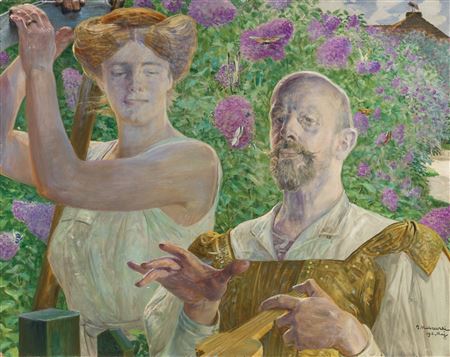
In his early work period, Malczewski produced mainly portraits and generic scenes. During his later art periods (beginning in the 1890's) he created paintings with symbolical content and biblical, legendary, patriotic, or allegoric-fantasy themes.Biography from Polswissart
Rafal Malczewski, son of Jacek Malczewski, was a Polish artist who flourished in the 20th century. He studied various subjects in Vienna before enrolling at the Academy of Fine Arts in Krakow. Known for his landscape paintings in a stylized "naive" realism style, he was influenced by his father and was friends with notable figures like Stanislaw Ignacy Witkiewicz and Karol Szymanowski. After escaping to France during World War II, he eventually settled in Brazil, where he painted watercolor views of Rio de Janeiro and Curitiba, as well as landscapes of Paraná. His work often depicted humanity's insignificance in the face of nature and technology, with recurring motifs of small human figures and industrial elements.Biography from Polswissart
Jacek Malczewski, born in 1854 in Radom, Poland, was a highly emotional and poetic artist known for his lyrical and melancholic disposition. He studied at the Kraków School of Fine Arts and the École des Beaux-Arts in Paris under Jan Matejko. Malczewski's work often featured patriotic themes, symbolism, and biblical allegories. He traveled extensively and settled in Kraków, where he became a professor at the School of Fine Arts. Malczewski's art matured over the years, culminating in symbolic masterpieces like "Melancholia" and "Bledne kolo." He was also involved in the local artistic community and co-founded the Society of Polish Artists "Sztuka." Malczewski passed away in 1929.Biography from Desa Unicum
Jacek Malczewski was a renowned Polish artist known for his symbolism painting style. He studied at the Krakow School of Fine Arts and in Paris, where he was influenced by various artists. Malczewski drew inspiration from Polish folklore, literature, history, as well as biblical and mythological traditions. He often explored patriotic, messianic, existential, and autobiographical themes in his work. Malczewski also had a successful teaching career at the Krakow Academy of Fine Arts and was a founding member of the Society of Polish Artists "Sztuka." His work was recognized internationally, earning him medals at exhibitions in Munich, Berlin, and Paris.Biography from Polswissart
Jacek Malczewski, born in 1854 in Radom, Poland, was a highly emotional and poetic artist known for his symbolic themes in painting. Raised in a patriotic environment, he chose patriotic subjects as the guiding principle in his work. Malczewski studied at the Kraków School of Fine Arts and the École des Beaux-Arts in Paris. He traveled extensively and settled in Kraków, where he became a professor at the School of Fine Arts. Malczewski's art evolved from academic and patriotic themes to symbolic, biblical, and allegorical-fantastical subjects. He was also a portrait painter and involved in the local artistic community. Malczewski passed away in 1929.