Page loaded successfully. Showing biography for Jack Wilkinson Smith.
Jack Wilkinson Smith BIOGRAPHY

1873 Paterson, New Jersey - 1949 Monterey Park, California. Known for: Landscape, seascape and mountain painting.
The following is from Clyde Porter, who credits a booklet titled Artistic Ramblings -Then and Now by Eve Madigan. Artists who worked with Jack Wilkinson Smith in San Gabriel or Alhambra, CA on... Read full biography
The following is from Clyde Porter, who credits a booklet titled Artistic Ramblings -Then and Now by Eve Madigan. Artists who worked with Jack Wilkinson Smith in San Gabriel or Alhambra, CA on Champion Place were Victor Forsythe, Frank Tenney Johnson, Eli Harvey, Sam Hyde Harris, Virginia McElroy,... Read full biography
The following is from Clyde Porter, who credits a booklet titled Artistic Ramblings -Then and Now by Eve Madigan. Artists who worked with Jack Wilkinson Smith in San Gabriel or Alhambra, CA on Champion Place were Victor Forsythe, Frank Tenney Johnson, Eli Harvey, Sam Hyde Harris, Virginia McElroy, Hughlette Wheeler (Tex) and Clyde Champion. Smith was born in Patterson, New Jersey in 1873. His grandfather owned an 80 acre farm, including what is now Madison Square Garden. His father painted some... Read full biography
The following is from Clyde Porter, who credits a booklet titled Artistic Ramblings -Then and Now by Eve Madigan. Artists who worked with Jack Wilkinson Smith in San Gabriel or Alhambra, CA on Champion Place were Victor Forsythe, Frank Tenney Johnson, Eli Harvey, Sam Hyde Harris, Virginia McElroy, Hughlette Wheeler (Tex) and Clyde Champion. Smith was born in Patterson, New Jersey in 1873. His grandfather owned an 80 acre farm, including what is now Madison Square Garden. His father painted some of the decorations in the New York State Capital Building in Albany. He studied at the Chicago Art Institute and under Frank Duveneck in Cincinnati and became a newspaper artist on the Cincinnati Enquirer. He gained national attention with his... Read full biography
The following is from Clyde Porter, who credits a booklet titled Artistic Ramblings -Then and Now by Eve Madigan. Artists who worked with Jack Wilkinson Smith in San Gabriel or Alhambra, CA on Champion Place were Victor Forsythe, Frank Tenney Johnson, Eli Harvey, Sam Hyde Harris, Virginia McElroy, Hughlette Wheeler (Tex) and Clyde Champion. Smith was born in Patterson, New Jersey in 1873. His grandfather owned an 80 acre farm, including what is now Madison Square Garden. His father painted some of the decorations in the New York State Capital Building in Albany. He studied at the Chicago Art Institute and under Frank Duveneck in Cincinnati and became a newspaper artist on the Cincinnati Enquirer. He gained national attention with his sketches of the Spanish American War. He went to Lexington, Kentucky, where he had his first "... Read full biography
Artist Biography
Biography page for Jack Wilkinson Smith ((1873 - 1949)), known for Landscape, seascape and mountain painting. Showing 7 biographical entries and 0 sample artworks.
Jack Wilkinson Smith - Artist Info
About Jack Wilkinson Smith
Biography from the Archives of askART
 The following is from Clyde Porter, who credits a booklet titled Artistic Ramblings -Then and Now by Eve Madigan.
Artists who worked with Jack Wilkinson Smith in San Gabriel or Alhambra, CA on Champion Place were Victor Forsythe, Frank Tenney Johnson, Eli Harvey, Sam Hyde Harris, Virginia McElroy, Hughlette Wheeler (Tex) and Clyde Champion.
Smith was born in Patterson, New Jersey in 1873. His grandfather owned an 80 acre farm, including what is now Madison Square Garden. His father painted some of the decorations in the New York State Capital Building in Albany.
He studied at the Chicago Art Institute and under Frank Duveneck in Cincinnati and became a newspaper artist on the Cincinnati Enquirer.
He gained national attention with his sketches of the Spanish American War. He went to Lexington, Kentucky, where he had his first "one man show", and met and married Emma Troop. They came to Los Angeles in 1908, where he taught in city schools.
Frank Tenney Johnson suggested that Smith look on Champion Place for a location for his studio, and he introduced him to Clyde Champion. Jack Wilkinson Smith promptly bought the house and property at 16 Champion Place, and Bernice and Clyde Champion built across the street. They were fast friends for twenty-two years, until Smith's death in New York in 1948 from a heart attack.
Smith painted from Kansas plains to the Oregon Coast.
His friends in Art of Los Angeles were Hanson Puthuff, F. Tenney Johnson, William Wendt, Charles Austin, Clyde Forsythe. Marjorie Reed contributed her success to Jack Wilkinson Smith, who was her instructor for years. He was the original founder of the Biltmore Salon, which later was operated on a cooperative basis with sixteen other artists. It was because of his dedication to the founding of this gallery and his membership on the board of the California Art Club, serving in the capacity as president, that he became the only artist in the exclusive "Murder Club" which discussed all sorts of recondite subjects.
His painting of Lingering Snow is in Gardena High School. Gathering Storm is one of the finest of his marine paintings. Of all the artists who painted in Alhambra in the 30's, Jack Wilkinson Smith was the most colorful in that he had a flair for entertaining and was very popular as a civic leader. He was very handsome and articulate.Biography from the Archives of askART
 Born in Paterson, New Jersey on Feb. 7, 1873, Jack Wilkinson Smith inherited his interest in art from his father who painted some of the decorations in the Capitol Building in Albany, NY. While in his teens, he studied at the Art Institute of Chicago and was apprenticed to artist Gardner Symons in Chicago. He later worked as a commercial artist in Lexington, KY and went on to become a sketch artist with the Cincinnati Enquirer.
While in Cincinnati, he studied at the Art Academy under Frank Duveneck. During the Spanish-American War, his front-line sketches brought him national renown. In 1906 he settled in Alhambra, CA and established a studio-home in the eucalyptus grove called "Artists Alley" where his neighbors included Eli Harvey, Frank Tenney Johnson, and summer-resident Norman Rockwell.
Smith was largely responsible for establishing the Biltmore Salon, which exhibited and sold works by local artists during the early part of this century. In the Midwest he had worked in watercolor; however, upon moving to Los Angeles, he switched to oil.
During the Depression he worked for Pacific Outdoor Advertising. An Impressionist, he traveled the state from one end to the other in search of subject matter. His Sierra landscapes, missions, and seascapes have made him one of California's most important painters.
Smith died in Monterey Park, CA on Jan. 8, 1949.
Member: Laguna Beach AA; Academy of Western Painters; Allied AA; Salmagundi Club; Calif. WC Society. Exh: Calif. Art Club, 1913-19; Sketch Club (LA), 1914; Panama-Calif. Expo (San Diego), 1915 (bronze and silver medals); Friday Morning Club (LA), 1915; Calif. State Fair, 1917-19 (medals); Liberty Fair, 1918 (prize); LACMA, 1918 (solo); Phoenix Expo, 1920 (2nd prize), 1922 (1st prize); Stendahl Gallery (LA), 1922; Women's Club (Hollywoood), 1922; Painters of the West, 1924-29 (gold medals); Ebell Club (LA), 1925; Biltmore Salon (LA), 1932-41; GGIE, 1939.
Collection: Irvine (CA) Museum; Phoenix Municipal Collection; Orange County (CA) Museum; Athletic Club (LA); Gardena High School.Biography from the Archives of askART
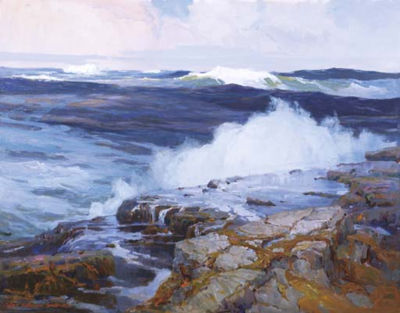 An impressionist painter of western landscapes, Jack Wilkinson Smith was born in Paterson, New Jersey. He had early exposure to artistic expression because his father was an artist who did decorative work on the Capitol Building in Albany, New York.
He studied at the Art Institute of Chicago and apprenticed to George Gardner Symons, who later became a well-known landscape painter in California. He worked for a period in Lexington, Kentucky as a commercial artist and then became a staff artist for the Cincinnati Enquirer. In Cincinnati, he studied at the Art Academy under Frank Duveneck. During the Spanish American War, 1898, he did front line sketches that brought him national attention.
In 1906, he settled in Alhambra, California, and his studio home was in the area called "Artists Alley," where his neighbors included artists Frank Tenney Johnson, Eli Harvey, and in the summers, Norman Rockwell. Smith was a primary organizer of the Biltmore Salon, where works by local artists were exhibited and sold.
For his work, he switched from watercolor to oil painting and traveled the state doing impressionist landscapes. He is renowned for his colorful High Sierra mountain views, missions, and marine paintings, and is considered one of California's most important painters. He also painted and exhibited in Arizona, winning second prize at the Phoenix Expo in 1920 and first prize in 1922. His work is in the Phoenix Municipal Collection.
He had many prestigious affiliations including the Salmagundi Club of New York, Academy of Western Painters, and the California Art Club.Biography from the Archives of askART
Jack Wilkinson Smith (1873-1949) (Bay Area/Los Angeles)
Early artist visitor to Morro Bay [1924]
“2 More Artists at Morro Bay. Jack Wilkinson Smith and Tenney Johnson Stop for Visit at Beach Art Colony. Evidencing that Morro Bay is rapidly gaining recognition in the art world of the Pacific Coast, and soon will become one of the leading artists’ colonies, two more nationally known artists arrived yesterday to spend a few days with the several famous artists who are painting scenes about Morro Bay.
Tenney Johnson, known for his figure and animal canvases and Jack Wilkinson Smith, who paints the High Sierras as well as marine views, are the two added to the colony. They are en route to Pendleton where Mr. Johnson plans to paint pictures at the annual round-up in the Oregon city and expect to stop over again for a few days on their return south.” per SLO Daily Telegram, Aug. 27, 1924, p. 4, and another notice on p. 5.
Source: Nancy Dustin Wall Moure, MORRO BAY (including LOS OSOS, BAYWOOD PARK and CAYUCOS) ART AND PHOTOGRAPHY BEFORE 1960 (Publications in [Southern] California Art, vol. 13, no. I), Los Angeles: Dustin Publications, 2016.Biography from American Legacy Fine Arts
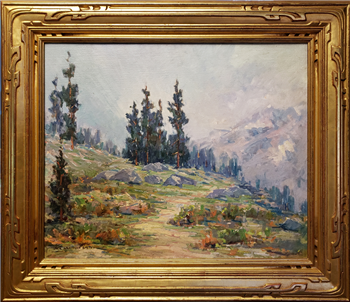 Jack Wilkinson Smith was originally from the East Coast, but had a Western spirit. He was born in Paterson, New Jersey on February 7, 1873 to an artist-father who painted some of the decorations in New York’s state Capitol Building in Albany. His East Coast roots were deep, as his grandfather owned an eighty-acre farm in New York, which now includes Madison Square Garden.
In his teens, Smith was already an aspiring artist. He dropped out of school and worked his way to Chicago where he attended the Art Institute of Chicago and apprenticed under George Gardner Symons (1863–1930). Later, Smith traveled to Lexington, Kentucky where he established himself as a sign and scenic painter. It was during this period that he met and married Emma B. Troop. Also in Lexington, he held his first solo fine art exhibition, which drew the attention of cartoonist Winsor McKay (1867(?)-1934) who helped Smith get a job as a newspaper artist on the Cincinnati Enquirer.
While in Cincinnati, Smith studied under Frank Duveneck (1848-1919) at the Cincinnati Academy of Art. Then, in 1898 during the Spanish-American War, Smith traveled to Cuba to sketch frontline combat scenes, which brought him national notice. However, it was the western landscape that beckoned Smith. Inspired by photographs, he began painting the imagery of the West before actually going there. Feeling encouraged by the sale of some of these works, in 1906 he and Emma moved from Cincinnati to Los Angeles.
Upon the urging of his good friend, western artist Frank Tenney Johnson (1874-1939), in 1926 at age fifty-three Smith moved to “Artists’ Alley” in Alhambra, California, and bought the house next door to Johnson on Champion Place. Fellow artist-neighbors included Eli Harvey (1860-1957), Clyde Forsythe (1885-1962), and Norman Rockwell (1894-1978) who spent many summers at Artists’ Alley. The neighborhood became a favorite gathering place for western artists, and some would travel and paint together in the deserts and Sierra Mountains.
Smith was quickly indoctrinated into life at the colony and the local art community. He became a supportive member of the California Art Club where he served as the organization’s sixth president from 1920 to 1921. Smith’s association with local artists led him to become the primary organizer of the Biltmore Salon with the purpose of displaying and selling work by local artists. The Salon’s inaugural exhibition was held on December 14, 1923 within the newly-opened Biltmore Hotel to an eager tourist market. Smith also had a key role in the start of the Painters of the West group that included twenty-five local artists.
When asked about California, Smith responded, “Why go elsewhere? Where are mountains nobler than the Sierras? Where are seas bluer than off the California coast? Where are forests to compare with our own?” Indeed, he said, “Whatever I have seen elsewhere I have found in California, and more glorious. It is all here.”
During the Depression years, Smith earned his income as a billboard painter for Pacific Outdoor Advertising. As an Impressionist artist, he traveled throughout California in search of inspiring subject matter. His paintings of the Sierra, missions, and seascapes have established Smith as one of California's most important painters. Los Angeles Times columnist Fred Hogue commented, “Jack Wilkinson Smith is the premier painter of California sunlight. He may violate the classic canons of art, but the canvases he creates may cause future critics to revise the accepted canons.”
Jack Wilkinson Smith passed away in Monterey Park, California on January 8, 1949.
Written and submitted by Elaine Adams,
Director, American Legacy Fine Arts
Research Resources:
"Pioneers of Artists' Alley," by Elaine Adams, California Art Club Newsletter, Summer 2007
Artists in California, 1786-1940 by Edan Hughes
AskARTBiography from William A. Karges Fine Art - Carmel
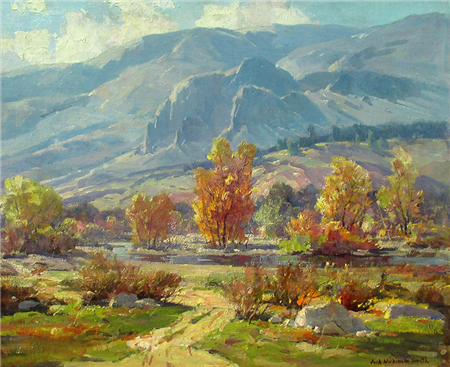 Jack Wilkinson Smith was born in Patterson, New Jersey, in 1873. His art studies were with George Gardner Symons at the Art Institute of Chicago, and with Frank Duveneck at the Cincinnati Art Academy.
In 1906 he settled in Monrovia, California, where his artist neighbors included Frank Tenney Johnson and Norman Rockwell. In southern California Smith helped found a major venue for local artists, the Biltmore Salon.
He is best known today for his powerful coastal scenes and dramatic Sierra Mountain paintings.Biography from Helene Halperin (formerly DeRu's Fine Arts)
Jack Wilkinson Smith was born in Patterson, New Jersey on February 7, 1873. Smith inherited his interest in art from his father who painted some of the decorations in the Capitol Building in Albany, New York. While in his teens, he studied at the Art Institute of Chicago and was apprenticed to George Gardner Symons in Chicago. He later worked as a commercial artist in Lexington, Kentucky and went on to become a staff artist with the Cincinnati Enquirer.
While in Cincinnati, he studied under Frank Duveneck at the Art Academy. During the Spanish-American War (1898), his front line sketches brought him national renown. In 1906 he settled in Alhambra, California and established a studio-home in the eucalyptus grove called "Artists Alley" where his neighbors included Eli Harvey, Frank Tenney Johnson and, summer resident, Norman Rockwell. Smith was largely responsible for establishing the Biltmore Salon, which exhibited and sold works by local artists during the early part of this century.
In the Midwest, he had worked in watercolor but upon moving to Los Angeles, he switched to oil. An Impressionist painter, he traveled from one end of the state to the other in search of subject matter. His Sierra landscapes, seascapes and missions have made him one of California's most important painters. Smith died in Monterey Park on January 18, 1949.