Page loaded successfully. Showing biography for Jacob Armstead Lawrence.
Jacob Armstead Lawrence BIOGRAPHY

1917 Atlantic City, New Jersey - 2000 Seattle, Washington. Known for: Modernist naive urban genre-figure painting.
Born in Atlantic City, New Jersey, Jacob Lawrence became known for his narrative series of tempera paintings expressive of his own life and that of his black peers who migrated from the South to the... Read full biography
Born in Atlantic City, New Jersey, Jacob Lawrence became known for his narrative series of tempera paintings expressive of his own life and that of his black peers who migrated from the South to the North. His vivid collage-appearing canvases typically had bold planes of color and symbolic elements... Read full biography
Born in Atlantic City, New Jersey, Jacob Lawrence became known for his narrative series of tempera paintings expressive of his own life and that of his black peers who migrated from the South to the North. His vivid collage-appearing canvases typically had bold planes of color and symbolic elements of African-American heritage of struggles, aspirations, and accomplishments. Lawrence's style was wide ranging, but he was most associated with narrative Synthetic Cubism whose popularity and... Read full biography
Born in Atlantic City, New Jersey, Jacob Lawrence became known for his narrative series of tempera paintings expressive of his own life and that of his black peers who migrated from the South to the North. His vivid collage-appearing canvases typically had bold planes of color and symbolic elements of African-American heritage of struggles, aspirations, and accomplishments. Lawrence's style was wide ranging, but he was most associated with narrative Synthetic Cubism whose popularity and uniqueness were suppressed by the advent of Abstract Expressionism. His major work, The Migration of the Negro, was a social-realist culmination of the art of the 1930s and not a harbinger of new styles. He was born in 1917 in Atlantic City, New Jersey, the... Read full biography
Born in Atlantic City, New Jersey, Jacob Lawrence became known for his narrative series of tempera paintings expressive of his own life and that of his black peers who migrated from the South to the North. His vivid collage-appearing canvases typically had bold planes of color and symbolic elements of African-American heritage of struggles, aspirations, and accomplishments. Lawrence's style was wide ranging, but he was most associated with narrative Synthetic Cubism whose popularity and uniqueness were suppressed by the advent of Abstract Expressionism. His major work, The Migration of the Negro, was a social-realist culmination of the art of the 1930s and not a harbinger of new styles. He was born in 1917 in Atlantic City, New Jersey, the son of parents who moved North in search of work. His father abandoned the family in 1924, and Lawr... Read full biography
Artist Biography
Biography page for Jacob Armstead Lawrence ((1917 - 2000)), known for Modernist naive urban genre-figure painting. Showing 4 biographical entries and 0 sample artworks.
Jacob Armstead Lawrence - Artist Info
About Jacob Armstead Lawrence
Name variants
Jacob Armstead Laurence
Biography from the Archives of askART
 Born in Atlantic City, New Jersey, Jacob Lawrence became known for his narrative series of tempera paintings expressive of his own life and that of his black peers who migrated from the South to the North. His vivid collage-appearing canvases typically had bold planes of color and symbolic elements of African-American heritage of struggles, aspirations, and accomplishments.
Lawrence's style was wide ranging, but he was most associated with narrative Synthetic Cubism whose popularity and uniqueness were suppressed by the advent of Abstract Expressionism. His major work, The Migration of the Negro, was a social-realist culmination of the art of the 1930s and not a harbinger of new styles.
He was born in 1917 in Atlantic City, New Jersey, the son of parents who moved North in search of work. His father abandoned the family in 1924, and Lawrence and his siblings were in foster homes before reuniting with their mother and then moving to Harlem in New York in 1930.
In New York, he took children's art classes and later, dropping out of high school, worked at a laundry and printing plant and took art training from Charles Alston at the Harlem Community Art Center. At the Center, he associated with a number of influential black people including painters Aaron Douglas and William Johnson.
In 1936, he did the first work that brought him significant attention, and this was a satirical series on street life in Harlem. The next year, he began a narrative series of tempera paintings on the life of Haitian independence leader Toussaint L'Ouverture. In 1937, Lawrence completed a thirty-two piece series on the life of Frederic Douglass, and in 1938, he did thirty-one paintings on the life of Harriet Tubman.
In 1940, Lawrence painted what would become his best-known narratives, The Migration Series, sixty storybook panels on the life of the Negro moving, as did his parents, from South to North following World War I. For these works, he relied heavily on research he did at the Schomburg Collection, a repository in Harlem of Black American history.
His working methods for his narrative cycles involved making detailed preparatory drawings and then applying color, one at a time, to each piece of paper, so that colors of the same palette were mixed all at once and then applied simultaneously.
During World War II, Lawrence served in the Coast Guard and was assigned to the first racially integrated ship in United States history.
In 1946, he began teaching at Black Mountain College in North Carolina at the invitation of Josef Albers. He also taught in New York at the Art Students League, New School for Social Research, Pratt Institute, and in Maine at the Skowhegan School. In 1971, he became a professor of art at the University of Washington in Seattle where he retired in 1986 as professor emeritus.
In the 1960s and 1970s, he continued to paint subjects that referred to racial and social issues of black Americans, and he has given much financial aid to organizations addressing these problems. In his later years, he worked on many commissions including the design of a 72-foot long mural that will be installed in 2001 in the New York Times Square subway station.
In 1996, a traveling exhibition titled "Jacob Lawrence: The Migration Series" was held, and it was a narrative of black Americans. The Catalogue Raisonne of his work is being prepared in Seattle by Peter Nesbett and Michelle DuBois and will be published by the University of Washington Press.
Lawrence died in Seattle on June 9, 2000. The year before he and his wife of 59 years, painter Gwendolyn Knight, established a foundation to create an art center in Harlem named for Lawrence.
Sources:
Mathew Baigell, Dictionary of American Art
Michael David Zellman, 300 Years of American Art
Biography from the Archives of askART
 Jacob Lawrence was born on September 7, 1917 in Atlantic City, New Jersey of parents who had migrated north from Virginia and South Carolina. His father, a railroad cook, disppeared when he was only seven, but his mother was able to support him although she was on welfare a good part of the time. He was the oldest of three children. He spent some time in foster care in Philadelphia after his father abandoned the family and finally settled with his mother in Harlem. He lost both siblings at an early age. His brother William died of an overdose of drugs and his sister Geraldine of tuberculosis.
When Lawrence was twelve, his mother sent him to a program at Utopia House where he encountered artist Charles Alston, who taught art and made Jacob aware of color and picturing the life around him. He rented studio space from Alston, whose studio had become a neighborhood workshop, a gathering place and debating club for the Harlem cultural world. Often he would walk the fifty-odd blocks downtown to the Metropolitan Museum of Art and study the Old Masters. He painted as much as he could. The earliest Lawrences to survive date from 1936, when he was thirteen. His first works were done in poster paints because they were cheapest, but he later graduated to egg tempera, casein tempera made with curdled milk, and gouache. All these are water-based paints applied on paper or on gesso-coated hardboard panels. His style of painting lends itself to narrative; and the simplest way to handle that was by making a series of pictures, something he did whenever he came upon a subject of epic proportions.
Critics have called Lawrence "the top US Negro Painter", a race-conscious title that tends to blur his individual style. Lawrence tells simple, straightforward stories with a lack of complexity that makes him something of a puzzle. He married a fellow painter, Gwendolyn Knight.
He got on the Works Progress Administration Federal Art Project at $23.86 a week during the Depression in 1938. He was on the Project for 18 months, and when it was over he was able to consider himself a full-fledged professional artist. His career flourished but the war caught up with him in 1943 when he was drafted into the Coast Guard and given the rank of steward's mate. The good luck that has dogged his career brought him a commanding officer who appreciated his talent and arranged to get him a post as a combat artist.
Out of service in 1945, Lawrence found himself almost a celebrity. His work was selling well; he won prizes and received a Guggenheim fellowship. He was asked to do book illustrations, and he was asked to teach at Black Mountain College where many big names of the American avant-garde were found. In 1949 he checked into a mental institution where he remained for eight months, meanwhile producing a series called Hospital.
Since 1950 he had been a popular teacher at Pratt Institute, at Brandeis University and other schools. In 1964 he spent eight months in Nigeria painting. In 1971 he was invited to be professor of art at the University of Washington in Seattle; he retired in 1987, but he remained in Seattle and he did some occasional teaching. He died of lung cancer on June 9, 2000.
Written and submitted by Jean Ershler Schatz, artist and researcher from Laguna Woods, California.
Sources include:
Article by Robert Wernick in Smithsonian Magazine
"Commitment on Canvas" by Avis Berman in Modern Maturity Magazine, August-September 1986
Time Magazine, February 24, 1061
:Jacob Lawrence, Portrait of a Serial Painter" by Stephen Wallis in Art & Antiques Magazine, December 1996
From the internet, Electric LibraryBiography from Michael Rosenfeld Gallery
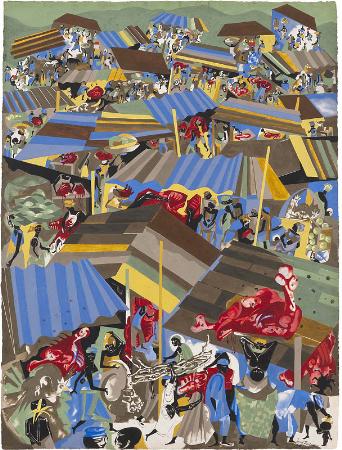 Jacob Lawrence was born in Atlantic City and came of age in Harlem during the Great Depression.
During the 1930s, Lawrence received early artistic training under Charles Alston at the Utopia Children's Center in Harlem, and the Harlem Art Workshops at 135th Street Public Library and 306 West 141st Street, which were run by Augusta Savage. Both Alston and Savage encouraged Lawrence in his studies and helped him secure scholarships for art classes and steady employment as an easel painter for the WPA (1938-40).
Inspired by everyday life in Harlem and the history of African-Americans in the United States, Lawrence developed a distinctive style of narrative painting featuring a flattened picture plane and boldly colored figures. In 1937, Lawrence began a narrative suite based on the life of the Haitian leader Toussaint L'Ouverture. He would eventually go on to create nine narrative series based on African-American life and heroes, including the now-famous series, "Migration of the Negro".
In 1941 Lawrence joined the roster of artists at Edith Halpert's Downtown Gallery, a leading gallery specializing in American art, and gained widespread recognition in 1944 when the Museum of Modern Art in New York organized the first traveling exhibition of his "Migration" series. The theme of migration continued to be an important subject for Lawrence, but he also represented African-Americans at work and play, and at home and abroad.
Jacob Lawrence lived and worked in Seattle, Washington with his wife, artist Gwendolyn Knight, until his death in 2000. In 2000, The Jacob and Gwendolyn Lawrence Foundation was established to serve as an educational resource on the art of Lawrence and his wife, artist Gwendolyn Knight, and a catalogue raisonné was published, documenting over 900 of Jacob Lawrence's paintings, drawings, and murals.Biography from The Johnson Collection
JACOB ARMSTEAD LAWRENCE (1917–2000)
Jacob Lawrence had a genuine talent for narrative art, whether done in series or as individual paintings. Influenced by the Harlem Renaissance, his subjects were invariably linked to the black community: their history and their struggles, as well as their jobs and leisure time activities.
One of three children, Lawrence was born in Atlantic City, New Jersey. Both of his parents had migrated north—his mother from Fredericksburg, Virginia, and his father from Charleston, South Carolina. Young Lawrence’s childhood was troubled, and he spent time in foster homes in Philadelphia. At age thirteen he and his mother moved to Harlem, and by the time he was sixteen he had dropped out of school.
Acting on his keen interest in art, Lawrence often walked sixty blocks to the Metropolitan Museum of Art. In 1935 he saw African Negro Art, an exhibition celebrating African art at the Museum of Modern Art. His involvement in his school’s history club and regular visits to the public library further satisfied his curiosity. He spent time at Utopia House, a quasi-day care center, which offered arts and crafts sessions under the supervision of Charles Alston, while also working odd jobs.
Despite the Great Depression, Harlem offered a lively cultural environment involving writers, artists, and entertainers. Between 1932 and 1934 Lawrence pursued art at the Harlem Art Workshop working in a corner of Alston’s studio at the 135th Library. He encountered such artists Aaron Douglas and Augusta Savage, meeting many of Savage’s students including Romare Bearden, Norman Lewis, and Gwendolyn Knight, whom he would marry in 1941.
When he was about seventeen Lawrence joined the Civilian Conservation Corps and worked building a dam near Middletown, Connecticut. In 1937 he received a two-year tuition scholarship to attend the American Artists School on West 14th street in Manhattan. With encouragement from Augusta Savage, in 1938 he joined the Work Progress Administration Federal Art Project’s easel painting division. It required that he produce two paintings every six weeks and paid a little less than twenty-four dollars each week.
The following year Lawrence had his first solo exhibition at the Harlem YMCA and in 1939 a solo show at the American Artists School. In 1944 he had his first major exhibition at the Museum of Modern Art in New York.
By then Lawrence had already undertaken his first series focusing on black heroes: the Haitian revolutionary Toussaint L’Ouverture. This was followed by series about Harriet Tubman, Frederick Douglass, and white abolitionist John Brown. Each series consisted of well researched small paintings done with poster paints accompanied by descriptive texts. In 1940–1941 he created sixty panels illustrating the Northern Migration, which he knew from his parents’ experience, as well as from many residents of Harlem.
The paintings were exhibited at Edith Halpert’s Downtown Gallery, and the Museum of Modern Art and the Phillips Collection each purchased thirty paintings. Beginning in 1943 Lawrence spent twenty-six months in the United States Coast Guard, at first as a steward’s mate in Saint Augustine, Florida, where he faced segregation firsthand. He was later transferred to a ship where the captain was sympathetic and appointed him to the role of ship’s illustrator.
After discharge, in 1945 Lawrence was awarded a Guggenheim Fellowship and the next year Josef Albers invited him to teach during the summer at Black Mountain College in western North Carolina. Lawrence enjoyed sitting in on Albers’s classes and never left campus because of the surrounding area’s segregationist attitudes. By the end of the decade Lawrence was suffering from depression and voluntarily sought treatment in a psychiatric hospital for nine months in 1950-1951. For the rest of his career, he painted genre subjects, many about life in Harlem.
In 1955 Lawrence began teaching design and figure drawing at Pratt Institute, Brooklyn, and fifteen years later he was promoted to the position of full professor, coordinator of the arts, and assistant to the dean. He also taught at Brandeis University in Waltham, Massachusetts, the Art Students League, and the New School for Social Research, both in New York, and periodically at the Skowhegan School of Painting and Sculpture in Maine, often overlapping with David Driskell. Despite these responsibilities Lawrence was very active as an artist; he typically painted with tempera or gouache in his distinctive quasi-cubist style, with compositions dominated by figures and with little concern for perspective or settings. He also began to develop screen prints, many of which replicate images from his earlier series. In 1980 he designed a forty-foot long porcelain mural for Howard University in Washington, DC, and he also illustrated several children’s books, some of which were based on his early series.
In the early 1960s Lawrence made two trips to Africa, accompanying an exhibition of his work to Lagos and subsequently lecturing in Nigeria. The work that resulted from these trips tends to be densely packed with figures and very colorful. During this decade he occasionally painted subjects reflecting the struggles of the Civil Rights movement. He returned repeatedly to certain themes, such as figures in libraries and builders—construction workers and cabinet makers—which represent the positive contributions of black people to American society.
In 1970 Lawrence moved west to join the faculty at the University of Washington in Seattle. Throughout the latter years of his career he garnered numerous accolades, had work included in many exhibitions, and served on a variety of national committees. When the National Association for the Advancement of Colored People gave him their highest honor, he responded saying, “If I have achieved a degree of success as a creative artist, it is mainly due to the Black experience which is our heritage—an experience which gives inspiration, motivation, and stimulation. I was inspired by the Black aesthetic by which we are surrounded, motivated to manipulate form, color, space, line and texture to depict our life, and stimulated by the beauty and poignancy of our environment.”
The Johnson Collection, Spartanburg, South Carolina
thejohnsoncollection.org