Page loaded successfully. Showing biography for Jacob Cox.
Jacob Cox BIOGRAPHY
1810 Philadelphia, Pennsylvania - 1892 Indianapolis, Indiana. Known for: Portrait, landscape, and still life painting.
The following information is from material developed for Crown Hill Cemetery in Indianapolis by Tom Davis:. Jacob Cox lived the history of art in Indianapolis for its first fifty years. He arrived to... Read full biography
The following information is from material developed for Crown Hill Cemetery in Indianapolis by Tom Davis:. Jacob Cox lived the history of art in Indianapolis for its first fifty years. He arrived to a backwoods town with stumps still standing in all but the most traveled streets, and these streets... Read full biography
The following information is from material developed for Crown Hill Cemetery in Indianapolis by Tom Davis:. Jacob Cox lived the history of art in Indianapolis for its first fifty years. He arrived to a backwoods town with stumps still standing in all but the most traveled streets, and these streets were knee deep in mud after every rain. By the time he died sixty years later trolleys ran down the streets, casting shadows from the street lights which lined the thoroughfares. Cox had been born in... Read full biography
The following information is from material developed for Crown Hill Cemetery in Indianapolis by Tom Davis:. Jacob Cox lived the history of art in Indianapolis for its first fifty years. He arrived to a backwoods town with stumps still standing in all but the most traveled streets, and these streets were knee deep in mud after every rain. By the time he died sixty years later trolleys ran down the streets, casting shadows from the street lights which lined the thoroughfares. Cox had been born in Burlington, New Jersey, the first of ten children born to a Quaker couple. His parents died in separate ferry accidents in Delaware, his mother when he was eight, his father two years later, and he was raised primarily by his grandfather and an aunt... Read full biography
The following information is from material developed for Crown Hill Cemetery in Indianapolis by Tom Davis:. Jacob Cox lived the history of art in Indianapolis for its first fifty years. He arrived to a backwoods town with stumps still standing in all but the most traveled streets, and these streets were knee deep in mud after every rain. By the time he died sixty years later trolleys ran down the streets, casting shadows from the street lights which lined the thoroughfares. Cox had been born in Burlington, New Jersey, the first of ten children born to a Quaker couple. His parents died in separate ferry accidents in Delaware, his mother when he was eight, his father two years later, and he was raised primarily by his grandfather and an aunt in Washington, Pennsylvania. He was already interested in art and did charcoal sketches on whatever available canvas he could find, usual... Read full biography
Artist Biography
Biography page for Jacob Cox ((1810 - 1892)), known for Portrait, landscape, and still life painting. Showing 1 biographical entries and 0 sample artworks.
Jacob Cox - Artist Info
About Jacob Cox
Biography from the Archives of askART
 The following information is from material developed for Crown Hill Cemetery in Indianapolis by Tom Davis:
Jacob Cox lived the history of art in Indianapolis for its first fifty years. He arrived to a backwoods town with stumps still standing in all but the most traveled streets, and these streets were knee deep in mud after every rain. By the time he died sixty years later trolleys ran down the streets, casting shadows from the street lights which lined the thoroughfares.
Cox had been born in Burlington, New Jersey, the first of ten children born to a Quaker couple. His parents died in separate ferry accidents in Delaware, his mother when he was eight, his father two years later, and he was raised primarily by his grandfather and an aunt in Washington, Pennsylvania. He was already interested in art and did charcoal sketches on whatever available canvas he could find, usually wooden boxes, but occasionally the fence or barn at his grandfather's farm. Perhaps punishments for this latter transgression discouraged him from seeking a career in art from the very beginning, and at the age of sixteen he was apprenticed to a tinsmith.
In 1830, he set out with his younger brother Charles to establish a tinsmith shop in Pittsburgh. There he met and courted Nancy Baird. Not long after they were married in 1832, Jacob and Charles set off on foot for Indianapolis having decided to move their business here. Nancy arrived about a week after they did, on a "conveyance" according to historian J.P. Dunn, bringing a supply of tinware and hardware with which the brothers set up a shop on the south side of Washington Street.
As the business began to prosper, a third brother, David joined them. This gave Jacob a little more time to pursue his real love, drawing and painting, still mostly in his spare hours. "I worked at tin smithing and copper smithing he once said, "painting for my own recreation and to gratify the painter's instinct that was always strong in me."
As early as 1835, doing portraits was included as one of the businesses of the tin shop, but his first known artistic commission was for doing a large political banner for the 1840 presidential campaign of William Henry Harrison. Though he did not leave the work of the tinsmith business, he did open a separate art studio in the business district in 1840, and an item in the December 30, 1841 issue of the Indiana State Sentinel told the public that "J. Cox, portrait painter, has removed to the room over the store of Morris & Brother, adjoining the Post Office, where he may be found at all times by his friends and public. Specimens of Portraiture by himself are to be seen at the State House."
After awhile though, he closed the shop and spent the winter of 1842-1843 in Cincinnati, where studies with John Dunn, the son of a former Indiana State Treasurer, and a large number of commissions in the prospering town enabled him to return a "wiser and more confident artist," but one who still relied on the tin shop to provide much of his living. The Sentinel again took up his cause, advising on December 16, 1843, "Reader, have you visited Mr. Cox's Painting Gallery? If not, take the first opportunity to do so; and if you are wise, whether married or single, have your portrait painted."
Many now buried in Crown Hill did so, including Senator Oliver Smith, Governors David Wallace and Noah Noble (he painted six governors), State Treasurer Samuel Merrill, and businessmen George Lockerbie and John L. Spann and his children. His own political work as trustee and town councilman for the 3rd Ward also brought him many contacts which later turned into commissions.
Art became an increasing part of his business life from this time on, though he does not appear to have completely severed his ties to the smith shop until as late as 1858. He received $1,500 for a series of temperance paintings done in 1853-1854, which he combined into one large panorama in accordance to the craze at the time. He was able to take a trip to New York City in 1860, during which he was able to view the work of the best artists of the day and even to take some classes at the National Academy of Design.
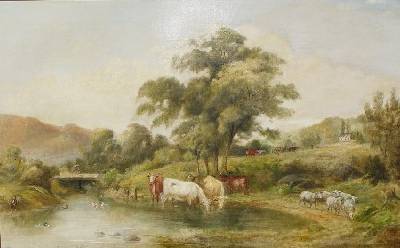
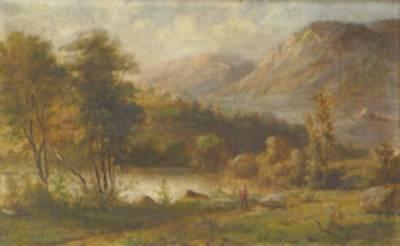
Upon his return to town, he felt comfortable enough about his future in art to build a new home for his family at 962 North Pennsylvania, with an attached studio. Wilbur Peat, Indiana Art historian, called this "the hub around which the majority of the city's art activities revolved, and the point to which most of its artists gravitated." He found time for his favorite paintings, landscapes, sketching in the beech groves that then surrounded the town, and along the banks of Fall Creek. Still lifes also became part of his repertoire.
Cox continued to paint and exhibit until his death in 1892 at the age of eighty one. Competition from younger, better artists like T.C. Steele had forced him out of the portrait business in the 1880s, but his "compositions" of landscapes filled with farm animals, and homey still lifes continued to be popular. Many of his works are on display today at the Morris-Butler House in Indianapolis.
Sarah T. Bolton, Indiana's first poet, was a friend of Indiana's first artist. In her poem "An Hour in Mr. Coxs Studio," she wrote in June, 1863:
On a dreary day in winter, when the wind with cold was crying;
When the Frost King, from his palace, rode adown the crisped air;
When the drifted snow in hillocks on the frozen ground was lying,
And the maples and the beeches stood shivering brown and bare;
In the great heart of the city, walled about with brick and mortar,
I found a bower of beauty where stern winter was denied;
And from all life's fret and worry gave my soul an hour to loiter,
And away she gayly flitted, taking Fancy for her guide.
Aye, away by blooming hedges, and green meadows starred with daisies;
By granite cliffs, where lichens hung their crimson banners gay;
By shadowy dells and dingles, floored with mosses, hung with hazes,
Where fragrant water lilies bathe their faces in bright spray. . . .
. . .And my truant soul, forgetting all the lore of sterner duty---
All the past, and all the future, in her dreaming wandered on;
Wandered on, enrapt, enchanted, in this new-found world of beauty,
Till common cares recalled her, when the little hour was gone.
And, although her wings were folded, she was richer, wiser, better,
And stronger for life's pathway, through the frost and through the snow;
And whatever befall her, till she breaks life's mortal fetter,
She will not forget that journey in the artist's studio.
copyright 2000 by Tom Davis