Page loaded successfully. Showing biography for Jacob Heusch.
Jacob Heusch BIOGRAPHY
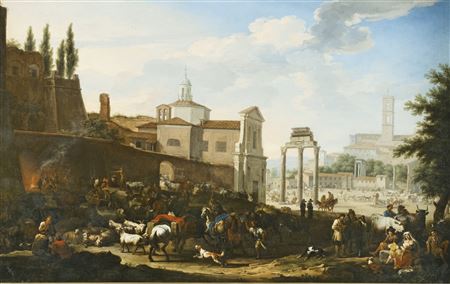
1656 Utrecht - 1701 Amsterdam. Known for: Painting.
Jacob Heusch was bornin 1656 in Utrecht. Jacob de Heusch is documented in Roman Bent in 1675 and a drawing dated 1680 belonging to the Museum of St. Anne in Luebeck, still bears witness to his... Read full biography
Jacob Heusch was bornin 1656 in Utrecht. Jacob de Heusch is documented in Roman Bent in 1675 and a drawing dated 1680 belonging to the Museum of St. Anne in Luebeck, still bears witness to his presence in the Eternal City. Confirmed by the book of accounts of the Falconieri family, where, in the... Read full biography
Jacob Heusch was bornin 1656 in Utrecht. Jacob de Heusch is documented in Roman Bent in 1675 and a drawing dated 1680 belonging to the Museum of St. Anne in Luebeck, still bears witness to his presence in the Eternal City. Confirmed by the book of accounts of the Falconieri family, where, in the years between 1686 and 1692, there was the purchase of his works. The artist's activity is oriented towards the style of Gaspard Dughet and Salvator Rosa, but the latter will be to arouse a real... Read full biography
Jacob Heusch was bornin 1656 in Utrecht. Jacob de Heusch is documented in Roman Bent in 1675 and a drawing dated 1680 belonging to the Museum of St. Anne in Luebeck, still bears witness to his presence in the Eternal City. Confirmed by the book of accounts of the Falconieri family, where, in the years between 1686 and 1692, there was the purchase of his works. The artist's activity is oriented towards the style of Gaspard Dughet and Salvator Rosa, but the latter will be to arouse a real passion, so as to cause him to imitate his canvases. The taste for the picturesque, the atmospheric sensitivity, and the ability to summon Arcadian scenarios persuaded critics to grant him credit for having influenced the art of Jan Frans van Bloemen and... Read full biography
Jacob Heusch was bornin 1656 in Utrecht. Jacob de Heusch is documented in Roman Bent in 1675 and a drawing dated 1680 belonging to the Museum of St. Anne in Luebeck, still bears witness to his presence in the Eternal City. Confirmed by the book of accounts of the Falconieri family, where, in the years between 1686 and 1692, there was the purchase of his works. The artist's activity is oriented towards the style of Gaspard Dughet and Salvator Rosa, but the latter will be to arouse a real passion, so as to cause him to imitate his canvases. The taste for the picturesque, the atmospheric sensitivity, and the ability to summon Arcadian scenarios persuaded critics to grant him credit for having influenced the art of Jan Frans van Bloemen and Andrea Locatelli. He died in 1701 in Amsterdam, Netherlands.... Read full biography
Artist Biography
Biography page for Jacob Heusch ((1656 - 1701)), known for Painting. Showing 2 biographical entries and 0 sample artworks.
Jacob Heusch - Artist Info
About Jacob Heusch
Name variants
Jakob de Heusch
Biography from Dorotheum, Vienna
Jakob de Heusch (Jacob Heusch) was born in 1656 in Utrecht. Jakob de Heusch was trained by his brother Willem and mentioned as a member of the Schildersbent, a society of Dutch and Flemish artists in Rome, in 1675. All of the Italian motifs in his paintings were taken from Rome and its surroundings. He worked for noble Roman families including the Doria Pamphilj, the Falconieri, the Colonna, the Rospigliosi, and the Corsini and his works can still be found in Roman collections. Heusch passed away in 1701.Biography from Wannenes Art Auctions
Jacob Heusch was bornin 1656 in Utrecht. Jacob de Heusch is documented in Roman Bent in 1675 and a drawing dated 1680 belonging to the Museum of St. Anne in Luebeck, still bears witness to his presence in the Eternal City. Confirmed by the book of accounts of the Falconieri family, where, in the years between 1686 and 1692, there was the purchase of his works. The artist's activity is oriented towards the style of Gaspard Dughet and Salvator Rosa, but the latter will be to arouse a real passion, so as to cause him to imitate his canvases. The taste for the picturesque, the atmospheric sensitivity, and the ability to summon Arcadian scenarios persuaded critics to grant him credit for having influenced the art of Jan Frans van Bloemen and Andrea Locatelli. He died in 1701 in Amsterdam, Netherlands.