Page loaded successfully. Showing biography for Jacques-Louis David.
Jacques-Louis David BIOGRAPHY
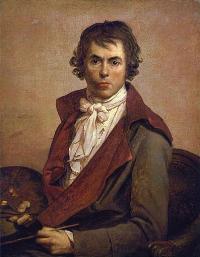
1748 Paris, France - 1825 Brussels, Belgium. Known for: Classical painting.
Jacques Louis David was born in Paris in 1748. His father lost his life in a duel, and so he was cared for by his mother, who intended him to be an architect. The first instruction he received was... Read full biography
Jacques Louis David was born in Paris in 1748. His father lost his life in a duel, and so he was cared for by his mother, who intended him to be an architect. The first instruction he received was from his great uncle, François Boucher; he was a pupil of Vien at the age of twenty-one. Owing to... Read full biography
Jacques Louis David was born in Paris in 1748. His father lost his life in a duel, and so he was cared for by his mother, who intended him to be an architect. The first instruction he received was from his great uncle, François Boucher; he was a pupil of Vien at the age of twenty-one. Owing to pique, Vien prevented David winning the Prix de Rome in 1771. He competed unsuccessfully for the next two years (He attempted suicide once because of this failure.) and in 1774, he obtained the blue... Read full biography
Jacques Louis David was born in Paris in 1748. His father lost his life in a duel, and so he was cared for by his mother, who intended him to be an architect. The first instruction he received was from his great uncle, François Boucher; he was a pupil of Vien at the age of twenty-one. Owing to pique, Vien prevented David winning the Prix de Rome in 1771. He competed unsuccessfully for the next two years (He attempted suicide once because of this failure.) and in 1774, he obtained the blue ribbon of French art. He accompanied Vien to Rome the following year; painted a little there, but drew from the antique mostly. They returned to France in 1780; his "Belisarius" procured his election to the Academie. He was admitted in 1783, for which he... Read full biography
Jacques Louis David was born in Paris in 1748. His father lost his life in a duel, and so he was cared for by his mother, who intended him to be an architect. The first instruction he received was from his great uncle, François Boucher; he was a pupil of Vien at the age of twenty-one. Owing to pique, Vien prevented David winning the Prix de Rome in 1771. He competed unsuccessfully for the next two years (He attempted suicide once because of this failure.) and in 1774, he obtained the blue ribbon of French art. He accompanied Vien to Rome the following year; painted a little there, but drew from the antique mostly. They returned to France in 1780; his "Belisarius" procured his election to the Academie. He was admitted in 1783, for which he painted the 'Death of Hector'. David married shortly after in 1791. His wife was the daughter of the king's contractor for the Louvre. H... Read full biography
Artist Biography
Biography page for Jacques-Louis David ((1748 - 1825)), known for Classical painting. Showing 2 biographical entries and 0 sample artworks.
Jacques-Louis David - Artist Info
About Jacques-Louis David
Biography from the Archives of askART
 Jacques Louis David was born in Paris in 1748. His father lost his life in a duel, and so he was cared for by his mother, who intended him to be an architect. The first instruction he received was from his great uncle, François Boucher; he was a pupil of Vien at the age of twenty-one.
Owing to pique, Vien prevented David winning the Prix de Rome in 1771. He competed unsuccessfully for the next two years (He attempted suicide once because of this failure.) and in 1774, he obtained the blue ribbon of French art. He accompanied Vien to Rome the following year; painted a little there, but drew from the antique mostly. They returned to France in 1780; his "Belisarius" procured his election to the Academie. He was admitted in 1783, for which he painted the 'Death of Hector'.
David married shortly after in 1791. His wife was the daughter of the king's contractor for the Louvre. He again visited Italy and Flanders. The classic movement of which he was the prophet exercised an influence not only on politics but even on furniture and passing fashions of the day.
David entered with ardor into the conflicts of the Revolution. He was elected in 1792 to be a representative of Paris in the Convention, where he sided with the extreme party of Robespierre. Twice he was thrown into prison and narrowly escaped with his life. On his release in 1795 he abandoned politics, devoting himself entirely to art. He was one of the original members of the Institute and he became acquainted with Napoleon who proved himself his warm friend and patron. Napoleon made David his 'premier peintre de l'Empereur' and gave him many important commissions. This friendship affected a strange metamorphasis in the politics of the painter. He became a staunch imperialist. On restoration of the Bourbons, he sought refuge in Brussels where he died in 1825.
David has suffered more than any other painter of his period from being what one might call a textbook personality. It has never been sufficiently emphasized that David was one of the great masters of portrait painting. Born with a natural capacity to seize a likeness, his long years of arduous training in Rome developed and refined his ability to draw. He posed his figures against dark backgrounds with so much taste and tact that the sense of reality is heightened, and the figures seldom appear mannered.
He reigned with absolute supremacy for many years. Among his pupils and disciples were Girodet, Gros, Gerard, Leopold Robert, Abel de Pujol and Ingres. Not until the rise of the Romantic School, under Gericault and Delacroix, was any real opposition offered to his classicsm. His chief excellence was in the correctness of his drawing, which frequently became hard and statuesque. His weakness is not apparent in his treatment of light and in his coloring which is monotonous and frequently unpleasant.
David was a man who made the times serve his personal ambition. He was a coward, a betrayer of his friends, sadistic, a fanatic for a cause. He died in 1825.
Compiled and submitted August 2004 by Jean Ershler Schatz, artist and researcher from Laguna Woods, California.
Sources include:
"French Painting" by R.H. Wilenski
Catalogue from Timken Art GalleryBiography from Swann Galleries
David, who lived from 1748 to 1825, was born to a prosperous family in Paris. His father died in a duel when David was a child after which David lived with his uncle who worked as an architect. Despite pressure to study architecture himself, he was passionate about drawing and tried to study with Francois Boucher (1703-1770), an important Rococo painter and a distant family member. As tastes were gradually shifting from the florid style of Rococo to a more restrained classical style, Boucher sent the young artist to Joseph-Marie Vien (1716-1809), who embraced the changing tastes.
David then attended the Académie Royale where he applied for the Prix de Rome, the prestigious scholarship to study at the French Academy in Rome, four times before finally being awarded the prize in 1774. He traveled to Italy with Vien, who had been appointed the director of the French Academy in Rome. While in Italy, David studied the work of Renaissance masters such as Caravaggio, Raphael and Carracci. He also absorbed the architecture and sculpture of the ancient city, filling notebooks with studies that he would draw upon throughout his career.
The present work is likely a drawing done while the artist was in Rome. During this time he also met the artist Anton Raphael Mengs (1728-1779), a German painter who embraced the Neoclassical style and introduced David to the writings of Johann Joachim Winckelmann (1717-1768), an important art historian who is cited with directing 18th century tastes away from the Rococo and towards Neoclassicism. David remained in Rome for five years.
Following his return to Paris the Académie Royale admitted him as an associate. Despite the changing political climate during his career, he worked for the monarchy of Louis XVI, the post-revolutionary government and the Emperor Napoleon Bonaparte. He gained acclaim as one of the foremost French Neoclassical artists of his day, producing compositions that often combined Enlightenment philosophy with his linear style creating a sense of moral clarity and balance amidst the turbulent times of his artistic career.