Page loaded successfully. Showing biography for Jacques Lipchitz.
Jacques Lipchitz BIOGRAPHY

1891 Druskieniki, Lithuania - 1973 Capri, Italy. Known for: Modernist sculpture, still life and figure painting.
Jacques Lipchitz, the eldest son of a wealthy Jewish contractor, was born in Druskieniki, Lithuania in 1891. His interest in modeling and drawing was evident when he was in grade school. At the age... Read full biography
Jacques Lipchitz, the eldest son of a wealthy Jewish contractor, was born in Druskieniki, Lithuania in 1891. His interest in modeling and drawing was evident when he was in grade school. At the age of 18, and against the wishes of his father to become an engineer, he departed for Paris to enroll in... Read full biography
Jacques Lipchitz, the eldest son of a wealthy Jewish contractor, was born in Druskieniki, Lithuania in 1891. His interest in modeling and drawing was evident when he was in grade school. At the age of 18, and against the wishes of his father to become an engineer, he departed for Paris to enroll in anatomy and stone carving classes at the Ecole des Beaux-Arts - at the encouragement of his mother and uncle. He also studied at the Academie Julian and the Academie Colarossi. In 1914, Lipchitz... Read full biography
Jacques Lipchitz, the eldest son of a wealthy Jewish contractor, was born in Druskieniki, Lithuania in 1891. His interest in modeling and drawing was evident when he was in grade school. At the age of 18, and against the wishes of his father to become an engineer, he departed for Paris to enroll in anatomy and stone carving classes at the Ecole des Beaux-Arts - at the encouragement of his mother and uncle. He also studied at the Academie Julian and the Academie Colarossi. In 1914, Lipchitz traveled with Diego Rivera to Madrid and Majorca, where he was introduced to Picasso, Max Jacob, Juan Gris, Modigliani, and other artists in the Cubist circle. However, his greatest influence came from his interest in art history, providing him with an... Read full biography
Jacques Lipchitz, the eldest son of a wealthy Jewish contractor, was born in Druskieniki, Lithuania in 1891. His interest in modeling and drawing was evident when he was in grade school. At the age of 18, and against the wishes of his father to become an engineer, he departed for Paris to enroll in anatomy and stone carving classes at the Ecole des Beaux-Arts - at the encouragement of his mother and uncle. He also studied at the Academie Julian and the Academie Colarossi. In 1914, Lipchitz traveled with Diego Rivera to Madrid and Majorca, where he was introduced to Picasso, Max Jacob, Juan Gris, Modigliani, and other artists in the Cubist circle. However, his greatest influence came from his interest in art history, providing him with an unlimited source of imagery. Lipchitz applied theories of mathematics and proportion to the co... Read full biography
Artist Biography
Biography page for Jacques Lipchitz ((1891 - 1973)), known for Modernist sculpture, still life and figure painting. Showing 5 biographical entries and 0 sample artworks.
Jacques Lipchitz - Artist Info
About Jacques Lipchitz
Name variants
Chaim Jacob Jacques Lipchitz, Jacques Lipschitz
Biography from the Archives of askART
 Jacques Lipchitz, the eldest son of a wealthy Jewish contractor, was born in Druskieniki, Lithuania in 1891. His interest in modeling and drawing was evident when he was in grade school. At the age of 18, and against the wishes of his father to become an engineer, he departed for Paris to enroll in anatomy and stone carving classes at the Ecole des Beaux-Arts - at the encouragement of his mother and uncle. He also studied at the Academie Julian and the Academie Colarossi.
In 1914, Lipchitz traveled with Diego Rivera to Madrid and Majorca, where he was introduced to Picasso, Max Jacob, Juan Gris, Modigliani, and other artists in the Cubist circle. However, his greatest influence came from his interest in art history, providing him with an unlimited source of imagery.
Lipchitz applied theories of mathematics and proportion to the concepts of Braque and Picasso, as did many second generation Cubists. A relatively new movement in art was being created, where curves, planes, lines, and their intersections and overlapping would form new relationships. His works display a lifetime of continuous growth and exploration, spanning the Cubism style to Mannerism, and subjects from non-committal to those that carry profound visual symbolism. Although he was a leader in innovation and experimentation, his work never embraced total abstraction and never tried to escape from the reality of art as symbolic expression.
In the mid-1920s, Lipchitz began making sculptures in a distinctively new style. His sculptures were frequently constructed from bronze and engaged new ways of exploring light and space. These new works, called transparents, provided a greater emphasis on utilizing negative space. Although unpopular at the time, the works and ideas behind the transparents became popular with Picasso and Juan Gris.
After 1925, Lipchitz departed from the Cubist manner and began to soften the geometric angularity of his pieces into curvilinear, openwork sculptures whose expressive subjects were drawn from ancient mythology and the Bible. He achieved naturalism in these works that can be seen in Woman Leaning on Elbow.
In 1941, Varian Fry was instrumental in facilitating Lipchitz to flee Vichy, France, to the United States -- during the German invasion of France. Lipchitz relocated in New York where he continued to fill commissions from all over the world including The Spirit of Enterprise, Fairmount Park, Philadelphia; Notre Dame de Liesse, Assy in Haute-Savoie; and his most famous work commissioned for the 1937 Paris Exposition Universelle entitled "Prometheus". (In the myth, the gods punish Prometheus for bringing fire to humans by turning him into stone and allowing a vulture to peck at his liver. In the piece, however, Prometheus is shown unchained, strangling the vulture, used as a symbol of ignorance.) In 1951, he presented Fry with his completed Embracing Figures. In 1952, a fire destroyed and claimed most of Lipchitz' work.
In 1955, he began producing his celebrated semi-automatics-masses of clay or plasticine, which he would first mold underwater using only his sense of touch.
Examples of his work can be seen in the Museum of Modern Art, New York City, and the Barnes Foundation, Merion, Pennsylvania.Biography from the Archives of askART
 A sculptor who adapted Cubism to sculpture, Jacques Lipchitz was one of the leading sculptors of the 20th century. He was born in Druskieniki, Lithuania and fled from Paris, where he had lived from his youth, to the United States in 1941 when the war was getting heavy.
He had studied at the Ecole des Beaux Arts in Paris from 1909 to 1911 and at the Academy Julian. He arrived in America when the Abstract Expressionist movement was beginning to take hold, and this likely influenced the much more emotional expression of the later part of his career. His work was much more emotional and rounded in form than the earlier cubist work, and his subject matter was epic, reflecting his interest in myths, heroic tales and religious symbolism. His largest work is Bellerophon Taming Pegasus, completed in 1964 for the Columbia University Law School and measuring 30 feet.
His sculpture, Bather, is in the sculpture garden of the Sheldon Memorial Art Gallery in Lincoln, Nebraska, and following is the Gallery's website description of the work:
..."he presents multiple views of the figure in the conceptual realism style of the Cubist movement. This was the largest figure attempted by Lipchitz at this point in his career. He says of this work: 'I was returning to the problem of creating a cubist figure, free-standing in surrounding space, creating that space by its axial pivot. The legs are placed firmly at right angles to each other, and the circular movement is suggested by curvilinear forms of drapery enclosing the arm, actually enclosing space . . . It was in a sense my farewell to literal cubism, the record of the movement when it was no longer necessary for me to concentrate on the vocabulary of forms, when I could move onto a sculpture of themes and ideas.'
Source:
(sheldon.unl.edu/HTML/ARTIST/Lipchitz_J/SG.html)
"Dictionary of American Sculptors," edited by Glenn Opitz
"Lipchitz, an Ocean Away From His Cubist Years," The New York Times on the Web, 3/17/2000.Biography from GallArt.com
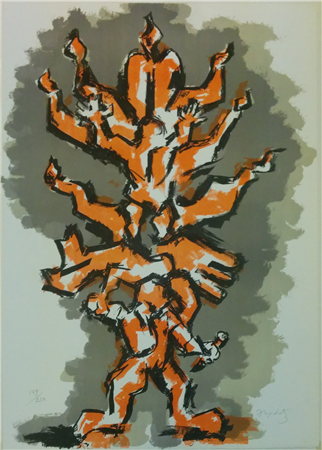 Jacques Lipchitz, Lithuanian (1891 - 1973)
Jacques Lipchitz was a Cubist sculptor. Jacques Lipchitz was born Chaim Jacob Lipchitz in Druskininkai, Lithuania, which then was under the rule of tsarist Russia Lithuania. Jacques was as a son of a Jewish building contractor. At first, under the influence of his father, he studied engineering, but soon after, supported by his mother, he moved to Paris (1909) to study at the École des Beaux-Arts and the Académie Julian.
It was there, in the artistic communities of Montmartre and Montparnasse that he joined a group of artists that included Juan Gris and Pablo Picasso and where his friend, Amedeo Modigliani, painted The Sculptor Jacques Lipchitz and His Wife Berthe Lipchitz.
Living in this environment, Lipchitz soon began to create Cubist sculptures. In 1912 he exhibited at the Salon National des Beaux-Arts and the Salon d'Automne with his first one-man show held at Léonce Rosenberg's Galerie L'Effort Moderne in Paris in 1920. In 1922 he was commissioned by the Barnes Foundation in Merion, Pennsylvania for five bas-reliefs.
With artistic innovation at its height, in the 1920s he experimented with abstract forms he called transparent sculptures. Later he developed a more dynamic style, which he applied with telling effect to bronze figure and animal compositions.
With the German occupation of France during World War II, and the deportation of Jews to the Nazi death camps, Jacques Lipchitz had to flee France. With the assistance of the American journalist Varian Fry in Marseille, he escaped the Nazi regime and went to the United States. There, he eventually settled in Hastings-on-Hudson, New York.
He was one of 250 sculptors who exhibited in the 3rd Sculpture International held at the Philadelphia Museum of Art in the summer of 1949. He has been identified in the LIFE Magazine photograph showing 70 of them. In 1954 a Lipchitz retrospective traveled from The Museum of Modern Art in New York to the Walker Art Center in Minneapolis and The Cleveland Museum of Art. In 1959, his series of small bronzes in an exhibition, "To the Limit of the Possible," was shown at Fine Arts Associates in New York.
Lipchitz taught one of the most famous contemporary artists, Marcel Mouly.
Beginning in 1963 he returned to Europe where he worked for several months of each year in Pietrasanta, Italy. In 1972 his autobiography was published on the occasion of an exhibition of his sculpture at The Metropolitan Museum of Art in New York.
Jacques Lipchitz died in Capri, Italy. His body was flown to Jerusalem for burial.Biography from Ketterer Kunst, Munich
Jacques Lipchitz did not see painting as his mission, as he expressed in an interview with the curator Katharine Kuh in November 1957: "I have no talent whatsoever for this medium." (quote after: Robin Cembalest, The Optimist Cubist, in: Art News from May 1, 2002). Instead he discovered a great talent and love for sculpting. "Sculpture is a man-made companion with an immortal human heart inside from which calls are emitted constantly, giving us joy, warming us and teaching us, all at the same time." (Jacques Lipchitz in a letter to Otto Gerson, November 1957).
When Jacques Lipchitz met the Spanish painter Juan Gris (1887-1927) in 1916 a lifelong friendship began. During World War I both artists left Paris for a longer time. In 1918 they, along with their families and several other artists, chose Beaulieu-lès-Loches as their refuge where they would spent the spring and summer months. Lipchitz and Gris were in a very fruitful artistic interchange, they discussed issues of sculpting, Lipchitz preferred form of artistic expression, in context of the creative aims and principles of Cubism, which Lipchitz did not only regard as a modern art tendency but as an entirely new view of the universe. It was during those years that he created masterly sculptures in the sense of Cubism. Both were on a quest to overcome the restrictions of conservative academic art. At that point Lipchitz was occupied with a number of drawings and gouaches in preparation of sculptural works, which he eventually realized after the end of the war when he returned to Paris in 1919. A. M. Hammacher, art historian and author of the monograph "Jacques Lipchitz. His Sculpture" attested this work offered here a key art-historically importance, as it reflects the aesthetic principles of both Jacques Lipchitz and his fellow artist Juan Gris like no other work in his oeuvre. A few months after it had been completed Lipchitz had his first solo show at Galerie Léonce Rosenberg in Paris.
Today Lipchitz is regarded one of the 20\up6 th Century's greatest sculptors, his works can be found in notable collections like the Museum of Modern Art in New York, the National Gallery of Art in Washington D. C., theTate Gallery, London, the Musée des Beaux-Arts in Nancy, the Sprengel Museums, Hannover or the Museum Folkwang in Essen. [CH]Biography from Crait + Müller
In 1933, when he created Géricault's Portrait, Jacques Lipchitz enjoyed great success, received commissions and navigated a buoyant and exciting context. The artist returned to the sources of his inspiration by creating this tribute to an artist he admired. Moreover, heir to a classical French training, he considers portraiture a useful and indispensable exercise in the evolution of his artistic work: "All my life, with a few interruptions, I've done portraits. I really enjoy doing them" (Arnason, 1972).
The artist worked, as he testifies, from a death mask of which he had acquired a print, and from existing portraits of the painter. Working from a death mask had an antecedent in his career: in 1920, paying homage to another artist, Amedeo Modigliani - who was, however, his friend - he created the Masque mortuaire de Modigliani from memory, thanks to a partial plaster cast brought to him by the painter Moïse Kisling and the Swiss astrologer Conrad Moricand. The tension created by the fine yet rough construction makes this portrait particularly lively and expressive. As for the half-nature scale, it lends it a particularly intimate character. This agitated style reflects the romantic temperament of the artist portrayed.
In 1952, he was featured in the French pavilion at the Venice Biennale, where Lipchitz exhibited 22 works. During this period, the artist was living in the United States, where he was also gaining recognition: many of his works were acquired by institutions (today, American museums hold over 230 of his works) and private collectors.