Page loaded successfully. Showing biography for James McIntosh Patrick.
James McIntosh Patrick BIOGRAPHY
1907 Dundee, Scotland - 1998. Known for: Rural landscape, portrait and still life painting, etching.
James McIntosh Patrick, OBE RSA was a Scottish painter, celebrated for his finely observed paintings of the Angus landscape and Dundee, Scotland, where he was based for most of his life. Born in... Read full biography
James McIntosh Patrick, OBE RSA was a Scottish painter, celebrated for his finely observed paintings of the Angus landscape and Dundee, Scotland, where he was based for most of his life. Born in Dundee, the son of Andrew Patrick, an architect and amateur artist who encouraged his son to draw and... Read full biography
James McIntosh Patrick, OBE RSA was a Scottish painter, celebrated for his finely observed paintings of the Angus landscape and Dundee, Scotland, where he was based for most of his life. Born in Dundee, the son of Andrew Patrick, an architect and amateur artist who encouraged his son to draw and paint, he studied painting at Glasgow School of Art from 1924 to 1928, studying with Maurice Greiffenhagen, and in Paris. He continued his interest in etching which was very popular in the 1920s and was... Read full biography
James McIntosh Patrick, OBE RSA was a Scottish painter, celebrated for his finely observed paintings of the Angus landscape and Dundee, Scotland, where he was based for most of his life. Born in Dundee, the son of Andrew Patrick, an architect and amateur artist who encouraged his son to draw and paint, he studied painting at Glasgow School of Art from 1924 to 1928, studying with Maurice Greiffenhagen, and in Paris. He continued his interest in etching which was very popular in the 1920s and was to prove a source of income for him during the Depression years. A foremost landscape painter, he began his career producing highly finished etchings, but when the market for these collapsed in the 1930s he turned towards painting in watercolour and... Read full biography
James McIntosh Patrick, OBE RSA was a Scottish painter, celebrated for his finely observed paintings of the Angus landscape and Dundee, Scotland, where he was based for most of his life. Born in Dundee, the son of Andrew Patrick, an architect and amateur artist who encouraged his son to draw and paint, he studied painting at Glasgow School of Art from 1924 to 1928, studying with Maurice Greiffenhagen, and in Paris. He continued his interest in etching which was very popular in the 1920s and was to prove a source of income for him during the Depression years. A foremost landscape painter, he began his career producing highly finished etchings, but when the market for these collapsed in the 1930s he turned towards painting in watercolour and oil. He produced portraits and still life works but is known mainly for his paintings of cultivated landscapes in the Scottish c... Read full biography
Artist Biography
Biography page for James McIntosh Patrick ((1907 - 1998)), known for Rural landscape, portrait and still life painting, etching. Showing 2 biographical entries and 0 sample artworks.
James McIntosh Patrick - Artist Info
About James McIntosh Patrick
Name variants
James Patrick
Biography from the Archives of askART
 James McIntosh Patrick, OBE RSA was a Scottish painter, celebrated for his finely observed paintings of the Angus landscape and Dundee, Scotland, where he was based for most of his life.
Born in Dundee, the son of Andrew Patrick, an architect and amateur artist who encouraged his son to draw and paint, he studied painting at Glasgow School of Art from 1924 to 1928, studying with Maurice Greiffenhagen, and in Paris.
He continued his interest in etching which was very popular in the 1920s and was to prove a source of income for him during the Depression years. A foremost landscape painter, he began his career producing highly finished etchings, but when the market for these collapsed in the 1930s he turned towards painting in watercolour and oil.
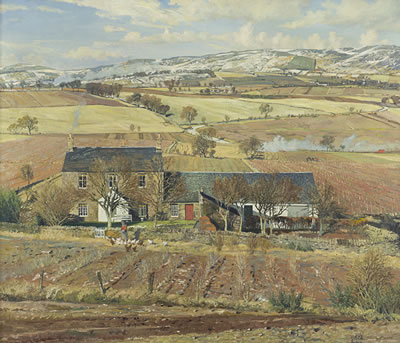
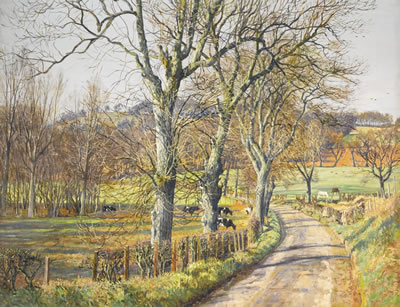
He produced portraits and still life works but is known mainly for his paintings of cultivated landscapes in the Scottish countryside. They are often very wide in scope yet meticulously detailed. In this he has been compared to Bruegel. His style was traditional but his use of colour could be bold, as were some compositional aspects of several of his paintings.
In Spring in Eskdale (1935) the scene seems to be viewed from a height, giving an almost aerial view, while in Stobo Kirk (1936) perspective is again deliberately but subtly distorted. Less unconventionally, his landscapes frequently make use of lanes, roads, waterways or other features leading from foreground to middle distance or beyond, drawing the viewer into the picture. This compositional trademark can be seen in one of his earliest landscapes, The Three Sisters, Glencoe (1934), Spring in Eskdale, and many of his later works.
Like many artists of the interwar period, he was profiled as an 'Artist of Note' in The Artist magazine, Vol XIV No 3, in November 1937.
He received many awards including the Guthrie Prize and was elected a full member of the Royal Scottish Academy in 1957. He was appointed OBE in the 1997 Birthday Honours
His works are displayed at such venues as McManus Galleries and Museum, Dundee, Aberdeen Art Gallery, Glasgow Art Gallery, Edinburgh City Art Centre, Manchester Art Gallery, the Walker Art Gallery, the National Gallery of South Africa, National Gallery of South Australia, the Sydney Art Gallery, and the Carnegie Institute (Pittsburgh, Pennsylvania, USA). In 1999 the Patrick family donated his archives to the Scottish National Gallery of Modern Art.
To celebrate its victory in the 1983 University Challenge competition, the University of Dundee commissioned McIntosh Patrick to produce to two paintings of its campus. Other examples of McIntosh Patrick's works held as part of the University's fine art collections include portraits of Principal Angus Robertson Fulton and Arthur Alexander Matheson.
Source:
"James McIntosh Patrick," Wikipedia, Feb. 2018Biography from McTear's
After the war, Patrick returned to Dundee with his wife and family and began painting outdoors rather than in the studio which he had upstairs in his house. By the 1950's he had perfected his style and technique in outdoor landscape painting and began recording his beloved Angus countryside on canvas, working in all seasons and all weather conditions.
His style was traditional and he didn't have much time for ''contemporary'' interpretations of landscape. ''The Tay Bridge from My Studio Window'', painted in 1947, is probably the best known of Patrick's works and illustrates the detailed style which he had finally decided upon as suiting his temperament best.
He was elected a full member of the Royal Scottish Academy in 1957. His reputation grew throughout the sixties and seventies and by the early eighties, he was a giant in the Scottish art world. James McIntosh Patrick was an exemplar in his life and work and imparted his knowledge freely.
He was, without doubt, the most able landscape painter that Scotland has produced in the 20th century and stands on equal terms with most of Europe's best landscape painters of that era. Sixty of his pictures are held in UK public collections at many of the finest museums and galleries in the UK.