Page loaded successfully. Showing biography for James Sr Sharples.
James Sr Sharples BIOGRAPHY
1751/52 Lancashire, England - 1811 New York City. Known for: Itinerant portrait often miniature painting, silhouettes of politicians, teaching.
The Sharples family created the finest pastel art in America after John Singleton Copley and before the renaissance of the medium in the later 19th century. James Sharples, born in Lancashire,... Read full biography
The Sharples family created the finest pastel art in America after John Singleton Copley and before the renaissance of the medium in the later 19th century. James Sharples, born in Lancashire, England in 1752, was a pupil of George Romney, the English portraitist. He worked in Bath (1781), Bristol... Read full biography
The Sharples family created the finest pastel art in America after John Singleton Copley and before the renaissance of the medium in the later 19th century. James Sharples, born in Lancashire, England in 1752, was a pupil of George Romney, the English portraitist. He worked in Bath (1781), Bristol (1783 and 1785), Liverpool and London before traveling to America about 1793 with his third wife, the former Ellen Wallace (1769-1849), who had been his pupil, and three children, Felix (circa... Read full biography
The Sharples family created the finest pastel art in America after John Singleton Copley and before the renaissance of the medium in the later 19th century. James Sharples, born in Lancashire, England in 1752, was a pupil of George Romney, the English portraitist. He worked in Bath (1781), Bristol (1783 and 1785), Liverpool and London before traveling to America about 1793 with his third wife, the former Ellen Wallace (1769-1849), who had been his pupil, and three children, Felix (circa 1786-1825), James, Jr. (circa 1788-1839) and Rolinda (circa 1793-1838). The family spent four years in Philadelphia and four in New York City. They returned to Bath in 1801, but in 1806, Felix and James, Jr. came back to America. Three years later, the rest... Read full biography
The Sharples family created the finest pastel art in America after John Singleton Copley and before the renaissance of the medium in the later 19th century. James Sharples, born in Lancashire, England in 1752, was a pupil of George Romney, the English portraitist. He worked in Bath (1781), Bristol (1783 and 1785), Liverpool and London before traveling to America about 1793 with his third wife, the former Ellen Wallace (1769-1849), who had been his pupil, and three children, Felix (circa 1786-1825), James, Jr. (circa 1788-1839) and Rolinda (circa 1793-1838). The family spent four years in Philadelphia and four in New York City. They returned to Bath in 1801, but in 1806, Felix and James, Jr. came back to America. Three years later, the rest of the family followed. When James, the father, died, his wife, his daughter and James, Jr. returned to Bristol, where they finally settled.... Read full biography
Artist Biography
Biography page for James Sr Sharples ((1751/52 - 1811)), known for Itinerant portrait often miniature painting, silhouettes of politicians, teaching. Showing 2 biographical entries and 0 sample artworks.
James Sr Sharples - Artist Info
About James Sr Sharples
Biography from the Archives of askART
 The Sharples family created the finest pastel art in America after John Singleton Copley and before the renaissance of the medium in the later 19th century. James Sharples, born in Lancashire, England in 1752, was a pupil of George Romney, the English portraitist. He worked in Bath (1781), Bristol (1783 and 1785), Liverpool and London before traveling to America about 1793 with his third wife, the former Ellen Wallace (1769-1849), who had been his pupil, and three children, Felix (circa 1786-1825), James, Jr. (circa 1788-1839) and Rolinda (circa 1793-1838).
The family spent four years in Philadelphia and four in New York City. They returned to Bath in 1801, but in 1806, Felix and James, Jr. came back to America. Three years later, the rest of the family followed. When James, the father, died, his wife, his daughter and James, Jr. returned to Bristol, where they finally settled.
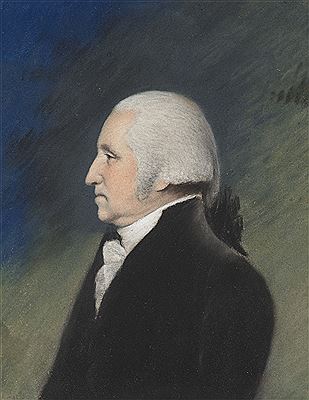
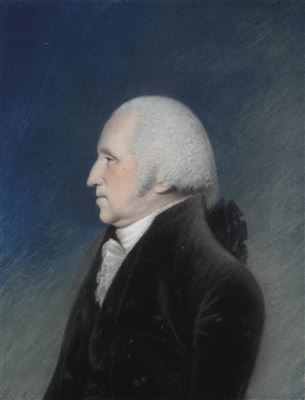
Sharples family members were specialists in pastel portraits of cabinet size, smaller than life, but larger than miniature. They were usually on thick gray paper, the wooly texture of which gives a soft, grainy appearance to the very sensitive draftsmanship. The likenesses are sometimes in the common three-quarter view, but many are in profile. The highlight of the their work was the often-replicated likeness of George Washington, done about 1796 or 1797.
The various members of the family worked so closely together that it is impossible to distinguish among their hands. Fine examples are usually assigned to James, Sr., but his wife, Ellen Sharples, was equally talented and, though she seems often to have copied her husband's pictures, she undoubtedly created original examples as well.
There is a large collection of their work in Bristol, England. James Sharples died in 1811.
Sources:
Matthew Baigell, Dictionary of American Artists
Peter Hastings Falk, Editor, Who Was Who in American ArtBiography from Adelaide Fine Art
JAMES SHARPLES, Sr.
James Sharples spent his early career in the English cities of Bath, Bristol, Liverpool, and London. He first exhibited at the Royal Academy in 1779, with one portrait of a lady and one portrait of two gentlemen, and would exhibit twelve more portraits over 1782, 1783, and 1785. Sharples exhibited in both oil and pastel, and notably exhibited one pastel portrait of the Duke of Northumberland.
Twice a widower by 1788, Sharples remarried in 1789 to Ellen Wallace (1769-1849), a strong-willed pupil of his who later trained herself to paint miniatures. In his three marriages, Sharples begat four children, all of whom practiced portraiture professionally, and three of whom participated as assistants in their father's practice. Together, the Sharples produced hundreds of works, many of which are housed at the Bristol City Museum and Art Gallery.Sharples is best known in America for his work from 1794-1801, in which he and his family toured the United States, seeking to capitalize on nationalist zeal. With assistance from his wife and children, Sharples produced a large body of portraiture depicting renowned figures of the Federal era. Ellen Sharples later wrote of her experience in America, "There certainly is no country where talents and useful accomplishments are more appreciated nor none where greater hospitality or kindness can be shown to strangers."
When financial concerns returned the Sharples to Bath, Sharples resumed his business in Bristol, where an advertisement appeared in 1801 soliciting "the nobility and gentry of Bristol." The margins were slimmer in England, however, and Sharples began planning his return to the United States within just a few years. Sharples' sons Felix and James Jr. crossed first in 1806, followed by their father, mother, and sister in 1809. Unfortunately, Sharples fell ill in 1810, and after a prolonged illness died in 1811. Following his final wishes, Ellen, James Jr., and Rolinda returned to England after his death. But his second son Felix, then aged twenty-five, remained in the United States where he had developed an independently thriving business. Sharples bequeathed his land in Pennsylvania to Felix—knowing of his son's affinity for the United States—and, on her return, Ellen left Felix with most of the family's portraits of distinguished Americans.
Felix removed to Virginia, where he carried on his father's trade as a portraitist to southern gentlemen. This is potentially the same or the basis for the Portrait of the Duke of Northumberland, waist length, in profile to the left, wearing the Order of Garter, pastel, Christie's London: April 09, 1991, lot 48, Bought in against $500/700 GBP.2 Waggoner (2001), p.13 Waggoner (2001), p. 84 Waggoner (2001), p. 14; Due to concerns for his finances and safety, Sharples delayed his voyage for three years, remaining in Bristol with Ellen and Rolinda. During this period, Ellen exhibited at the Royal Academy for the first and only time, displaying five miniature portraits.5 Waggoner (2001), p. 15 James Sharples (1751/2-1811) in America From 1796 to 1801, James Sharples produced a large body of portraiture depicting prominent American revolutionaries, including Aaron Burr, Alexander Hamilton, George Washington, James Madison, and John Adams. Emigrating from Bath, Sharples arrived in New York and immediately set to work in 1796.
He primarily worked in pastel on paper, as the medium allowed him flexibility in travel and reproduction. With sharp acumen, Sharples marketed his works competitively at $15 per profile and $20 per full-face view [Waggoner 6-7]. In doing so, he managed to wrestle commissions away from similar portraitists in the region, such as Charles Balthazar Julien Févret de Saint-Mémin, James Peale, and Edward Greene Malbone [Waggoner 7]. Sharples concentrated his business in New York and Philadelphia, but traveled throughout the United States with letters of introduction. In 1801, however, financial troubles in Bath forced Sharples to abandon his successful enterprise and return to England [Metz 4]. Despite his short stay, Sharples impressed New York society greatly enough to merit an entry in William Dunlap's The History of the Rise and Progress in the United States (1834), which concludes: "Sharples was a plain, well-disposed man, and accumulated property by honest industry, and uncommon facility with his materials." Examples of Sharples' American work are housed in the Second Bank of the United States Portrait Galleries, The Metropolitan Museum of Art, the New York Historical Society, and the Museum of Fine Arts, Boston, among others.Waggoner, Diane. "The Sharples Family and Legal Papers: 1794-1854" (Bristol: Bristol Central Library and Record Office, 2001).Metz, Kathryn. "Ellen and Rolinda Sharples, mother and daughter painters", Women's Art Journal, XVI (1995), pp. 3-11.
Source: Adelaide Fine Art
Submitted by: Ann Marenakos