Page loaded successfully. Showing biography for Jamini Roy.
Jamini Roy BIOGRAPHY
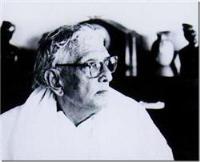
1887 Chhandar, India - 1972 Calcutta, India. Known for: Folk art painting of India.
Jamini Roy was born in 1887 into a middle-class family of land-owners at a small village called Chhandar in the District of Bankura in Bengal . When he was sixteen he was sent to study at the... Read full biography
Jamini Roy was born in 1887 into a middle-class family of land-owners at a small village called Chhandar in the District of Bankura in Bengal . When he was sixteen he was sent to study at the Government School of Art in Calcutta. He was taught to paint in the prevailing academic tradition drawing... Read full biography
Jamini Roy was born in 1887 into a middle-class family of land-owners at a small village called Chhandar in the District of Bankura in Bengal . When he was sixteen he was sent to study at the Government School of Art in Calcutta. He was taught to paint in the prevailing academic tradition drawing Classical nudes and painting in oils and in 1908 he received his Diploma in Fine Art. However, he soon realised that he needed to draw inspiration, not from Western traditions, but from his own... Read full biography
Jamini Roy was born in 1887 into a middle-class family of land-owners at a small village called Chhandar in the District of Bankura in Bengal . When he was sixteen he was sent to study at the Government School of Art in Calcutta. He was taught to paint in the prevailing academic tradition drawing Classical nudes and painting in oils and in 1908 he received his Diploma in Fine Art. However, he soon realised that he needed to draw inspiration, not from Western traditions, but from his own culture, and so he looked to the living folk and tribal art for inspiration. He was most influenced by the Kalighat Pat, with its bold sweeping brush-strokes. He moved away from his earlier impressionist landscapes and portraits and between 1921 and 1924... Read full biography
Jamini Roy was born in 1887 into a middle-class family of land-owners at a small village called Chhandar in the District of Bankura in Bengal . When he was sixteen he was sent to study at the Government School of Art in Calcutta. He was taught to paint in the prevailing academic tradition drawing Classical nudes and painting in oils and in 1908 he received his Diploma in Fine Art. However, he soon realised that he needed to draw inspiration, not from Western traditions, but from his own culture, and so he looked to the living folk and tribal art for inspiration. He was most influenced by the Kalighat Pat, with its bold sweeping brush-strokes. He moved away from his earlier impressionist landscapes and portraits and between 1921 and 1924 began his first period of experimentation with the Santhal dance as his starting point. His new style was bot... Read full biography
Artist Biography
Biography page for Jamini Roy ((1887 - 1972)), known for Folk art painting of India. Showing 3 biographical entries and 0 sample artworks.
Jamini Roy - Artist Info
About Jamini Roy
Name variants
Roy Jamini
Biography from the Archives of askART
 Jamini Roy was born in 1887 into a middle-class family of land-owners at a small village called Chhandar in the District of Bankura in Bengal .
When he was sixteen he was sent to study at the Government School of Art in Calcutta. He was taught to paint in the prevailing academic tradition drawing Classical nudes and painting in oils and in 1908 he received his Diploma in Fine Art.
However, he soon realised that he needed to draw inspiration, not from Western traditions, but from his own culture, and so he looked to the living folk and tribal art for inspiration. He was most influenced by the Kalighat Pat, with its bold sweeping brush-strokes. He moved away from his earlier impressionist landscapes and portraits and between 1921 and 1924 began his first period of experimentation with the Santhal dance as his starting point.
His new style was both a reaction against the Bengal School and the Western tradition. His underlying quest was threefold to capture the essence of simplicity embodied in the life of the folk people; to make art accessible to a wider section of people; and to give Indian art its own identity. He was awarded the Padma Bhusan in 1955. His work has been exhibited extensively in international exhibitions and can be found in many private and public collections such as the Victoria and Albert Museum, London. He spent most of his life living and working in Calcutta. Initially he experimented with Kalighat paintings but found that it has ceased to be strictly "patua" and went to learn from village patuas. Consequently his techniques as well as subject matter was influenced by traditional art of Bengal. He preferred himself to be called a patua. Jamini Roy died in 1972 .
In 1934, he received a Viceroy's gold medal in an all India exhibition for one of his work. In 1954 he was awarded the Padma Bhushan by the Government of India.
CRITICAL VIEWS
In 1929 while inaugurating Roy's exhibition sponsored by Mukul Dey at Calcutta, the then Statesman Editor Sir Alfred Watson said: "....Those who study the various pictures will be able to trace the development of the mind of an artist constantly seeking his own mode of expression. His earlier work done under purely Western influence and consisting largely of small copies of larger works must be regarded as the exercises of one learning to use the tools of his craft competently and never quite at ease with his models. From this phase we see him gradually breaking away to a style of his own, moulded by many influences, but ultimately resulting in a treatment of mass and line which is almost Egyptian in its outlook. There is a primitive force, perhaps yet not quite sure of itself, but consciously striving to break into individual expression.
You must judge for yourselves how far Mr. Roy has been able to achieve the ends at which he is obviously aiming. His work will repay study. I see in it as I see in much of the painting in India today a real endeavour to recover a national art that shall be free from the sophisticated tradition of other countries, which have had a continuous art history. The work of those who are endeavouring to revive Indian art is commonly not appreciated in its true significance. It is sometimes assumed that revival means no more than a return to the methods and traditions of the past. That would be to create a school of copyists without visions and ideals of their own. From the point of view of art it would be a wholly worthless endeavour — a thing of no significance. Art to deserve the name must be living and expanding. Upon the minds of its exponents must be beating the illumination of all the ages. Whatever direction Indian art may take in the future it cannot, if it is to have value, go wholly back to the past any more than it can become merely imitative of the Western outlook. It must have a vision of its own. All Indian art today is in the stage of experiment. Its exponents are seeking some firm ground on which they can stand, and they are seeking it by numerous paths. It is that fact which makes the present period so intensely interesting to the student of art. Failures there must be, but any day may emerge the man who is to set Indian art on the road of high accomplishment.
....Art in any form cannot progress without encouragement. The artist must live and he must live by the sale of his work. In India as elsewhere the days when the churches and the princes were the patrons of art have passed. Encouragement today must come from a wider circle. I would say to those who have money to spare buy Indian art with courage. You may obtain some things of little worth; you may, on the other hand, acquire cheaply something that is destined to have great value. What does it matter whether you make mistakes or not. By encouraging those who are striving to give in line and colour a fresh expression to Indian thought you are helping forward a movement that we all hope is destined to add a fresh lustre to the country."
Source:
"Jamini Roy", Wikipedia:Biography from the Archives of askART
 Born in 1887 into a middle-class family of land-owners at a small village called Chhandar in the District of Bankura in Bengal, Jamini Roy studied at the Government School of Art in Calcutta. He learned painting in the Western tradition and found first acclaim as a portrait painter in the European style. Going forward, he cultivated a personal painting style inspired largely by traditional Indian folk and village arts, particularly those of his native Bengal.
His work captures the essence of simplicity in the life of the Indian people, making it more accessible to a wider section of the population and giving Indian Art its own identity. Roy spent most of his life living and working in Calcutta and was awarded the Padma Bhusan in 1955 by the Government of India. His work has been exhibited in international exhibitions and is held in public and private collections including the Victoria and Albert Museum in London, England.
Jamini Roy died in Calcutta in 1972.
Source:
AskART filesBiography from Saffronart
Born in 1887 in a small village in Beliatore, Bankura district, West Bengal, Jamini Roy joined the Government School of Art, Kolkata in 1903. He began his career by painting in the Post-Impressionist genre of landscapes and portraits, very much in keeping with his training in a British academic system.
Yet, by 1925, Roy had begun experimenting along the lines of popular bazaar paintings sold outside the Kalighat temple in Kolkata. By the early 1930s, Roy made a complete switch to indigenous materials to paint on woven mats, cloth and wood coated with lime. The inspiration for painting on woven mats was the textures he found in Byzantine art, which he had seen in color photographs.
It occurred to him that painting on a woven mat might make for an interesting mosaic-like surface. The Santhals, a tribal people who live in the rural districts of Bengal, were an important subject for Roy. A series of works done a decade before World War II is a very good example of how he captured the qualities that are a part of native folk painting and recombined them with those of his own. He fused the minimal brush strokes of the Kalighat style with elements of tribal art from Bengal (like that of the terracotta work found in the Bishnupur temple in Bengal, where terracotta was often composed into decorative units - some elaborate in design - over portals and across exterior walls of the temples).
Roy's rejection of the then modern style of painting and his foray into the realm of Bengali folk paintings marked a new beginning in the history of Indian modern art. The mother and child, Radha, and animals were painted in simple two-dimensional forms, with flat color application and an emphasis on the lines. The main subjects were often enclosed within decorative borders with motifs in the background.
The figure of the Christ was also a subject that Roy often painted. Roy held several one-man exhibitions and numerous group shows. His works can be found in several private and public collections, institutions and museums all over the world, including the Lalit Kala Academy in Delhi and museums in Germany and the United States of America. He was honored with the Padma Bhushan in 1955. Jamini Roy died on 24th April 1972 in Kolkata, where he had lived all his life.