Page loaded successfully. Showing biography for Jan Lebenstein.
Jan Lebenstein BIOGRAPHY
1930 Brest Litovsk, Poland - 1999 Krakow, Poland. Known for: Painting and sculpture.
A painter from Poland, Jan Lebenstein was born in 1930 in Brest Litovsk and died in 2000 in Krakow. He studied painting at Warsaw's Academy of Fine Arts (1948-54) under Artur Nacht-Samborski. He... Read full biography
A painter from Poland, Jan Lebenstein was born in 1930 in Brest Litovsk and died in 2000 in Krakow. He studied painting at Warsaw's Academy of Fine Arts (1948-54) under Artur Nacht-Samborski. He debuted in the period that preceded the post-1956 "thaw", during the "Against War, Against Fascism"... Read full biography
A painter from Poland, Jan Lebenstein was born in 1930 in Brest Litovsk and died in 2000 in Krakow. He studied painting at Warsaw's Academy of Fine Arts (1948-54) under Artur Nacht-Samborski. He debuted in the period that preceded the post-1956 "thaw", during the "Against War, Against Fascism" Polish National Exhibition of Young Visual Arts at Warsaw's Arsenal (1955), showing a series of modest, nostalgic landscapes depicting the lackluster suburbs of Warsaw (Stary Rembertów / Old Rembertów,... Read full biography
A painter from Poland, Jan Lebenstein was born in 1930 in Brest Litovsk and died in 2000 in Krakow. He studied painting at Warsaw's Academy of Fine Arts (1948-54) under Artur Nacht-Samborski. He debuted in the period that preceded the post-1956 "thaw", during the "Against War, Against Fascism" Polish National Exhibition of Young Visual Arts at Warsaw's Arsenal (1955), showing a series of modest, nostalgic landscapes depicting the lackluster suburbs of Warsaw (Stary Rembertów / Old Rembertów, 1955). Both their subject (everyday reality) and their language reflected the artist's fascination with the art of Utrillo. Within Poland, however, they constituted a distinct, independent creative style. Recognizing this, the exhibition jury awarded... Read full biography
A painter from Poland, Jan Lebenstein was born in 1930 in Brest Litovsk and died in 2000 in Krakow. He studied painting at Warsaw's Academy of Fine Arts (1948-54) under Artur Nacht-Samborski. He debuted in the period that preceded the post-1956 "thaw", during the "Against War, Against Fascism" Polish National Exhibition of Young Visual Arts at Warsaw's Arsenal (1955), showing a series of modest, nostalgic landscapes depicting the lackluster suburbs of Warsaw (Stary Rembertów / Old Rembertów, 1955). Both their subject (everyday reality) and their language reflected the artist's fascination with the art of Utrillo. Within Poland, however, they constituted a distinct, independent creative style. Recognizing this, the exhibition jury awarded the artist a prize. At this same the artist also created a series of largely unknown and uncomplicated gouaches of modest interiors (S... Read full biography
Artist Biography
Biography page for Jan Lebenstein ((1930 - 1999)), known for Painting and sculpture. Showing 3 biographical entries and 0 sample artworks.
Jan Lebenstein - Artist Info
About Jan Lebenstein
Name variants
Jan Lebens
Biography from the Archives of askART
 A painter from Poland, Jan Lebenstein was born in 1930 in Brest Litovsk and died in 2000 in Krakow. He studied painting at Warsaw's Academy of Fine Arts (1948-54) under Artur Nacht-Samborski. He debuted in the period that preceded the post-1956 "thaw", during the "Against War, Against Fascism" Polish National Exhibition of Young Visual Arts at Warsaw's Arsenal (1955), showing a series of modest, nostalgic landscapes depicting the lackluster suburbs of Warsaw (Stary Rembertów / Old Rembertów, 1955).
Both their subject (everyday reality) and their language reflected the artist's fascination with the art of Utrillo. Within Poland, however, they constituted a distinct, independent creative style. Recognizing this, the exhibition jury awarded the artist a prize.
At this same the artist also created a series of largely unknown and uncomplicated gouaches of modest interiors (Skrzypek / The Fiddler, c. 1955). The simplified, symbol-like human figures inhabiting them announced the artist's future tendency towards deformation.
In 1956 Lebenstein linked up with the independent, alternative (as we would say today) Teatr na Tarczynskiej / Tarczynska Street Theatre, run by writer Miron Bialoszewski in his Warsaw apartment. The group was more a circle of friends than a drama troupe in the real sense of the term. Core members included the poet and his friends, above all Ludmila Murawska and Ludwik Hering.
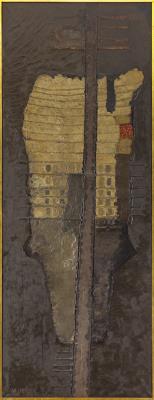
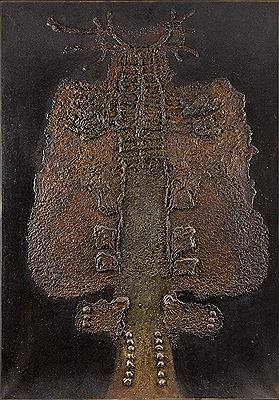
Lebenstein had his first solo exhibition on Tarczynska, for which he created his Figury kreslone / Drafted Figures, which were followed by Figury hieratyczne / Hieratic Figures and finally by his Figury osiowe / Axial Figures. These compositions (drawn and painted) depicted vertically oriented, highly simplified human figures. The figures were centrally located on the canvas, most often female, and in the drawings resembled insect-like creatures (Figure dans un interieur, 1956).
His precise, detailed, even "anatomical" drawings shared something with the art of Wols, while their pictorial values (the near autonomy he granted to material, the richness of tones in his usually narrow and seemingly unimpressive color range) placed them on par with works created at the same time by Polish artists Zbigniew Tymoszewski and Rajmund Ziemski.
The originality of this highly personal figural art formula saturated with existential fears drew the recognition of French critics, who awarded Lebenstein the Grand Prix at the First International Biennale of Young Artists in Paris in 1959. The painter immediately settled in France, though he would remain on the sidelines of the Parisian artistic melting pot.
He developed a stronger link to the Polish émigré community (those at the Paris-based Instytut Literacki / Literary Institute and "Kultura" / "Culture" magazine, as well as the editors and writers of "Zeszyty Literackie" / "Literary Notebooks") than to the European or global art worlds, though his work interested such influential authors as Jean Cassou, Raymond Cogniat, Mary McCarthy, and Michel Ragon. In spite of his success, Lebenstein always felt he was an artist apart and independent. Neither did this change in 1971, when Lebenstein accepted French citizenship after residing in the country for many years
The artist's imagination was most strongly inspired by the great texts of world culture. He believed that the road to modernity lead through a processing of tradition. As he himself said, the cellars of the Louvre, filled with relics of the ancient Sumerian and Babylonian civilizations, fascinated him. He was stimulated by the mythologies of ancient civilizations like Assyria, Babylon, Egypt, and Greece, as he was by the Bible. This was the impulse for consistent production of works reflecting an apocalyptic vision of the world.
His own Zoology Lesson - a personal myth about the derivation and animalistic nature of humans (Leçon de zoologie, 1972) - occupied a central place in his art. In particular, Lebenstein emphasized the biological and physiological foundations of human sensuality. A reader of cultural archetypes, he focused mainly on erotic aspects and themes (reflected in the motifs of the Great Mother and the Great Vamp) and on the concept of Thanatos, manifested in the "Isle of the Dead" motif (Lebenstein dedicated his exhibition at the Théatre National de l'Odéon in Paris to, among others, Arnold Böcklin, creator of a well-known painting of the same title).
He caricatured "human fauna", creating strange creatures barely recognizable as being of "human derivation" (Carnet intime series, 1960-65). These pre-evolutionary representatives of archaic tribes were evidently subject to the pressures of untamed desires and appeared above all in Lebenstein's work after 1960 (Bottom I, Inassouvissement, both 1969).
At around the same time he created a series of paintings that portrayed "prehistoric" animals (Créatures abominables series, 1960-65) and imagined "vertebrates" (Deux vertébrés, 1966). This rich, baroque bestiary served as a bank of models from which he drew direct inspiration for subsequent works. Carefully and arduously formed, his compositions of this time seem almost sculpted in wrinkled, dough-like layers of paint, and radiant with an exceptional richness of subtle pictorial effects.
Lebenstein would soon abandon this extraordinary noble material in favor of a stylization that also characterized his gouaches and temperas of the 1970s and 80s (between 1976 and 1989 the painter used no oils). These are distinguished above all by fine, often manneristic, curving lines (Animals' Sweety Bar, 1976; Asile, 1989). The works, no longer possessing the textures of his earlier oil paintings, are worthy of note for their unsettled atmosphere and tension inherent in complicated, erotic "dangerous liaisons".
In contrast to many 20th century artists, who shied away from narration in their paintings, drawings, and prints, Lebenstein not only tended towards anecdote, but was also an illustrator of literary works. His achievements in this sphere include a series of outstanding illustrations - to George Orwell's Animal Farm"(1974), the Book of Job"(1979), the Apocalypse (1983), and the Book of Genesis (1995). The artist also produced illustrations for a number of short stories by his friend Gustaw Herling-Grudzinski. Furthermore, Lebenstein designed a stained-glass window with scenes of the Apocalypse for a Palotine chapel in Paris (1970) and dabbled in scenery design.
Before 1981 the artist had only one exhibition in Poland (1977), subsequent to which he donated a large selection of works to the National Museum in Wroclaw. During Martial Law his works were presented at exhibitions organized under the independent cultural movement, primarily with the support of the Catholic Church.
In 1976 Lebenstein was granted an award by the New York-based Alfred Jurzykowski Foundation, and in 1987 he received the independent Jan Cybis Prize. He had to wait another eleven years to experience official Polish state recognition, receiving the Great Cross and Star of the Order of the Restoration of Poland from the President of Poland and an official state prize from the Minister of Culture and Art.
The largest official exhibition of Lebenstein's oeuvre in Poland (a retrospective) was held in 1992, very late in the artist's career, at Warsaw's Zacheta Gallery; extensive information about his oeuvre is contained in the catalogue to that exhibit. The artist's creative path and achievements were finally summed up in an exhibition titled "Etapy / Stages", presented in Paris and a number of Polish cities in the year preceding the painter's death.
Written by Malgorzata Kitowska-Lysiak, Art History Institute of the Catholic University of Lublin, Faculty of Art Theory and the History of Artistic Doctrines, December 2001.
Source:
"Jan Lebenstein," CULTURE PL, Web, Sep. 2017Biography from Dom Aukcyjny Ostoya
Jan Lebenstein was a Polish artist who studied at the Academy of Fine Arts in Warsaw (1948-54) with Artur Nacht-Samborski. He made his debut in the period preceding the thaw during the National Exhibition of Young Fine Arts Against War, Against Fascism at the Warsaw Arsenal (1955).
In 1959, he received the Grand Prix at the 1st International Youth Biennial in Paris and settled permanently in France. Lebenstein drew topics from ancient literature, mythology, and the Bible, and studied cultural archetypes and transformed them into paintings. He also created a series devoted to the images of prehistoric animals.
Lebenstein was associated with the Parisian Kultura community, where he illustrated stories by G. Herling-Grudzinski published there. Additionally, he illustrated Animal Farm by G. Orwell, published by the Literary Institute, and designed a stained glass window with scenes from the Apocalypse in the Pallottine chapel in Paris.
In 1976, Lebenstein received the Foundation Award. A. Jurzykowski from New York, and in 1987, he received the independent award. J. Cybis.Biography from Agra Art S.A.
Jan Lebenstein (Brest Litewski 1930 - Krakow 1999) in the years 1948-1954 he studied painting at the Academy of Fine Arts in Warsaw under the supervision of prof. Eugeniusz Eibisch and Artur Nacht-Samborski.
In 1955 he took part in an exhibition at the Warsaw Arsenal. A friend of Miron Bialoszewski during his studies, he showed his first individual exhibition in 1956 at the Teatr na Tarczynska. In 1959 he won the Grand Prix de la Ville de Paris at the 1st Youth Biennale in Paris and this year he moved to Paris for good. After a series of "drawn figures" (on graph paper) and "hieratic figures" from 1955-1958, he paints a series of "axis figures" (1958-1962), which he exhibits in Paris and the USA.
Simultaneously, in 1960, he began to draw "passes", a kind of journal that would provide the motifs used in the paintings in the future. In the years 1964-1965 he paints " Award of the Museum of the Archdiocese of Warsaw in 1985, Jan Cybis in 1987.