Page loaded successfully. Showing biography for Jan Adam Zandleven.
Jan Adam Zandleven BIOGRAPHY
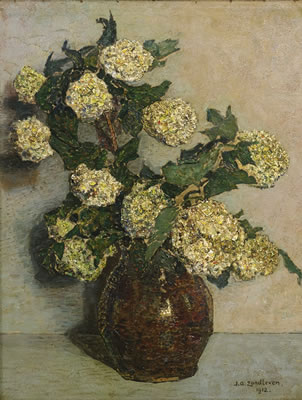
1868 - 1953. Known for: Landscape and still-life painting, writing.
Jan Adam Zandleven (6 February 1868– 16 July 1923) was a Dutch painter, mostly of landscapes and still-lifes. He was the son of a paint manufacturer and merchant. Although he always wanted to be an... Read full biography
Jan Adam Zandleven (6 February 1868– 16 July 1923) was a Dutch painter, mostly of landscapes and still-lifes. He was the son of a paint manufacturer and merchant. Although he always wanted to be an artist, he never took formal lessons and worked for his father's company until 1901, when some of his... Read full biography
Jan Adam Zandleven (6 February 1868– 16 July 1923) was a Dutch painter, mostly of landscapes and still-lifes. He was the son of a paint manufacturer and merchant. Although he always wanted to be an artist, he never took formal lessons and worked for his father's company until 1901, when some of his works received positive reviews from Paul Gabriël and Jozef Israëls. Despite continuing opposition from his father, he chose to become a painter and made the acquaintance of the art dealer, Henk... Read full biography
Jan Adam Zandleven (6 February 1868– 16 July 1923) was a Dutch painter, mostly of landscapes and still-lifes. He was the son of a paint manufacturer and merchant. Although he always wanted to be an artist, he never took formal lessons and worked for his father's company until 1901, when some of his works received positive reviews from Paul Gabriël and Jozef Israëls. Despite continuing opposition from his father, he chose to become a painter and made the acquaintance of the art dealer, Henk Bremmer, who gave him advice and financial support, as well as introducing him to the art collector, Helene Kröller-Müller, who became a major patron. In 1904, he and his wife settled in Gorssel, lived briefly in Hengelo, then moved to Putten, near the... Read full biography
Jan Adam Zandleven (6 February 1868– 16 July 1923) was a Dutch painter, mostly of landscapes and still-lifes. He was the son of a paint manufacturer and merchant. Although he always wanted to be an artist, he never took formal lessons and worked for his father's company until 1901, when some of his works received positive reviews from Paul Gabriël and Jozef Israëls. Despite continuing opposition from his father, he chose to become a painter and made the acquaintance of the art dealer, Henk Bremmer, who gave him advice and financial support, as well as introducing him to the art collector, Helene Kröller-Müller, who became a major patron. In 1904, he and his wife settled in Gorssel, lived briefly in Hengelo, then moved to Putten, near the Veluwe in 1912, where he spent much of his time painting in the woods; sometimes accompanied by his friend, the still-life painter Jan C... Read full biography
Artist Biography
Biography page for Jan Adam Zandleven ((1868 - 1953)), known for Landscape and still-life painting, writing. Showing 1 biographical entries and 0 sample artworks.
Jan Adam Zandleven - Artist Info
About Jan Adam Zandleven
Biography from Davis Brothers Auction
Jan Adam Zandleven (6 February 1868– 16 July 1923) was a Dutch painter, mostly of landscapes and still-lifes. He was the son of a paint manufacturer and merchant. Although he always wanted to be an artist, he never took formal lessons and worked for his father's company until 1901, when some of his works received positive reviews from Paul Gabriël and Jozef Israëls.
Despite continuing opposition from his father, he chose to become a painter and made the acquaintance of the art dealer, Henk Bremmer, who gave him advice and financial support, as well as introducing him to the art collector, Helene Kröller-Müller, who became a major patron.
In 1904, he and his wife settled in Gorssel, lived briefly in Hengelo, then moved to Putten, near the Veluwe in 1912, where he spent much of his time painting in the woods; sometimes accompanied by his friend, the still-life painter Jan Carbaat (1866–1924).
A deeply religious man, this painting would often produce a state akin to meditation and the degree of his concentration is clearly visible in his attention to small details. The influence of Impressionism is obvious, but his technique was more closely related to Pointillism.
Between 1916 and 1922, he exhibited regularly at the "Kunsthandel Gerbrands" in Utrecht. After 1918, he lived in Rhenen, where he died. Major retrospectives have been held at the Stedelijk Museum in 1929 and, more recently, at the Museum Flehite in 2012.