Page loaded successfully. Showing biography for Jean-Philippe Dallaire.
Jean-Philippe Dallaire BIOGRAPHY
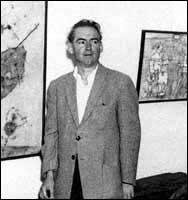
1916 Hull, Quebec, Canada - 1965 Vence, France. Known for: Painting, graphics, murals, illustration, design, teaching.
Jean-Philippe Dallaire was a painter, graphic artist, muralist, illustrator, tapestry designer and educator. He was born in Hull, Quebec, Canada. He lived in Paris, France (1938-1945); Québec City... Read full biography
Jean-Philippe Dallaire was a painter, graphic artist, muralist, illustrator, tapestry designer and educator. He was born in Hull, Quebec, Canada. He lived in Paris, France (1938-1945); Québec City (1946 -1952); Ottawa, Ontario (1952 -1957); Montreal, Quebec (1957-1959) and Vence, France (1) (1959 -... Read full biography
Jean-Philippe Dallaire was a painter, graphic artist, muralist, illustrator, tapestry designer and educator. He was born in Hull, Quebec, Canada. He lived in Paris, France (1938-1945); Québec City (1946 -1952); Ottawa, Ontario (1952 -1957); Montreal, Quebec (1957-1959) and Vence, France (1) (1959 - 1965) where he died. His mediums were oil, watercolor, gouache, charcoal, crayon, pencil and mixed mediums. His subjects were figures, portraits, humor, fantasy, folklore, mythology, dreams, still... Read full biography
Jean-Philippe Dallaire was a painter, graphic artist, muralist, illustrator, tapestry designer and educator. He was born in Hull, Quebec, Canada. He lived in Paris, France (1938-1945); Québec City (1946 -1952); Ottawa, Ontario (1952 -1957); Montreal, Quebec (1957-1959) and Vence, France (1) (1959 - 1965) where he died. His mediums were oil, watercolor, gouache, charcoal, crayon, pencil and mixed mediums. His subjects were figures, portraits, humor, fantasy, folklore, mythology, dreams, still life, genre, shape, color and texture. His styles were Realism, Surrealism, Cubism and Abstraction. His work is identified by its meticulous craftsmanship, painstaking attention to details, vivid colors, draftsmanship, flattened planes and... Read full biography
Jean-Philippe Dallaire was a painter, graphic artist, muralist, illustrator, tapestry designer and educator. He was born in Hull, Quebec, Canada. He lived in Paris, France (1938-1945); Québec City (1946 -1952); Ottawa, Ontario (1952 -1957); Montreal, Quebec (1957-1959) and Vence, France (1) (1959 - 1965) where he died. His mediums were oil, watercolor, gouache, charcoal, crayon, pencil and mixed mediums. His subjects were figures, portraits, humor, fantasy, folklore, mythology, dreams, still life, genre, shape, color and texture. His styles were Realism, Surrealism, Cubism and Abstraction. His work is identified by its meticulous craftsmanship, painstaking attention to details, vivid colors, draftsmanship, flattened planes and decorativeness. His Surrealist work appears to derive from Art Brut (see AskART glossary) and bears a resem... Read full biography
Artist Biography
Biography page for Jean-Philippe Dallaire ((1916 - 1965)), known for Painting, graphics, murals, illustration, design, teaching. Showing 2 biographical entries and 0 sample artworks.
Jean-Philippe Dallaire - Artist Info
About Jean-Philippe Dallaire
Name variants
Jean-Phillippe Daillaire, Jean-Phillipe Dalliare
Biography from the Archives of askART
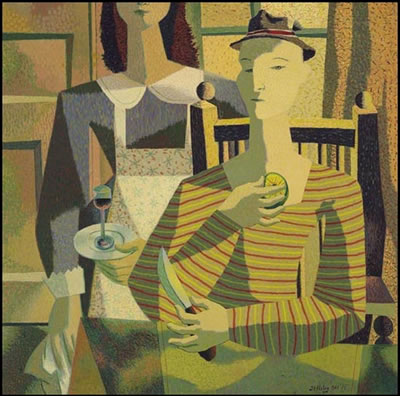 Jean-Philippe Dallaire was a painter, graphic artist, muralist, illustrator, tapestry designer and educator. He was born in Hull, Quebec, Canada. He lived in Paris, France (1938-1945); Québec City (1946 -1952); Ottawa, Ontario (1952 -1957); Montreal, Quebec (1957-1959) and Vence, France (1) (1959 - 1965) where he died.
His mediums were oil, watercolor, gouache, charcoal, crayon, pencil and mixed mediums. His subjects were figures, portraits, humor, fantasy, folklore, mythology, dreams, still life, genre, shape, color and texture. His styles were Realism, Surrealism, Cubism and Abstraction. His work is identified by its meticulous craftsmanship, painstaking attention to details, vivid colors, draftsmanship, flattened planes and decorativeness. His Surrealist work appears to derive from Art Brut (see AskART glossary) and bears a resemblance to the figurative work of Paul Klee, Jean Dubuffet, and to his stated influences Alfred Pellan and Picasso (see all in AskART).
Quotes:
"I work according to my intuition and whim, ...As it is in Surrealism, it is the subconscious that I express, and that is made explicit through form and color in the painting." and "One could say that I do not take life seriously. I always had a fondness for birds, little flags and the texture of fabrics. Perhaps it is a bit decorative, but so what." - Jean-Philippe Dallaire .
While Dallaire is often considered a largely self taught artist he has attended numerous art schools and studied under some prominent artists. He studied with Charles Goldhamer (see AskART), Peter Haworth (see AskART), Robert Ross (1902-1984), and Elisabeth Wyn Wood (see AskART) at Central Technical School, Toronto (1935); with Charles Maillard (1887-1971) and Felix Charpentier (see AskART) at the Ecole des Beaux-Arts, Montreal (1938); with Maurice Denis and Georges Desvallieres (see both in AskART) at Ateliers d'Art Sacre in Paris (1938); with Andre Lhote (see AskART) also in Paris (1938 -1940); and tapestry design with Jean Lurcat (2) (see AskART) at Aubusson, France, (summer 1949).
His career as an educator involved teaching painting at the École des Beaux-Arts in Québec City (1946-1952)(3). He also worked for the National Film Board in Ottawa, Ontario (1952-1957), where he illustrated short animated educational films.
During World War II Dallaire, as a Canadian citizen, and thus an enemy civilian, was interned by the Nazis (1940) in the Saint Denis (Paris suburb) "Ilag" were he remained until the camp was liberated by the United States Army in August 1944. While at the camp, which had a library, sports activities and a theatre, he continued to paint and studied Italian.
Dallaire exhibited with the Montreal Museum of Fine Arts from 1953 to 1961. His works were also included in the National Gallery of Canada (Ottawa) exhibition titled "300 Years of Canadian Art" (1967). He had solo exhibitions at the University of Montreal (1947), Dominion Gallery, Montreal (1954) and Robertson Galleries, Ottawa (c.1955). In 1968 a retrospective exhibition of his work was held at the Montreal Museum of Modern Art and the Museum of Quebec (Quebec City).
His work is avidly collected. It is also in numerous museums including the Art Gallery of Ontario (Toronto), the Museum of Quebec, Musée d'art de Joliette (Quebec City), the Agnes Etherington Art Centre (Kingston,Ontario) and the Art Gallery of Greater Victoria (B.C.) There are 12 paintings of his in the collection of the National Gallery of Canada (Ottawa). He also created murals for the Dominican monasteries in Ottawa, Ontario and Fall River, Massachusetts; and a tapestry wall hanging for the Queen Elizabeth Hotel (Montreal).
He is listed in A Dictionary of Canadian Artists (1974), by Colin S. MacDonald; in The Collector's Dictionary of Canadian Artists at Auction (2001), by Anthony R. Westbridge and Diana L. Bodnar; in The Canadian Encyclopedia (1985), Hurtig Publishers; in Art and Architecture in Canada (1991), by Loren R. Lerner and Mary F. Williamson; and in The Dictionary of Art (1996), edited by Jane Turner.
Footnotes:
(1) Vence is a town within 20 miles of Cannes, Nice and Monaco on the French Riviera.
(2) Lurcat was a surrealist and cubist painter who was responsible for the modern revival of French tapestry design at Aubusson where French rug making dates back to 1665. His influence on Dallaire's art is very evident.
(3) Jean-Paul Lemieux (see AskART) was also teacher there, from 1937 until retirement 1965.
Prepared and contributed to askART by M.D. SilverbrookeBiography from Waddington's
Jean-Philippe Dallaire (1916-1965) began drawing at the age of 11, and early years studying in art colleges in Toronto and Quebec led to an extended period in Paris. Here, he was introduced to the works of Miró, Picasso, and others, as well as meeting fellow Québécois artist Alfred Pellan; through these, he was exposed to Cubism and Surrealism.
In contrast to the often impersonal qualities of these modern styles, Dallaire’s works are highly personal, tempered by a sensible working-class background and enlivened by an air of festivity. Dallaire used the strategies of abstraction to feel liberated in his work: transforming highly schematized forms into rich and animated representations.
Two violoncellist works demonstrate his skill in bridging the gap between painting and drawing, as well as a pronounced interest in exploring the boundaries of abstraction while remaining rooted in whimsical representation. The Cubist influence is undeniable but not overbearing: it’s easy to see traces of Braque or Picasso in both subject and palette, while the work settles on a resoundingly humanist centre. Fragments of arms and scalloped wood are evocatively brought to life with spontaneous and bright gestures. There is a sense that the scenes are collapsed on themselves: figure is fused to instrument, while the stage is flattened and bowed out, until the whole tableau seems to thrust forward. Bold calligraphic lines throughout the works bring a sense of spontaneous structure to the scenes, ably demonstrating Dallaire’s talent for draughtsmanship, humour, and caricature.