Page loaded successfully. Showing biography for Jean Lambert-Rucki.
Jean Lambert-Rucki BIOGRAPHY
1888 Poland - 1967 France. Known for: Abstract painting.
Jean Lambert-Rucki. 1888 - 1967. Lambert-Rucki was born in Cracow, Poland in 1888. He studied at the Fine Arts Academy of Cracow before he moved to Paris in 1911. He was mobilized in World War One,... Read full biography
Jean Lambert-Rucki. 1888 - 1967. Lambert-Rucki was born in Cracow, Poland in 1888. He studied at the Fine Arts Academy of Cracow before he moved to Paris in 1911. He was mobilized in World War One, after the war he settled in the Montparnasse district. He became a naturalized French citizen in... Read full biography
Jean Lambert-Rucki. 1888 - 1967. Lambert-Rucki was born in Cracow, Poland in 1888. He studied at the Fine Arts Academy of Cracow before he moved to Paris in 1911. He was mobilized in World War One, after the war he settled in the Montparnasse district. He became a naturalized French citizen in 1932. In Paris he associated with his friend, also born in Cracow, Poland Moise Kisling, along with Modigliani, Soutine, and the other artists of Montparnasse. Lambert-Rucki exhibited at the Salon... Read full biography
Jean Lambert-Rucki. 1888 - 1967. Lambert-Rucki was born in Cracow, Poland in 1888. He studied at the Fine Arts Academy of Cracow before he moved to Paris in 1911. He was mobilized in World War One, after the war he settled in the Montparnasse district. He became a naturalized French citizen in 1932. In Paris he associated with his friend, also born in Cracow, Poland Moise Kisling, along with Modigliani, Soutine, and the other artists of Montparnasse. Lambert-Rucki exhibited at the Salon d'Automne in 1919, he exhibited regularly at the Salon des Indépendants beginning in 1920, the Salon d'Automne and the Salon des Tuileries from 1933. He also showed with the Cubists at the Section d'Or group from 1922 to1924. He exhibited, from 1924, at the... Read full biography
Jean Lambert-Rucki. 1888 - 1967. Lambert-Rucki was born in Cracow, Poland in 1888. He studied at the Fine Arts Academy of Cracow before he moved to Paris in 1911. He was mobilized in World War One, after the war he settled in the Montparnasse district. He became a naturalized French citizen in 1932. In Paris he associated with his friend, also born in Cracow, Poland Moise Kisling, along with Modigliani, Soutine, and the other artists of Montparnasse. Lambert-Rucki exhibited at the Salon d'Automne in 1919, he exhibited regularly at the Salon des Indépendants beginning in 1920, the Salon d'Automne and the Salon des Tuileries from 1933. He also showed with the Cubists at the Section d'Or group from 1922 to1924. He exhibited, from 1924, at the gallery of Léonce Rosenberg, Galerie l'Effort Moderne. Lambert-Rucki had been friends with Leopold Survage before... Read full biography
Artist Biography
Biography page for Jean Lambert-Rucki ((1888 - 1967)), known for Abstract painting. Showing 3 biographical entries and 0 sample artworks.
Jean Lambert-Rucki - Artist Info
About Jean Lambert-Rucki
Name variants
Jean Lambert Rucci, Jean Lambert Rucki
Biography from Papillon Gallery
Jean Lambert-Rucki
1888 - 1967
Lambert-Rucki was born in Cracow, Poland in 1888. He studied at the Fine Arts Academy of Cracow before he moved to Paris in 1911. He was mobilized in World War One, after the war he settled in the Montparnasse district. He became a naturalized French citizen in 1932.
In Paris he associated with his friend, also born in Cracow, Poland Moise Kisling, along with Modigliani, Soutine, and the other artists of Montparnasse.
Lambert-Rucki exhibited at the Salon d'Automne in 1919, he exhibited regularly at the Salon des Indépendants beginning in 1920, the Salon d'Automne and the Salon des Tuileries from 1933. He also showed with the Cubists at the Section d'Or group from 1922 to1924. He exhibited, from 1924, at the gallery of Léonce Rosenberg, Galerie l'Effort Moderne.
Lambert-Rucki had been friends with Leopold Survage before the war, in about 1919 they met again. They both exhibited at Galerie l'Effort Moderne and the Section d'Or, the similarities in their paintings are striking. They both used a small shadowy figure in their paintings for many years. Many people have argued who was the first to do so, but like Picasso and Broque who painted works that were indistinguishable from each other's, it hardly matters.
In 1930 Lambert-Rucki was invited to participate in the first exhibition of l'Union des Artistes Modernes, where he continued to show his works in subsequent years.
Lambert-Rucki was represented in the Pavillon de l'Union des Artistes Moderne at l'Exposition Universalle in Paris in 1937, He executed many wall sculpture and masks. He also exhibited jewelry designs that were produced by master jeweler Jean Fouquet, and shown in the Pavillon de la Lumiére.
Lambert-Rucki was a sculptor and a painter; he achieved his greatest successes in his collaboration with furniture designer Jean Dunand where he met in 1923. Lambert-Rucki designs for Dunand's lacquered furniture were at the height of the Art Deco movement.
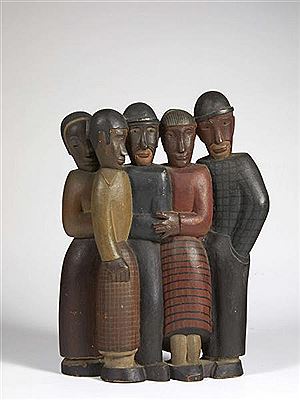
Lambert-Rucki worked in several different styles; he painted Cubist cityscapes, and many works influenced by the Tribal Art of Africa, his Cubist and primitive styles translated well into his vast production of sculpture.Biography from Polswissart
Jean Lambert-Rucki was an avant-garde artist, expressing himself primarily through sculpture and graphic art.
Jean Lambert-Rucki was associated with the movements of Cubism, Surrealism, and Art Deco. He graduated from Józef Mehoffer's studio at the Kraków Academy of Fine Arts.
In 1911, Jean Lambert-Rucki moved to Paris, where he studied at the Colarossi Academy and worked as a retoucher in a photography studio.
By 1913, Jean Lambert-Rucki was exhibiting at the Autumn Salon. During World War I, he enlisted in the Foreign Legion. Wounded in combat, he was sent to Thessaloniki, where Jean Lambert-Rucki worked as an archaeologist at the Archaeological Museum.
In 1918, Jean Lambert-Rucki returned to Paris. Through his acquaintance with Fernand Léger, Jean Lambert-Rucki came under the wing of art dealer Leonce Rosenberg in the early 1920s. Lambert-Rucki showed his first Cubist sculptures in a solo exhibition at the Galerie L'Effort Moderne in 1923. Combining modern forms with mosaic inlay, they evoked widespread admiration in Paris.
Equally popular were the luxurious objects in the Art Deco spirit, which secured Lambert-Rucki's success at the 1925 Paris International Exhibition. In 1930, Lambert-Rucki became a pioneer of modern religious art.
In 1931, Jean Lambert-Rucki became an active member of the Union des Artistes Modernes (UAM), where he exhibited alongside René Herbst, Charles-Édouard Jeanneret (Le Corbusier), Robert Mallet-Stevens, the architect Georges-Henri Pingusson, and Jean Fouquet (for whom he created jewelry).
In 1933, Jean Lambert-Rucki left his Montparnasse studio and moved to another one at 26 Rue des Plantes in Paris. In May 1943 he took part in a collective exhibition of artists from the "2ème groupe" at the Galerie Drouant-David in Paris.Biography from Desa Unicum
Artist Jean Lambert-Rucki was born in 1888.
After returning from the trenches of World War I, Jean Lambert-Rucki settled on the outskirts of Paris, on the Moulin du Beurre street, which no longer exists today.
Mara Rucki recalled that in this quiet neighborhood, “cows and donkeys walked along the quiet streets lined with large block stones. My father fed hungry cats often. A cat and a monkey have become a frequent subject of his works. "
Indeed, throughout the 1920s, and especially in the 1930s, animals appeared in Cubist sculptures by Lambert-Rucki. At that time, the artist also abandoned the previously developed characteristic style, which was the result of cubism and art déco. He began modeling in terracotta figures of donkeys, storks, bulls, sparrows and giraffes.
In 1937, he even prepared a fantastic Christmas tree, on whose branches - made of wooden boards - hordes of animals were lurking.
Jean Lambert-Rucki passed away in 1967.