Page loaded successfully. Showing biography for Jene Highstein.
Jene Highstein BIOGRAPHY
1942 Baltimore, Maryland - 2013 Salem, New York. Known for: Sculptor-performance/abstract.
"A Rebellious Sensuality: Jene Highstein, 1942 – 2013", by Lilly Wei, Review for artcritical:the online magazine of art and ideas, May 4th, 2013. An exhibition of early works is scheduled to open at... Read full biography
"A Rebellious Sensuality: Jene Highstein, 1942 – 2013", by Lilly Wei, Review for artcritical:the online magazine of art and ideas, May 4th, 2013. An exhibition of early works is scheduled to open at the Clocktower in Lower Manhattan this June. In what proved to be his last public event, Jene... Read full biography
"A Rebellious Sensuality: Jene Highstein, 1942 – 2013", by Lilly Wei, Review for artcritical:the online magazine of art and ideas, May 4th, 2013. An exhibition of early works is scheduled to open at the Clocktower in Lower Manhattan this June. In what proved to be his last public event, Jene Highstein, who died on April 27 at his upstate farm of lung cancer, described his childhood summers swimming and fishing off the white sand beaches of North Carolina. This dialogue took place in late... Read full biography
"A Rebellious Sensuality: Jene Highstein, 1942 – 2013", by Lilly Wei, Review for artcritical:the online magazine of art and ideas, May 4th, 2013. An exhibition of early works is scheduled to open at the Clocktower in Lower Manhattan this June. In what proved to be his last public event, Jene Highstein, who died on April 27 at his upstate farm of lung cancer, described his childhood summers swimming and fishing off the white sand beaches of North Carolina. This dialogue took place in late February at ArtHelix, Bushwick, where a selection of his recent Cape Breton drawings formed an exhibition curated by Bonnie Rychlak. Cape Breton was a place where many of his friends had bought land in the 1960s although he visited it for the first time... Read full biography
"A Rebellious Sensuality: Jene Highstein, 1942 – 2013", by Lilly Wei, Review for artcritical:the online magazine of art and ideas, May 4th, 2013. An exhibition of early works is scheduled to open at the Clocktower in Lower Manhattan this June. In what proved to be his last public event, Jene Highstein, who died on April 27 at his upstate farm of lung cancer, described his childhood summers swimming and fishing off the white sand beaches of North Carolina. This dialogue took place in late February at ArtHelix, Bushwick, where a selection of his recent Cape Breton drawings formed an exhibition curated by Bonnie Rychlak. Cape Breton was a place where many of his friends had bought land in the 1960s although he visited it for the first time only in 2002—and instantly fell in love. It reminded him of the idyllic holidays of his youth although the landscape w... Read full biography
Artist Biography
Biography page for Jene Highstein ((1942 - 2013)), known for Sculptor-performance/abstract. Showing 2 biographical entries and 0 sample artworks.
Jene Highstein - Artist Info
About Jene Highstein
Biography from the Archives of askART
 "A Rebellious Sensuality: Jene Highstein, 1942 – 2013", by Lilly Wei, Review for artcritical:the online magazine of art and ideas, May 4th, 2013
An exhibition of early works is scheduled to open at the Clocktower in Lower Manhattan this June.
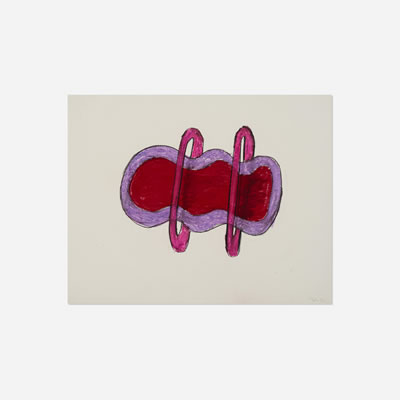
In what proved to be his last public event, Jene Highstein, who died on April 27 at his upstate farm of lung cancer, described his childhood summers swimming and fishing off the white sand beaches of North Carolina. This dialogue took place in late February at ArtHelix, Bushwick, where a selection of his recent Cape Breton drawings formed an exhibition curated by Bonnie Rychlak.
Cape Breton was a place where many of his friends had bought land in the 1960s although he visited it for the first time only in 2002—and instantly fell in love. It reminded him of the idyllic holidays of his youth although the landscape was northern and very different. But he loved the “wildness” and “remoteness” of Nova Scotia, the restless, constantly changing weather that re-drew sky, sea, and earth. And above all, he loved the light. So he, too, bought land, spending parts of summers and sometimes other seasons in this private arcadia.
The light-flickered, delicately colored Cape Breton drawings are a Post-minimalist sculptor’s musings on phenomena, on what disappears, what changes and what remains, one whose work over an almost 50-year career was more typically characterized by refined, although enormously scaled, weighty, often distinctly architectural forms in monochrome, in shades of blacks, whites, grays and the natural coloration of the material.
Yet a rebellious sensuality could almost always be detected in these austere, potent sculptures of metal, stone, wood, concrete, plaster, glass, their geometry softened by the artist into something more idiosyncratic, humanized by a curve, a swell, an irregularity, as it was in his playground-sized sculpture for the Wanås Foundation in Sweden, a sloping, irregular ovoid that he dryly called Grey Clam (1990/2001).
Like any good artist, Highstein liked to challenge and be challenged, and like any good artist, he was compelled to experiment. He was at ease within a range of media and disciplines, collaborating at times with other artists, dancers, musicians, and architects such as Steven Holl with whom he constructed a resplendently luminous nine-meter tall ice edifice in Finland in 2003.
Called Oblong Voidspace, this piece was, as Highstein explained, “about the absence of sculpture: the outside being more architectural and the inside more experiential. Like a ceremonial space, the interior focuses attention on the convergence of body and mind.” Highstein also designed sets for theatre productions, working with the ELD Dance Company in Stockholm for many years. The evolution of his work, he had often stated, depended upon finding new forms. These forms were abstract, not taken directly from nature but from experiences of nature, associations with nature, steeped in nature but conceived in the studio.
These memorable configurations were distinctively his own in the particular integration of the abstract and the biomorphic, an empathetic, substantive “convergence of body and mind” that is present in all of his works, seen most recently in New York at Danese in a well-received show of his towers and elliptical sculptures.
Jene Highstein was born in Baltimore, Maryland in 1942 and attended the University of Maryland, then the University of Chicago in the mid-1960s, where his major was philosophy. He later studied at the New York Studio School and the Royal Academy Schools in London, earning a degree in art in 1970.
His first exhibition was at Lisson Gallery, London, in 1968. Returning to New York, he showed at 112 Greene Street for a time, part of the utopian-minded, fiercely independent, artist-run alternative space that included much of the downtown avant-garde such as Jeffrey Lew, Gordon Matta-Clark, Richard Nonas, Alan Saret, Mary Heilmann and Vito Acconci. By 1976, Highstein was showing with Holly Solomon among other galleries in New York and soon after with Ace Gallery in Los Angeles and in New York.
More recently, he had solo exhibitions at Texas Gallery, Houston and Danese, New York, as well as in Europe and Asia. His many one-person museum shows include those at the University Art Museum, Berkeley, California (1980); the Philips Collection, Washington, D.C. (1991); MoMA PS1, New York (2003); and a solo throughout Madison Square Park, New York (2005).
An exhibition of early works is scheduled to open at the Clocktower in Lower Manhattan this June. Highstein received four National Endowment of the Arts awards over the years and a Guggenheim Fellowship among other honors and his work is included in numerous private and public collections, including every major museum in New York.
Extremely well-spoken, well-read, and well-traveled, a student of Buddhism, deeply committed to art, a keen observer of the world and the art world with an elegant, highly original turn of mind—he was trained as a philosopher, after all and reveled in argument and paradox—Highstein also had a bracing streak of irreverence and a dislike of pretension. When an audience member approached him after the ArtHelix talk and asked if a statement he had just made was contradictory, he replied, laughing, “don’t believe anything I say, I’m making it up as I go along.” Which of course meant, don’t believe that—or do.Biography from the Archives of askART
 JENE HIGHSTEIN, THE ROOMS
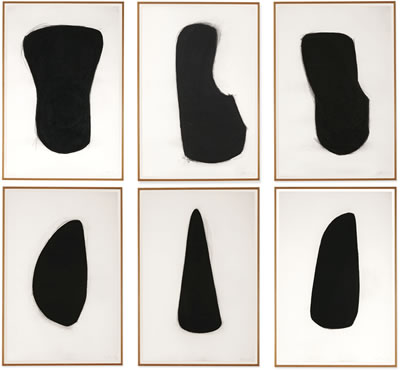
Over the course of a relatively short career (Jene Highstein died at the age of 70), the artist experimented with and explored not only various materials but also with defining forms of sculpture. He began casting dense spheres and lozenge shaped objects in iron and bronze. He continued to develop ideas about the shape of things through carvings in wood and stone. Even when small in scale these works all have a remarkable dominating presence.
His early mounds as he called them are certainly minimal in style but unlike other minimal sculpture of the time his carry with them references to archeology and anthropology and ancient cultures. Black Mound for Suzi from 1976 is among the first of these works. Primitive in shape and form yet is is a sophisticated statement about how sculpture comes into being and becomes a focused presence. The mound dominates the room much in the same way a Judd or Morris does yet its origins are not based on modern geometry but on ancient ceremony.Highstein is private and personal the way most other Minimal artists are naturally public in their works.
The overriding question asked by Highstein over the years is, what determines sculpture? Is it a single line or is it a three dimensional form? Is it a form placed in an open space or concentrated to fit in a room?
In the last decade of his life and beginning in the late 90s he became interested in the space in which sculpture sits. He explored these in seemingly endless drawings and studies, rooms with doors, windows and stairs leading to the same. That is he began to build rooms somewhat rudimentary in appearance and in no way functional but more symbolic if not ceremonial since he focused their structure of door ways much like one would find in a coliseum from the years of the Roman Empire or a more stone primitive structure like the one illustrated below .
The drama of these enigmatic rooms is their scale, a human scale that invites the viewer to explore these ovoid constructions. But it is also the play of light and shadow that makes these installation somewhat mysterious. Most were built in gallery or museums spaces ,one wonders if Highstein ever imagined these outdoors like some of his large mounds with open roofs to the sky?
So what we have now are rooms within rooms a kind of Surrealist drama when scale challenges scale. And sculpture is an event that one comes upon, discovers if you will in a landscape or in a gallery.
The evolution of Highstein’s visual ideas moves from a ground hugging black mounds to dramatic works such as Venus, 1990 or Barge, 1993 installations that fill the space from floor to ceiling. Barge is a massive presence, the grey dense plaster shape suggesting the hull of a giant ship. Yet soon that dense solid form will give way to his rooms. Rooms shaped with a single door or A Room with Ten Doors.
They are the precise opposite of his earlier installations. Highstein again questioning what the possibilities of a form are when it is closed or when it is open The dense form and others like it created for shows in Santa Barbara, Portland, Los Angeles and Stockholm ,Sweden. The new format is altered by a single decision: create a door way, thereby creating a new experience, one that is dominated by light and therefore sculpted by light.
Highstein’s highly unique installations evolved from single private enigmatic forms to these highly imaginative open rooms-- atrium like --suggesting a comparison to a Roman model. The atrium was considered the center of the Roman house's social and political life. So with these later works, Highstein is creating his own brand of public art, a room for many.
Source:
Michael Klein Fine Arts, 2019