Page loaded successfully. Showing biography for Joe Shuster.
Joe Shuster BIOGRAPHY
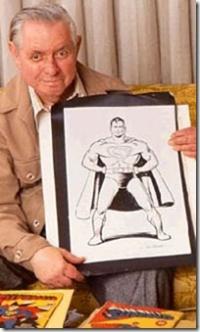
1914 Toronto, Ontario - 1992 Los Angeles, California. Known for: Cartoons, illustration, comic book artist.
Joe Shuster (1914 - 1992). Joe Shuster was the comic book illustrator who, with writer Jerry Siegel (1914 - 1996), created the character "Superman". It debuted June 1, 1938, and is believed by many... Read full biography
Joe Shuster (1914 - 1992). Joe Shuster was the comic book illustrator who, with writer Jerry Siegel (1914 - 1996), created the character "Superman". It debuted June 1, 1938, and is believed by many to be, "The most important comic-book character of the Twentieth Century and the very first... Read full biography
Joe Shuster (1914 - 1992). Joe Shuster was the comic book illustrator who, with writer Jerry Siegel (1914 - 1996), created the character "Superman". It debuted June 1, 1938, and is believed by many to be, "The most important comic-book character of the Twentieth Century and the very first superhero…" - Ron Goulart, page 320, Comic Book Encyclopedia. (1). Shuster was born in Toronto, Ontario, Canada. He lived in the USA from the age of nine; first in Cleveland, Ohio; then New York City; and... Read full biography
Joe Shuster (1914 - 1992). Joe Shuster was the comic book illustrator who, with writer Jerry Siegel (1914 - 1996), created the character "Superman". It debuted June 1, 1938, and is believed by many to be, "The most important comic-book character of the Twentieth Century and the very first superhero…" - Ron Goulart, page 320, Comic Book Encyclopedia. (1). Shuster was born in Toronto, Ontario, Canada. He lived in the USA from the age of nine; first in Cleveland, Ohio; then New York City; and finally in Los Angeles, California where he died. (2). His mediums were comic strips*, comic books and graphic novels. His original art was created with pencil and pen & ink. His subjects were detectives, spies, adventure, genre*, cityscape, romance,... Read full biography
Joe Shuster (1914 - 1992). Joe Shuster was the comic book illustrator who, with writer Jerry Siegel (1914 - 1996), created the character "Superman". It debuted June 1, 1938, and is believed by many to be, "The most important comic-book character of the Twentieth Century and the very first superhero…" - Ron Goulart, page 320, Comic Book Encyclopedia. (1). Shuster was born in Toronto, Ontario, Canada. He lived in the USA from the age of nine; first in Cleveland, Ohio; then New York City; and finally in Los Angeles, California where he died. (2). His mediums were comic strips*, comic books and graphic novels. His original art was created with pencil and pen & ink. His subjects were detectives, spies, adventure, genre*, cityscape, romance, fantasy, science fiction, crime, violence, horror, humor, and superheroes. Some of his other co-crea... Read full biography
Artist Biography
Biography page for Joe Shuster ((1914 - 1992)), known for Cartoons, illustration, comic book artist. Showing 1 biographical entries and 0 sample artworks.
Joe Shuster - Artist Info
About Joe Shuster
Biography from the Archives of askART
 Joe Shuster (1914 - 1992)
Joe Shuster was the comic book illustrator who, with writer Jerry Siegel (1914 - 1996), created the character "Superman".
It debuted June 1, 1938, and is believed by many to be, "The most important comic-book character of the Twentieth Century and the very first superhero…" - Ron Goulart, page 320, Comic Book Encyclopedia. (1)
Shuster was born in Toronto, Ontario, Canada. He lived in the USA from the age of nine; first in Cleveland, Ohio; then New York City; and finally in Los Angeles, California where he died. (2)
His mediums were comic strips*, comic books and graphic novels. His original art was created with pencil and pen & ink. His subjects were detectives, spies, adventure, genre*, cityscape, romance, fantasy, science fiction, crime, violence, horror, humor, and superheroes. Some of his other co-creations are Dr. Occult (1935), Federal Man (1936), Slam Bradley (1937), and Funnyman (1948). His style is described as Comic Strip* Art. (3)
His formal art education includes the Cleveland Art School [now - The Cleveland Institute of Art], Ohio (1931) and the John Huntington Polytechnic Institute, Cleveland, Ohio (1932). (4)
He worked for DC Action Comics [AKA: DC National, AKA: DC Comics] from 1936 to 1947 and afterwards as a freelance cartoonist. (5)
His honors include induction into the Will Eisner Award Hall of Fame* in 1992; the Jack Kirby Hall of Fame (a component of the Harvey Awards) in 1993; and the Canadian Comic Book Creator Hall of Fame in 2005. The Joe Shuster Awards for Canadian Comic Book Creators founded in 2004 are named after him. (6)
The three biographies below, courtesy of Comic Art & Graffix and Shuster's obituaries in The New York Times and the Independent, provide more details about the creation of Superman, three decades of legal battles over copyrights and compensation (7), and Shuster's life.
Comic Art & Graffix - Biography
Joe Shuster was born in Toronto, Canada on July 10, 1914. At the age of nine, his family moved to Cleveland, Ohio where he would later meet Jerome Siegel, with whom he would become a creative partner.
In 1932/33 the pair edited & published their own fan magazine covering the new fantasy fiction of the day. The fanzine, aptly titled Science Fiction lasted six issues. It was during the time they published Science Fiction that they were exposed to Phillip Wylie's pseudo-science fiction novel Gladiator, which was destined to be the seminal influence for the Siegel & Shuster creation, which itself would become one of the most important fantasy characters of all time. That character, "Superman", would even later be the model for scores of other super powered comic heroes, giving birth to the "Golden Age of Comics" in the late 1930's.
Having first introduced the super character as a villain in their fanzine in a story entitled "the Reign of the Superman", the duo eventually molded him into a comic strip which they had unsuccessfully marketed as early as 1936, during which time they each earned a living by writing (Siegel) and drawing (Shuster) comic stories for DC-National.
Henri Duval, Spy, Radio Squad, Slam Bradley, Federal Men and the more popular Dr. Occult kept them at DC until finally DC editor Sheldon Mayer took a chance & had Superman published as the lead feature in DC's inaugural issue of the now famous "Action Comics". (One story has Max (M.C.) Gaines sending the feature over to Mayer). Superman was an instant hit and less than one year later was promoted to his own book - a first for any super hero!
Unfortunately for the two creators, a common practice at the time of Superman's first appearance was for the publisher to retain all rights to the character. Thus, they had no financial or copyright interest in Superman, even though they did receive good pay for supplying DC with stories and art throughout the early forties. The Saturday Evening Post reported that the pair had a combined 1940 income of over $75,000!
But this compensation still did not please them, and in 1946 after having tried for years to get DC to let them in on the millions of dollars they were making, they finally decided to sue the comics publishing giant.
They were represented by a New York attorney by the name of Albert Zugsmith, who himself would later go to Hollywood where he became a producer of generally low budget thrillers & hot-rod genre films.
The case was settled in the New York State Supreme Court in 1948 with the creative team receiving the comparatively small settlement of $120,000. That sum was less than the pair would have made supplying stories to DC during the two years that the court case continued.
It was also after this settlement that the Siegel & Shuster byline, which had appeared on every story since 1938, was summarily dropped. As such, other than in a historical or creative context, their names had not appeared in conjunction with Superman, until the 1980's when DC reinstated the byline. Shuster would leave the comics field during the late forties, and Siegel's presence was very limited at best until finally he also left comics.
Many have commented that Shuster's artwork was done in a crude, narrative style (which comic artist Jim Steranko [see AskART] likened to editorial cartooning) which was reminiscent of Milton Caniff's [see AskART] art. Indeed, under his own inks, Shuster was very polished and illustrative, and his style itself became a model for many artists in the comic book industry during the thirties until the art of Lou Fine, Will Eisner, Jack Kirby and the influence of Hal Foster, Caniff & Alex Raymond [see all in AskART] revolutionized the medium.
Siegel & Shuster would again sue DC in 1978 for royalties from the Superman character, and through the help of then DC publisher in charge Carmine Infantino, and comics artist Neal Adams [see AskART], as well as public outcry from the comics hobby, they received a settlement from DC for $35,000 each per year for the remainder of their lives.
Still a paltry settlement when taking into account the hundreds of millions of dollars that DC made off the character in comics, from movies & radio, toys & other merchandising. Even while DC sued other publishers, like Fawcett & Fox for plagiarizing their flagship hero, they themselves were copying him in their own books (Starman in Adventure Comics being the most obvious). Siegel & Shuster did not profit from these in-house swipes either.
Joe Shuster, nearly blind & very bitter about his treatment from DC died July 30, 1992 just short of his seventy-eighth birthday. Though forgotten by the publisher that should have eulogized him as their savior, he will never be forgotten by the millions of fans worldwide who have read his legendary creation. Source: Comic Art & Graffix - http://www.comic-art.com/biographies/shuster1.htm
The New York Times - Obituary
Joseph Shuster, Cartoonist, Dies; Co-Creator of 'Superman' Was 78.
By Bruce Lambert
Published: August 3, 1992
Joseph Shuster, a co-creator of Superman who sold the rights to the character for $130, never dreaming it would become a legendary figure in popular culture reaping billions of dollars, died on Thursday at his home in Los Angeles. He was 78 years old.
He died of congestive heart failure, the Los Angeles County coroner's office said.
One night in 1934, Jerry Siegel conceived a superhuman hero, and the next day, he asked his buddy, Mr. Shuster, to draw it. Syndicators repeatedly rejected their comic strip until 1938, when Detective Comics [DC] bought the 13-page story for $10 a sheet.
"We were young kids," Mr. Shuster said later. "What did we know?"
Published as a booklet under the name Action Comics, Superman was an instant hit. His popularity helped establish comic books as a format and spawned a genre of bizarrely costumed superheroes, from Spiderman to Wonder Woman.
Superman: The Industry
Superman reigned as king of the realm and an industry unto himself. Almost faster than a speeding bullet, the Man of Steel appeared in newspaper comics, a radio show, animated cartoons, movie-theater serials, a television series, a Broadway musical, a novel, feature films and a stream of franchised goods, from lunch boxes and toys to bubble gum. In the 1970's alone, Superman sales exceeded $1 billion.
Superman was the baby alien from outer space, reared as a normal American boy and growing up to become Clark Kent, mild-mannered reporter. But when danger loomed, he transformed into the crusader for Truth, Justice and the American Way, ducking into the nearest phone booth, doffing his glasses and stripping to a blue bodysuit. Red cape flowing, he flew off, using X-ray vision and other powers to thwart the latest evil menace or global disaster. He leaped over tall buildings, gallantly kept the admiring and curious Lois Lane at arm's length and feared only kryptonite.
For several years, the Shuster-Siegel team earned a modest living as Superman's cartoonist and writer. But when they pressed for a share of the profits, they were dumped. They tried other story lines, including a character called Funnyman, which flopped.
Poverty, Then a Pension
Protracted litigation seeking money from Superman's owners also failed. By the 1970's, both men were nearly destitute and even sold their old comic books as collectors' items worth thousands of dollars apiece. Mr. Shuster, partly blind and unemployed, lived in a threadbare Queens [New York] apartment.
Finally he and Mr. Siegel appealed to the court of public opinion. In 1975 Warner Communications, which then owned Superman, volunteered to give each a pension of $20,000 a year. In 1981 the figure was raised to $30,000, plus a $15,000 bonus after the first film in the "Superman" series grossed $275 million.
Mr. Shuster was born in Toronto. As a youngster, he moved with his family to Cleveland, where he met Mr. Siegel.
No information on survivors was available.
SOURCE: New York Times - http://query.nytimes.com/gst/fullpage.html?res=9E0CE6D71330F930A3575BC0A964958260
The Independent - Obituary
By Denis Gifford
Friday, 7 August 1992
Joseph Shuster, artist, born Toronto 10 July 1914, died Los Angeles 30 July 1992.
Joe Shuster was the cartoonist who created Superman, the world's first comic-strip superhero.
Superman, who began life in perhaps the world's most rejected strip cartoon, rose in a little over half a century to become one of the three most recognisable characters on earth, alongside Mickey Mouse and Charlie Chaplin. At a current reckoning, Superman has starred in at least 44 different comic-book series, plus radio, records, film serials, animated cartoons, television and four of the world's top-grossing feature films. All of which should have made Joe Shuster and his writing partner, Jerome Siegel, two of the world's richest men. But it did not.
Shuster was born in Toronto in 1914. The family crossed the border in 1923, settling down in Cleveland, Ohio. Joe had been drawing with his left hand since he was four years old. He loved the strip cartoons and Sunday comic supplements in the newspaper his father read. His favourite page was the incredible fantasy series Little Nemo, drawn by Winsor McCay [see AskART]. As he later remembered, 'fantastic imagination and marvellous detail were there, which I have never seen since'. Little Nemo's fabulous world of Slumberland combined with the futuristic fantasies of Frank R. Paul [see AskART], the illustrator who drew the coloured covers of early science-fiction magazines, to influence Shuster, and by the age of 12 his sketch-books were peppered with rocket-ships and interplanetary city-scapes. His first published strip, drawn at the age of 15, was in The Federalist, a school magazine published at the Alexander Hamilton Junior High School.
Shuster was 17 and a student at Glenville High School when he had the encounter that was to launch him on a career for life. He met another boy with a penchant for science fiction and an ambition to be a writer. This was Jerry Siegel, also 17. The shy Shuster, who tended to hide his drawing away from the crowd, and the ebullient Siegel made a perfectly balanced pair. Beginning with the school newspaper, the Glenville Torch, they designed strips of all kinds, posting them off to every syndicate they could locate, who just as regularly posted them back. Among their many rejects were Ma Jenkins (a lookalike for Harold Gray's Maw Green), 'Snoopy and Smiley' (a pair of pranksters not unlike Bud Fisher's [see AskART] Mutt and Jeff), and 'Inko' (a clone of Max Fleischer's [see AskART] Koko the Clown). But there were also some totally original strips, science-fiction heroes like Steve Walsh - Scientific Adventurer Extraordinary, and his amazing Penetrascope, set in the year AD 3000. While still at college they used a mimeograph to publish their own highly illustrated magazine. It was called Science Fiction and featured a prophetic story entitled 'The Reign of the Supermen'. That was in 1933.
The following year, Siegel and Shuster were out on their own. They talked the local giveaway paper, the Cleveland Shopping News, into taking their cartoons for their Christmas number, then persuaded them to publish a complete colour comic entirely produced by themselves. Entitled Popular Comics and priced at five cents, it featured more science-fiction series, such as Bruce Verne: G-Man of the Future, in which a one-man G-ship fired space torpedoes at an escapee from a Prison Planetoid. Unfortunately the team was ahead of its time once again, and the comic was completed but never published until a comic fanatic issued it in a limited edition 50 years later.
In 1935 the modern American comic book was born when Major Malcolm Wheeler Nicholson converted his failing tabloid comic New Fun to the familiar format still in use today. The rechristened More Fun was issued in January 1936 and included two series by Siegel and Shuster: Henri Duval, a period French swashbuckler, and Dr Occult the Ghost Detective. Nicholson's companion comic, New Comics, also carried their crime strip Federal Men. Siegel and Shuster, sometimes working under the semi-anagram of Leger and Reuths, were kept busy throughout 1936, creating two new series for yet another companion comic, Detective. Spy, and Slam Bradley made their debuts in No 1 of Detective (March 1937). Meanwhile, the team still found time to pursue their ambition to create a successful newspaper strip.
Shuster drew up a number of sample strips of their newly contrived character, an alien from the far-off planet Krypton, shot to earth as a baby, adopted by a farming couple, and who rapidly grew in the span of a strip or two into the cloaked and costumed crime fighter they christened Superman. On his chest was the emblazoned 'S' which would become a symbol instantly recognised all over the world. But not yet. At first, Superman was rejected by every newspaper syndicate in the business. 'Too fantastic for our readers' was the frequently received rejection.
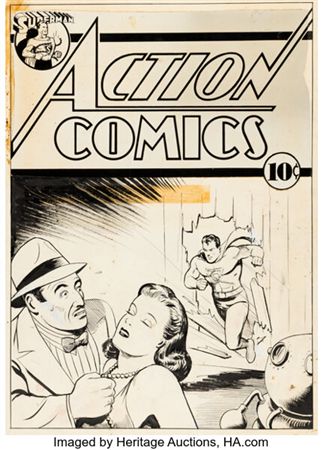
Siegel and Shuster heard from their editor, the youthful Sheldon Mayer, that yet another new comic book was being planned, and submitted Superman. Mayer loved it: others did not. Eventually Harry Donenfield, who had taken over the group from Major Nicholson, was prevailed upon and Action Comics No 1 was launched in June 1938. Shuster cut up his newspaper strips, pasting them into standard page format, and drew the first cover, Superman slinging a crook's limo over his head. The comic book was an instant sell-out, and today a mint copy of Action No 1 is valued at dollars 65,000. For their 13 pages, Shuster and Siegel were paid between them dollars 130. In addition, all rights in Superman were signed away to the publisher.
Shuster was forced to set up his own art studio to produce the ever-increasing quota of Superman strips demanded by his publisher. In addition, from January 1939 they finally achieved their original ambition by producing Superman as a daily newspaper strip, with a full-colour page every Sunday. A club, Supermen of America, was organized and the long-running daily radio serial began. Max Fleischer produced a series of brilliantly animated cartoons which for super-heroic effects have never been bettered, despite all modern improvements in the art. Columbia Pictures produced two long serial films starring Kirk Alyn as the 'Man of Steel'. A novel was published, and all this was only the beginning. Not that it did very much for either of the creators.
In 1947 Shuster and Siegel brought a suit against their publisher, now known as Superman DC, for a share in the profits. A long-running series of court battles between Siegel and DC Comics ensued. Little was heard of Shuster, whose failing eyesight forced him into early retirement. Virtually penniless, married to the loyal Joanna, the original model for Superman's long-suffering girl friend Lois Lane (8), Shuster remained in the ever-darkening shadows until several of the young wave of new comic artists, infuriated, took up his cause.
Eventually, an out-of-court settlement was reached with Warner Brothers, who had taken over the comic company and were then involved in launching the first of their blockbusting Superman movies. An annual income of dollars 20,000 a year was arranged for both Shuster and Siegel. Shuster moved from his half-furnished New York apartment and settled in California.
Joe Shuster was no great artist by today's standards, but it was his original depiction of Superman that gave the youth of the world a brand new all-American hero. Source: The Independent - http://www.independent.co.uk/news/people/obituary-joe-shuster-1538812.html.
Footnotes:
(1) Source: Comic Book Encyclopedia (2004), by Ron Goulart (see AskART book references).
(2) Source: The New York Times, Obituary - August 3, 1992.
(3) Source: Comic Book Encyclopedia (2004), by Ron Goulart (see AskART book references).
(4) Sources: The Scribner Encyclopedia of American Lives, Volumes 1 - 5: Notable Americans Who Died Between 1981 and 1999" (1998), edited by Professor Kenneth T. Jackson (see AskART book references); and The Canadian Encyclopedia (Online) - http://thecanadianencyclopedia.com/index.cfm?PgNm=TCE&Params=A1ARTA0007380.
(5) Source: Comic Art & Graffix - http://www.comic-art.com/biographies/shuster1.htm.
(6) Sources: The Will Eisner Award Hall of Fame - http://www.comic-con.org/cci/cci_eisners_pastwinners.php#1992; The Jack Kirby Hall of Fame - http://www.harveyawards.org/awards_1993win.html; and The Joe Shuster Awards - http://joeshusterawards.com/about-the-ccbcaa/.
Note: The Canadian Comic Book Creator Awards Association was established in 2004 as a not-for-profit organization. The central purpose of the Awards Association is to hand out the annual Joe Shuster Awards [named after the co-creator of Superman] for Canadian Comic Book Creators - and by doing so, give recognition to — and raise awareness of — the efforts made by Canadians who make, publish and sell comic books, webcomics and graphic novels. Source: The Joe Shuster Awards - http://joeshusterawards.com/about-the-ccbcaa/.
Note: The Harvey Awards [named after Harvey Kurtzman and founded in 1988] are one of the comic book industry's oldest and most respected awards. The Harveys recognize outstanding achievements in over 20 categories, ranging from Best Artist to the Jack Kirby Hall of Fame. They are the only industry awards both nominated by and selected by the full body of comic book professionals. Source: The Harvey Awards - http://www.harveyawards.org/history.html.
(7) As of November 2010, litigation over the rights to the Superman character continues into its seventh decade with depositions ordered in a new case between the Shuster/Siegel heirs and Warner Brothers. Source: The Hollywood Reporter - http://www.hollywoodreporter.com/blogs/thr-esq/superman-lawsuit-delay-lifted-depositions-46688.
(8) Joanne was the name of Jerry Siegel's wife and most sources name her as the model for Lois Lane. Source Cleveland.Com - http://www.cleveland.com/obituaries/index.ssf/2011/01/jerome_siegel_cleveland-born_c.html.
* For more in-depth information about these terms and others, see AskART.com Glossary http://www.askart.com/AskART/lists/Art_Definition.aspx.
Prepared and contributed to askART by M.D. Silverbrooke.