Page loaded successfully. Showing biography for Joel Babb.
Joel Babb BIOGRAPHY

Born 1947 Georgia. Known for: Urban and rural landscape, portrait and still life painting.
"Landscape painter Joel Babb explores his Renaissance," By Penelope Mack, Bowdoin Orient newspaper, Bowdoin, Maine, October 12, 2018. OLD IS NEW Maine-based painter Joel Babb finds inspirations in... Read full biography
"Landscape painter Joel Babb explores his Renaissance," By Penelope Mack, Bowdoin Orient newspaper, Bowdoin, Maine, October 12, 2018. OLD IS NEW Maine-based painter Joel Babb finds inspirations in the cityscapes of Boston and captures fleeting sensations in nature. Citing influences from Leonardo,... Read full biography
"Landscape painter Joel Babb explores his Renaissance," By Penelope Mack, Bowdoin Orient newspaper, Bowdoin, Maine, October 12, 2018. OLD IS NEW Maine-based painter Joel Babb finds inspirations in the cityscapes of Boston and captures fleeting sensations in nature. Citing influences from Leonardo, Canaletto and Lorrain, Babb is the modern Renaissance man. On October 3rd, Joel Babb, a renowned landscape painter based in Sumner, Maine, presented his art and creative process in the Edwards Center... Read full biography
"Landscape painter Joel Babb explores his Renaissance," By Penelope Mack, Bowdoin Orient newspaper, Bowdoin, Maine, October 12, 2018. OLD IS NEW Maine-based painter Joel Babb finds inspirations in the cityscapes of Boston and captures fleeting sensations in nature. Citing influences from Leonardo, Canaletto and Lorrain, Babb is the modern Renaissance man. On October 3rd, Joel Babb, a renowned landscape painter based in Sumner, Maine, presented his art and creative process in the Edwards Center for Art and Dance. Referencing Roman monuments and Baroque landscapes, he guided his audience through his decades-long journey in capturing nature and culture. As an undergraduate art history student at Princeton in the late 1960s, Babb painted in an... Read full biography
"Landscape painter Joel Babb explores his Renaissance," By Penelope Mack, Bowdoin Orient newspaper, Bowdoin, Maine, October 12, 2018. OLD IS NEW Maine-based painter Joel Babb finds inspirations in the cityscapes of Boston and captures fleeting sensations in nature. Citing influences from Leonardo, Canaletto and Lorrain, Babb is the modern Renaissance man. On October 3rd, Joel Babb, a renowned landscape painter based in Sumner, Maine, presented his art and creative process in the Edwards Center for Art and Dance. Referencing Roman monuments and Baroque landscapes, he guided his audience through his decades-long journey in capturing nature and culture. As an undergraduate art history student at Princeton in the late 1960s, Babb painted in an abstract manner, producing Surrealist expressions of imaginative fantasies in line with popular tastes at the time. Dur... Read full biography
Artist Biography
Biography page for Joel Babb ((Born 1947)), known for Urban and rural landscape, portrait and still life painting. Showing 2 biographical entries and 0 sample artworks.
Joel Babb - Artist Info
About Joel Babb
Biography from the Archives of askART
 "Landscape painter Joel Babb explores his Renaissance," By Penelope Mack, Bowdoin Orient newspaper, Bowdoin, Maine, October 12, 2018
OLD IS NEW Maine-based painter Joel Babb finds inspirations in the cityscapes of Boston and captures fleeting sensations in nature. Citing influences from Leonardo, Canaletto and Lorrain, Babb is the modern Renaissance man.
On October 3rd, Joel Babb, a renowned landscape painter based in Sumner, Maine, presented his art and creative process in the Edwards Center for Art and Dance. Referencing Roman monuments and Baroque landscapes, he guided his audience through his decades-long journey in capturing nature and culture.
As an undergraduate art history student at Princeton in the late 1960s, Babb painted in an abstract manner, producing Surrealist expressions of imaginative fantasies in line with popular tastes at the time. During a seven-month stay in Rome after graduation, Babb began attempting to sketch and paint his surroundings, grappling with representing the world as he s
His stylistic switch from abstraction to realism was inspired by his discovery of Old Master works, a passion that took form while he worked as a night watchman at the Museum of Fine Arts in Boston and enrolled in the Museum School. Navigating his own artistic endeavors, Babb found guidance in the work of Leonardo da Vinci and became fixated on his anatomical sketches. In this early stage of his artistry, he practiced a little bit of everything.
“I had a Renaissance of discovering all the things that Renaissance artists [learned],” Babb said. “I began that same process too, in terms of drawing from Roman architecture and drawing from Roman statues … it’s occurred to me lately that every artist who sets out on his process of becoming an artist should have this period in the Renaissance, trying to rediscover what was in the past, and what was to some extent lost.”
Babb found his calling in the landscape paintings of the greats.
“I really had no ability to capture a landscape in drawing or painting until I discovered Claude [Lorrain’s] drawings,” he said, citing the 17th century French painter as a major influence.
Babb’s world, however, looked vastly different from the Italian ports Lorrain favored. Boston, his city of residence, lacked the wide open skies and mossy ruins of Rome—yet he saw an opportunity for creation. Boston would be his muse.
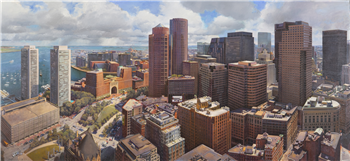
One particularly breathtaking example of his cityscapes is Copley Square from 500 Boylston.” Its canvas is filled half with the reflective windows of the John Hancock building, a mirror of the city around it.
To create this piece, Babb spent a lot of time taking 4×5 inch photographs from the roof of 500 Boylston Street in Boston. The work takes on a previously unseen level of detail that he says was inspired by two shows he had seen before doing the painting. The first was an exhibition of the Baroque painter Canaletto, whose epic landscapes depicted both city and country. The second was an exhibition of Richard Este paintings, a painter whose New York street scenes are almost indistinguishable from photos.
Babb used both artists’ techniques of capturing light and defining depth and perspective to create a modern tribute to landscape artists of the past.
Eventually, Babb found the cityscapes and their endless detail exhausting and moved to Maine for a change of scenery. He had been granted some land by a friend and built a studio and home in Sumner. There, his landscapes turned from the brick and cement of Boston to the woods and streams of rural Maine.
Painting ever changing waters and skies, though, posed a new problem: how do you capture a scene which is constantly moving? Babb photographed ocean views and forest landscapes in changing weather, and then merged these elements together in paint.
“I wanted to really express the idea of the restlessness of natural forces … I discovered that … all the people at Hudson River School also did the same thing. They thought to capture the spirit of a place you can’t just take exactly what’s there, you have to blend the elements together and compose [a scene],” he said.
As advice for young painters, Babb urges skepticism and approaching current trends in the art world with a grain of salt. He is adamant about the value of studying the Old Masters.
“I really like being a painter and I think I’m a contemporary artist, but the art scene has developed all these new media and so I think something is lost by not undertaking, or at least becoming knowledgeable about, [the older media],” he said.
Babb continues to capture cities and nature with the eye of a Renaissance man and the influence of history’s great landscape artists at the forefront of his mind. But there’s also something irrevocably modern about his work due to the world he depicts.
“I’m thinking, ‘How are these paintings gonna look in 100 years?’” he said. “And I want to do paintings that will be interesting [then].”
Perhaps to future generations, Babb’s brownstones and skyscrapers will seem as quaint and archaic as Lorrain and Canaletto’s pastoral scenes seem to our 21st century eyes.Biography from Vose Galleries
 Born in Georgia and raised predominantly in Nebraska, Joel Babb received his B.A. in studio art and art history from Princeton University in 1969. He primarily studied abstract painting, but after a pivotal postgraduate year in Europe, he turned from abstraction to realism and enrolled in the M.F.A. program at the School of the Museum of Fine Arts, Boston. Despite the paucity of traditional painting classes, Joel found that his access to the Museum's Old Master collections provided the examples he needed to slowly develop his craft, learning from the masterworks directly.
He applied that eighteenth-century style to modern subjects, and quickly became a standard bearer for representational art. Joel taught drawing and painting at the School of the Museum of Fine Arts, Boston, and in several Boston area schools from 1974 - 2004.
Somewhat leery of the commercial art world, Joel began selling his work to many major collections through private consultants. His success came from his extraordinarily realistic depictions of Boston, for which he is best known for today, and he received many commissions for his cityscapes, which can be seen in the Charles Hotel in Cambridge, Mass Financial and many other top hotels, hospitals and financial institutions.
In 1984, he had his first solo show, which was at Bates College and thereafter continued to exhibit widely at such institutions as National Academy in New York City, Portland Museum of Art, Ogunquit Museum in Maine and Gallery Naga in Boston. His powerful paintings were standouts in the 2003 group exhibition "Realism Now" at Vose Galleries. Regarding his phenomenal cityscapes, Marcia L. Vose, Director of Vose Contemporary remarked, "I once joked to Joel that he is the modern day Canaletto--in a helicopter--and we mused together what the great Venice artist (1697-1768) would have done in the contemporary world. But he's not just a copyist. He has spent years developing the style of the old masters but has fused these techniques with modern aids to stretch in new ways. His art is his own—spellbinding, versatile."
A true artist of many talents, Joel's work can be seen in many collections including the deCordova Museum and the Fogg Art Museum. Extricating himself from the city after leaving teaching in 2004, Joel decided to devote himself full time to his art and began to prepare for his first solo exhibition at Vose Galleries. He found solace in his studio, built in the early 1980s in a remote part of western Maine (where he still lives simply with his wife Frannie), shifting his focus to landscapes of the surrounding forests. In a third exhibition at Vose Galleries, he departed from his exacting depictions of huge cityscapes or his panoramas in the Maine woods, and has loosened his brushstroke to paint on location.
On his painting trips to Mt. Desert Island, Joel writes, "Even the presence of so many people cannot overwhelm the epic beauty of the place. I managed to find quiet places to paint a little off the track. One foggy morning, going to my spot, I startled a herd of deer on the road, and getting out of my truck I saw fine spider webs from the trees going across the roadway telling me that I was the first to pass that way that morning. Minute to minute, day to day a landscape changes completely. Even when the sea is calm, the barren rocks bear evidence of waves of immense size having ground away the Maine woods to their foundations."
Online Source:
http://www.vosegalleries.com/contemporary/bio.cfm?artistid=458