Page loaded successfully. Showing biography for Jogen Chowdhury.
Jogen Chowdhury BIOGRAPHY
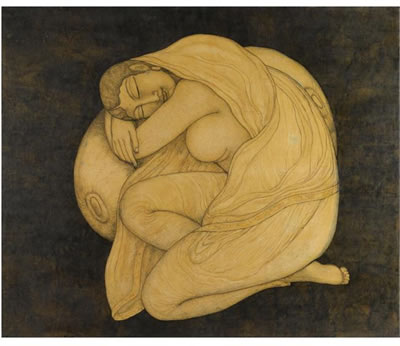
Born 1939 East Bengal village (now part of Bangladesh). Known for: Pastel and ink on paper, figurative approach.
Jogen Chowdhury is known for his ability to successfully marry traditional imagery with the zeitgeist of contemporary painting, in a skillful blend of an urbane self-awareness and a highly localized... Read full biography
Jogen Chowdhury is known for his ability to successfully marry traditional imagery with the zeitgeist of contemporary painting, in a skillful blend of an urbane self-awareness and a highly localized Bengali influence. His early works show an attention to figuration that carries through in his... Read full biography
Jogen Chowdhury is known for his ability to successfully marry traditional imagery with the zeitgeist of contemporary painting, in a skillful blend of an urbane self-awareness and a highly localized Bengali influence. His early works show an attention to figuration that carries through in his current pieces. In an interview, Chowdhury commented that, in his early works, "the space projected a simple iconic presence. A spatial sequence was worked out but the space was not complex. The background... Read full biography
Jogen Chowdhury is known for his ability to successfully marry traditional imagery with the zeitgeist of contemporary painting, in a skillful blend of an urbane self-awareness and a highly localized Bengali influence. His early works show an attention to figuration that carries through in his current pieces. In an interview, Chowdhury commented that, in his early works, "the space projected a simple iconic presence. A spatial sequence was worked out but the space was not complex. The background seemed to vanish." Anshuman Dasgupta describes these works as more iconic and more dramatized; per contra, Chowdhury describes his later works as "now more personalized and subtle". During his college days, Chowdhury took part in leftist literary... Read full biography
Jogen Chowdhury is known for his ability to successfully marry traditional imagery with the zeitgeist of contemporary painting, in a skillful blend of an urbane self-awareness and a highly localized Bengali influence. His early works show an attention to figuration that carries through in his current pieces. In an interview, Chowdhury commented that, in his early works, "the space projected a simple iconic presence. A spatial sequence was worked out but the space was not complex. The background seemed to vanish." Anshuman Dasgupta describes these works as more iconic and more dramatized; per contra, Chowdhury describes his later works as "now more personalized and subtle". During his college days, Chowdhury took part in leftist literary circles, the members of which dismissed Rabindranath Tagore as a bourgeoisie and became interested in the... Read full biography
Artist Biography
Biography page for Jogen Chowdhury ((Born 1939)), known for Pastel and ink on paper, figurative approach. Showing 2 biographical entries and 0 sample artworks.
Jogen Chowdhury - Artist Info
About Jogen Chowdhury
Biography from Saffronart
Jogen Chowdhury is known for his ability to successfully marry traditional imagery with the zeitgeist of contemporary painting, in a skillful blend of an urbane self-awareness and a highly localized Bengali influence. His early works show an attention to figuration that carries through in his current pieces. In an interview, Chowdhury commented that, in his early works, "the space projected a simple iconic presence. A spatial sequence was worked out but the space was not complex. The background seemed to vanish." Anshuman Dasgupta describes these works as more iconic and more dramatized; per contra, Chowdhury describes his later works as "now more personalized and subtle".
During his college days, Chowdhury took part in leftist literary circles, the members of which dismissed Rabindranath Tagore as a bourgeoisie and became interested in the works of Russian authors. But by and large, Chowdhury kept himself apart from cultural movements: though a friend of the members of the Hungry Generation, his imagery was drawn from his cultural background more than his intellectual milieu. "My background is relevant," he once remarked in an interview, explaining that his life in Calcutta was "quite disturbed with political movements. This has a definite influence on my work like the Ganesha period. he Bengali business class worshipping the icon, and their corruption, how they degenerate just like the flesh." The famine, the Partition, and the food movement all cast a pall over his formative years, and a quality of darkness may be seen to inhere in Chowdhury's work. Yet as well as an indicator of sadness, this darkness can be understood to evoke an aura of mystery. It is an effect enhanced in Chowdhury's more recent works, which, increasingly, crop the central image. Chowdhury explains that "The purpose is to hide some parts. The moment I show the entire figure, the interest in the details would be lost. Earlier on, the figures were observed in their natural bearings which came through expressionistic stylization and the weight of reality was greater. There is an effect of distancing today."
Speaking on contemporary art, Chowdhury maintains the necessity of a uniquely Indian approach to art, as opposed to the blind aping of Western trends, "To be global you do not have to do something that is imitative of America, Australia or England. It has to have an authenticity, which is not what blind imitation allows for."
Born in 1939 in Faridpur, Bengal, Chowdhury studied at the Government College of Art and Crafts, Kolkata, from 1955-60, followed by a stint at L'Ecole Nationale Superior des Beax-Arts, Paris, in 1965-57 on a French Government Scholarship.
His recent solo exhibitions include 'A Calligraphy of Touch and Gaze', presented by Kalakriti Art Gallery at ICIA, Mumbai, in 2008; and 'Abahoman: Flowing Life' at Vadehra Art Gallery, New Delhi, in 2007.
Chowdhury has also had solo exhibitions at Gajah Gallery, Singapore; Gallerie Foundation for Indian Artists, Amsterdam; and the Fine Art Resource, Berlin.
In 1966, Chowdhury was awarded the Prix le France de la Jeune Peinture in Paris, and, in 1986, received an award at the Second Biennale of Havana, Cuba. He was presented the Kalidas Sanman by the Government of Madhya Pradesh in 2001.
The artist lives and works in Santiniketan.Biography from Pundole's
Jogen Chowdhury, born in 1939 in an East Bengal village (now part of Bangladesh), experienced a troubled start in life but overcame challenges to become a highly proficient artist known for his unique style of working in pastel and ink on paper. He graduated from the College of Art and Craft, Kolkata, and studied at L’École des Beaux-Arts, Paris. Throughout his career, he held various positions in the art world, including working as a designer, curator, and teacher. Chowdhury's artwork style is characterized by his use of pastel and ink to create figurative studies with mutated forms and fine crosshatching techniques. He officially retired in 1999 to focus on his art full time.