Page loaded successfully. Showing biography for John Baeder.
John Baeder BIOGRAPHY
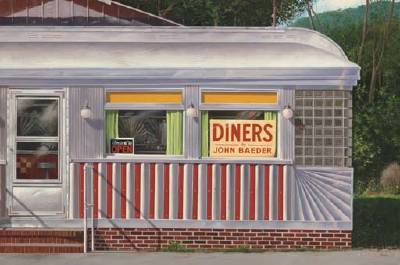
Born 1938 South Bend, Indiana. Known for: Photo-realistic dining scene painting, commercial art.
The following biography was supplied by the artist, August 2004. Various facets of life become vehicles for liberating the soul. When I was 5 years old, I began travelling each summer with my parents... Read full biography
The following biography was supplied by the artist, August 2004. Various facets of life become vehicles for liberating the soul. When I was 5 years old, I began travelling each summer with my parents and sister to South Bend, Indiana, which provided the stimulus of visual ecstasy. This was the... Read full biography
The following biography was supplied by the artist, August 2004. Various facets of life become vehicles for liberating the soul. When I was 5 years old, I began travelling each summer with my parents and sister to South Bend, Indiana, which provided the stimulus of visual ecstasy. This was the beginning of early sensory experiences that immersed themselves deep into the unconscious. It provided seeds for the conscious later on (way later on). Eventually, they blossomed and became art. On the... Read full biography
The following biography was supplied by the artist, August 2004. Various facets of life become vehicles for liberating the soul. When I was 5 years old, I began travelling each summer with my parents and sister to South Bend, Indiana, which provided the stimulus of visual ecstasy. This was the beginning of early sensory experiences that immersed themselves deep into the unconscious. It provided seeds for the conscious later on (way later on). Eventually, they blossomed and became art. On the train, the dining car was beyond just an eating event. It was compounded with the fulfillment of looking out the window of our "drawing room" and soaking in the countryside and the backyards of small towns and communities. For my tiny, tender eye,... Read full biography
The following biography was supplied by the artist, August 2004. Various facets of life become vehicles for liberating the soul. When I was 5 years old, I began travelling each summer with my parents and sister to South Bend, Indiana, which provided the stimulus of visual ecstasy. This was the beginning of early sensory experiences that immersed themselves deep into the unconscious. It provided seeds for the conscious later on (way later on). Eventually, they blossomed and became art. On the train, the dining car was beyond just an eating event. It was compounded with the fulfillment of looking out the window of our "drawing room" and soaking in the countryside and the backyards of small towns and communities. For my tiny, tender eye, these were paintings framed by a large window. My first museum. During the same early period, we lived in a hotel for 6 months.... Read full biography
Artist Biography
Biography page for John Baeder ((Born 1938)), known for Photo-realistic dining scene painting, commercial art. Showing 2 biographical entries and 0 sample artworks.
John Baeder - Artist Info
About John Baeder
Biography from the Archives of askART
 The following biography was supplied by the artist, August 2004
Various facets of life become vehicles for liberating the soul.
When I was 5 years old, I began travelling each summer with my parents and sister to South Bend, Indiana, which provided the stimulus of visual ecstasy. This was the beginning of early sensory experiences that immersed themselves deep into the unconscious. It provided seeds for the conscious later on (way later on). Eventually, they blossomed and became art.
On the train, the dining car was beyond just an eating event. It was compounded with the fulfillment of looking out the window of our "drawing room" and soaking in the countryside and the backyards of small towns and communities. For my tiny, tender eye, these were paintings framed by a large window. My first museum.
During the same early period, we lived in a hotel for 6 months. Across from the "Biltmore" in Atlanta, Georgia was the "Majestic." It was an eatery with a counter, but not a diner in the traditional, pure, bonafide sense. It had short stools and I was enthralled sitting on those stools with all the grown-ups. I was even more thrilled by observing with complete and clear amazement the choreography of the counterman preparing food so swiftly on the grill, right in front of me. I couldn't tear my eyes away from his twists and turns of the wrist, flipping burgers and flopping toast; the opening and closing of the polished metal doors; and of course the magical one-hand-egg-breaking routine. I loved it all. It was entertainment in a spiritual area I knew nothing about, and more visual joy for the little boy and his beginning sensibilities. Later on, (way later on), these stimuli would be redefined and redistributed on canvas.
I am concerned with process: the revelation of a particular and poignant part of the urban landscape, and thus the preservation of a unique and rapidly disappearing icon of American roadside culture. (Take from culture in one dimension and contribute back in another dimension.) A significant aspect of the process is the quest, which basically is the transformation of documented archaeological findings - travel, investigation, gathering of material. Painting is the mere act of transcendence; an end product that enters space and time; the final leg of the quest.Biography from RoGallery
 John Baeder, born in South Bend, Indiana, 1938, studied at Auburn University in Alabama. His subjects have been almost exclusively isolated roadside diners and eateries. A book featuring him, Diners by John Baeder, was published in 1978 by Abrams Press.
John Baeder is a Photorealist painter. His images have entered the secondary market as reproductions on posters, calendars, and postcards (here the energy comes full circle, as old postcards were an important source of inspiration for the paintings). The Disney Company, Coca Cola, and fashion moguls Perry Ellis, Liz Claiborne, and Guess have appropriated them.
The diners appear on memorabilia-oriented merchandise, such as painted plates, and in three dimensions as butter dishes, planters, canisters, etc. (part of an extensive ceramic line produced by Sigma/Towle in 1979/80). The authors of a book on art deco chose to illustrate the sleek design of New York City's Empire Diner with Baeder's painting of that diner, rather than with an actual photograph. (Alastair Duncan, American Art Deco (New York: Abrams, 1986)
Baeder's vision of roadside America also represented in the book, Diners, Gas, Food, Lodging, and Sign Language. Together, the paintings and writings have impacted the commercial arena with work that is part of the resurgence of current diner mania, fostered by restaurateurs and their NeoDiners.
The diner paintings were always a part of Baeder's special consciousness. Like a vanishing point, they represent his convergence of a variety of interests and influences that took some time, and another career, to formulate.
In the late 1950s, Baeder attended Auburn University. His earliest paintings were expressionist figural abstractions inspired by the work of Diebenkorn, de Kooning, Tworkov, and others. As a serious student, Baeder read and reread the then little-known IT IS, an Abstract Expressionist journal of painting, poetry published in 1958-59. The real magic of the Auburn years, however, was the trips back and forth, between semesters, from Atlanta to Alabama. It was during these drives that Baeder's romance with the back roads of America stirred and his love affair with diners took hold. As a youngster, he enjoyed bike rides with a Baby Brownie camera in hand; This was the beginning of his documentary quest. His targets were old relics, in particular old cars, whose craftsmanship and beauty caught his attention.
Baeder makes the observation of himself and of his generation that they were "image addicts." They were brought up on, and their vision was stimulated by billboards, movies, TV, advertising, and the now highly regarded photo journalist images that covered the pages of Life, Collier's, and Look magazines.
And, in fact, Baeder began his professional career as an art director. He worked first in Atlanta, from 1960-64, with a branch of a New York ad agency. Then he moved in New York City. During his years as an art director, Baeder kept his technical artistic abilities honed through drawing, painting, and photography; this was especially important as part of a process leading up to Photorealism. The many aspects of art directing, including marketing, merchandising, promotions, and public relations, kept his vision focused on American material culture.
One of Baeder's New York City ad agency offices was across the street from the Museum of Modern Art. The Museum's photography department was like a haven for him. He studied the work of Bernice Abbott, Russell Lee, Walker Evans, and Ben Shahn, and other photographers of the FSA (Farm Security Administration). Baeder began to collect photography-Abbott, Atget, Evans, and Lewis Hine are represented in his collection-and he began to take pictures in earnest. Urged on by an already-developed sensitivity for the beauty and value of old things, he documented the urban environment, especially the fast-disappearing elements of city fabrics. It was a short step to the diners.
As a child Baeder also had an urge to travel, and the painful reality that his father did not drive left a void for which he now found compensation. In the late '60s, he began to collect old postcards of roadside America-not just diners, but gas stations, tourist camps, motels, restaurants, and the main streets of small-town America. With these postcards a sort of alchemy took place. Postcards have their grounding in early modern realist photography and early color lithography. They were the perfect catalyst for an Ad Man to cross the threshold into the world of the artist.
Baeder's first impulse was to scale up the postcards, to turn them into paintings. His pleasure was that these simple images could hold their representational qualities while being keyed to play off abstract patterns as well. Baeder was aware of Pop Art and its visual, and sometimes technical, ties to the world of advertising. He saw in it a harbinger of something new and substantial, which was quite the opposite of postwar abstraction. It was not long before Baeder, through the intervention of John Kacere, by Ivan Karp, was discovered, and was exhibiting at the OK Harris Gallery. And it was also not long before diners became the focus of the paintings.
Other photorealists have chosen eateries as subjects, but it is asserted that Baeder applied a special discipline and rigor to the subject and has developed the diner image into an American icon.
He has made pilgrimage after pilgrimage to capture, lovingly, with his camera images of hundreds of diners across the United States and runs the gamut from reportage to social commentary. It seems a throwback to the early 18th century western tradition of the "grand tour," fed by the romantic lure of ancient monuments, untravelled terrain, and foreign soil. Baeder's romance with the American roadside can be regarded, perhaps, as the twentieth-century heir of this tradition.
Baeder's work is a locus of the hearth, in Jungian thought and ideology, an archetype of basic needs-food, clothing, shelter-a symbol of nurturing---The Great Mother.
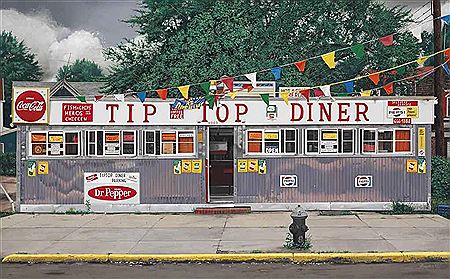
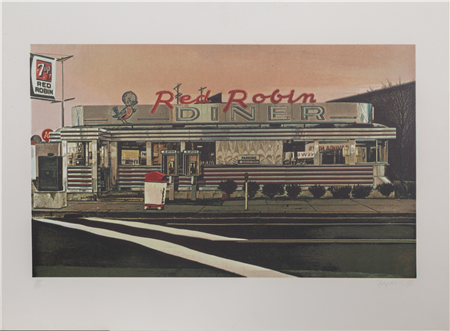
Diner after diner dominates Baeder's paintings. Though their basic form is given by the early Pullman railroad dining car, their unique character is what impresses. It is the result of the individual creativity, often naive and spontaneous, of those who own and run them. Colorful paint schemes, shiny chrome, quippy signage are intended to fill the senses with pleasant and often clever simplicities. Far from the world of cryptic emblems of morality and of seventeenth-century genre paintings, these twentieth-century genre images offer hospitality, warmth, and enjoyment. The dress code here is come-as-you-are; the architectural order is freedom of expression.
But we should not be fooled by the lack of formality we sense in these' paintings. They are crafted images by the artists with conjoined composition, color, form, and technique to set off, the imagery. The graphic component, the signage, is supposed to lend visual (calligraphic) interest and verbal appeal.
Special note should be made of a particular detail in the Harris Diner. The prominent red truck parked to the left of the flagpole is identified by the logo on the door as belonging to the OK Harris Gallery. n this subtle way, one of this country's foremost realists tips his hat to his gallery, perhaps the most important in the advancement of contemporary realism.
As we study Baeder's images collectively we become aware that the diner paintings are above all a social record of a fast-disappearing American subculture. The diners and their settings document regional tastes and mores, the richness and variety of our expansive culture and society, our mobility and the personal freedoms that draw so many to our shores. In this, Baeder belongs to the tradition of nineteenth- and twentieth- century realist and regionalist painters and pictorial journalists, who explored with contagious humanity the character of ordinary Americans as they imprinted themselves upon the American landscape. And, as America homogenizes under the sign of the Golden Arches, the paintings are a potent reminder of the fast-disappearing character and diversity of American culture.