Page loaded successfully. Showing biography for John Gadsby Chapman.
John Gadsby Chapman BIOGRAPHY
1808 Alexandria, Virginia - 1889 Brooklyn, New York. Known for: Sea-landscape, portrait, genre and history painting.
Born in Alexandria, Virginia, John Gadsby Chapman was a highly productive painter, illustrator, and engraver*, living primarily as an expatriate* in Italy. He was a student of Charles Bird King in... Read full biography
Born in Alexandria, Virginia, John Gadsby Chapman was a highly productive painter, illustrator, and engraver*, living primarily as an expatriate* in Italy. He was a student of Charles Bird King in Washington DC, worked briefly as a professional artist in Winchester, Virginia, and was enrolled in... Read full biography
Born in Alexandria, Virginia, John Gadsby Chapman was a highly productive painter, illustrator, and engraver*, living primarily as an expatriate* in Italy. He was a student of Charles Bird King in Washington DC, worked briefly as a professional artist in Winchester, Virginia, and was enrolled in the Pennsylvania Academy of the Fine Arts* in Philadelphia. However, as a young man, he left for Italy, studying in Rome and Florence, and returning to America in 1831. In the U.S., he became a... Read full biography
Born in Alexandria, Virginia, John Gadsby Chapman was a highly productive painter, illustrator, and engraver*, living primarily as an expatriate* in Italy. He was a student of Charles Bird King in Washington DC, worked briefly as a professional artist in Winchester, Virginia, and was enrolled in the Pennsylvania Academy of the Fine Arts* in Philadelphia. However, as a young man, he left for Italy, studying in Rome and Florence, and returning to America in 1831. In the U.S., he became a reputable portrait and history painter, living between New York and Washington D.C. One of his best known works is a large, highly colorful mural, The Baptism of Pocahontas, which is in the rotunda of the U.S. Capitol, and which brought him great renown for... Read full biography
Born in Alexandria, Virginia, John Gadsby Chapman was a highly productive painter, illustrator, and engraver*, living primarily as an expatriate* in Italy. He was a student of Charles Bird King in Washington DC, worked briefly as a professional artist in Winchester, Virginia, and was enrolled in the Pennsylvania Academy of the Fine Arts* in Philadelphia. However, as a young man, he left for Italy, studying in Rome and Florence, and returning to America in 1831. In the U.S., he became a reputable portrait and history painter, living between New York and Washington D.C. One of his best known works is a large, highly colorful mural, The Baptism of Pocahontas, which is in the rotunda of the U.S. Capitol, and which brought him great renown for its placement in such a distinguished location. The work is described as "though lacking in monumentality, it is... Read full biography
Artist Biography
Biography page for John Gadsby Chapman ((1808 - 1889)), known for Sea-landscape, portrait, genre and history painting. Showing 2 biographical entries and 0 sample artworks.
John Gadsby Chapman - Artist Info
About John Gadsby Chapman
Biography from the Archives of askART
 Born in Alexandria, Virginia, John Gadsby Chapman was a highly productive painter, illustrator, and engraver*, living primarily as an expatriate* in Italy. He was a student of Charles Bird King in Washington DC, worked briefly as a professional artist in Winchester, Virginia, and was enrolled in the Pennsylvania Academy of the Fine Arts* in Philadelphia. However, as a young man, he left for Italy, studying in Rome and Florence, and returning to America in 1831.
In the U.S., he became a reputable portrait and history painter, living between New York and Washington D.C. One of his best known works is a large, highly colorful mural, The Baptism of Pocahontas, which is in the rotunda of the U.S. Capitol, and which brought him great renown for its placement in such a distinguished location. The work is described as "though lacking in monumentality, it is the most luminous* and colorful of the Rotunda pictures."
John Chapman also did about 1400 illustrations for Harper's Family Bible, published in 1846 with wide readership. His own American Drawing Book "was probably the most popular of all the 'how-to-it' art books of the 19th century."
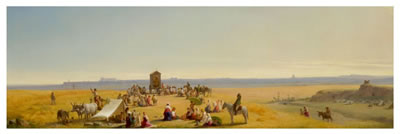
From 1848 to 1889, he lived in Italy almost until his death, doing color etchings of Rome and landscape painting. These compagna paintings were popular with American tourists because they were cheerful and descriptive with colorful images of paintings in bucolic surroundings.
Conrad Wise Chapman and John Linton Chapman were landscape painters and sons of John Gadsby Chapman.
Source:
Matthew Baigell, Dictionary of American Art, pp. 66-67
* For more in-depth information about these terms and others, see AskART.com Glossary http://www.askart.com/AskART/lists/Art_Definition.aspxBiography from The Johnson Collection
JOHN GADSBY CHAPMAN (1808–1889)
Born in Alexandria, John Gadsby Chapman's lineage was steeped in Virginia history, connecting him to prominent commercial and political clans. Following early instruction from two local artists, George Cooke and Charles Bird King, Chapman studied at the Pennsylvania Academy of the Fine Arts before making the requisite artistic pilgrimage to Rome in 1828. There, he copied Old Masters and learned classic drafting technique until 1831. Upon his return to America, Chapman launched a career as a highly productive and respected landscape painter and portraitist, working first in Alexandria, then Washington, D.C., Richmond and Philadelphia. In 1834, the artist moved to New York, earning great success as an illustrator and history painter; two years later, he was elected a full academician to the National Academy of Design. On the heels of these achievements, Chapman was chosen to paint one of the four monumental murals commissioned for the rotunda in the United States Capitol building. His finished panorama, The Baptism of Pocahontas, draws upon Chapman's heritage as a native Virginian familiar with the colonial era.
In 1840, Chapman resumed his career as an illustrator, producing several hundred engravings for a large illuminated edition of the Bible printed by Harper's, as well as images for novels and books of popular verse. He also authored The American Drawing Book, first published in 1847. Described as "A Manual for the Amateur, and Basis of Study for the Professional Artist," the well regarded primer was reissued several times. Yet, Chapman, grieving the loss of two of his young children and plagued by financial instability, was discontent with life in America. In 1848, he held a sale of all of his artwork and possessions and used the proceeds to return to Italy.
Chapman and his family lived in England, Paris and Florence before settling in Rome in 1850. Chapman remained in Italy until 1884, painting scenes of the Roman Campagna for the grand tour trade. Immersed in history and local ambience, Chapman was at peace: "I have every reason to be happy and contented … In a professional point of view I have all that I could desire, facilities of study and production, quiet, profitable association with art and artists of every nation at all times, and … [I am] free from the wearing toil that I formerly endured in New York." When the Civil War curtailed American travel abroad, however, Chapman's fortunes declined. He returned to America in 1884, spending his last years with his sons, the artists Conrad Wise Chapman and John Linton Chapman.
The Bay of Naples is believed to be the prototype for one of Chapman's most successful prints to be found in public collections. Warmly lit and richly colored, it is a classic example of dramatically forced perspective. In the foreground, a vivid genre group rounds the curve of a road which leads the eye to the deep azure blue pool at the foot of the hill, even as the curling tendril of smoke arising from Mount Vesuvius looms in the pale blue-grey background.
The Johnson Collection, Spartanburg, South Carolina
thejohnsoncollection.org