Page loaded successfully. Showing biography for John Marshall Gamble.
John Marshall Gamble BIOGRAPHY

1863 Morristown, New Jersey - 1957 Santa Barbara, California. Known for: Floral landscape and coastal view painting.
Born in Morristown, New Jersey, John Gamble, influenced by French Impressionist painter, Claude Monet, is known for his California floral coastal and landscape paintings, especially fields of poppies... Read full biography
Born in Morristown, New Jersey, John Gamble, influenced by French Impressionist painter, Claude Monet, is known for his California floral coastal and landscape paintings, especially fields of poppies and lupines. From Santa Barbara, he was one of the leaders of the California plein-air painting... Read full biography
Born in Morristown, New Jersey, John Gamble, influenced by French Impressionist painter, Claude Monet, is known for his California floral coastal and landscape paintings, especially fields of poppies and lupines. From Santa Barbara, he was one of the leaders of the California plein-air painting movement, and he was also a successful portrait painter. Another favorite painting subject was coastal views of Pacific Ocean sunsets, and judging by his auction records, he occasionally painted in... Read full biography
Born in Morristown, New Jersey, John Gamble, influenced by French Impressionist painter, Claude Monet, is known for his California floral coastal and landscape paintings, especially fields of poppies and lupines. From Santa Barbara, he was one of the leaders of the California plein-air painting movement, and he was also a successful portrait painter. Another favorite painting subject was coastal views of Pacific Ocean sunsets, and judging by his auction records, he occasionally painted in Arizona and Utah. One of his closest painting companions was Elmer Wachtel. His father worked for a steamship company, and as a teen teenager, Gamble moved with his family to Auckland, New Zealand, and then in 1883, when he was age 20, he went to San... Read full biography
Born in Morristown, New Jersey, John Gamble, influenced by French Impressionist painter, Claude Monet, is known for his California floral coastal and landscape paintings, especially fields of poppies and lupines. From Santa Barbara, he was one of the leaders of the California plein-air painting movement, and he was also a successful portrait painter. Another favorite painting subject was coastal views of Pacific Ocean sunsets, and judging by his auction records, he occasionally painted in Arizona and Utah. One of his closest painting companions was Elmer Wachtel. His father worked for a steamship company, and as a teen teenager, Gamble moved with his family to Auckland, New Zealand, and then in 1883, when he was age 20, he went to San Francisco. There he trained with Virgil Williams and Emil Carlsen at the San Francisco School of Design. Following... Read full biography
Artist Biography
Biography page for John Marshall Gamble ((1863 - 1957)), known for Floral landscape and coastal view painting. Showing 7 biographical entries and 0 sample artworks.
John Marshall Gamble - Artist Info
About John Marshall Gamble
Name variants
John M Gamble
Biography from the Archives of askART
 Born in Morristown, New Jersey, John Gamble, influenced by French Impressionist painter, Claude Monet, is known for his California floral coastal and landscape paintings, especially fields of poppies and lupines. From Santa Barbara, he was one of the leaders of the California plein-air painting movement, and he was also a successful portrait painter.
Another favorite painting subject was coastal views of Pacific Ocean sunsets, and judging by his auction records, he occasionally painted in Arizona and Utah. One of his closest painting companions was Elmer Wachtel.
His father worked for a steamship company, and as a teen teenager, Gamble moved with his family to Auckland, New Zealand, and then in 1883, when he was age 20, he went to San Francisco. There he trained with Virgil Williams and Emil Carlsen at the San Francisco School of Design. Following this period, he went to Paris to study at the Academie Julian with Jean Paul Laurens and Benjamin Constant.
He opened a studio in San Francisco but relocated to Santa Barbara after his studio was lost in the big fire in 1906. For twenty-five years, he was color consultant for the Santa Barbara Board of Architectural Review but made a good living from the sale of his paintings. For the opening of the Fox Arlington Theatre in Santa Barbara, he created a huge panoramic landscape on the stage curtain.
Source:
Edan Hughes, Artists in California, 1786-1940
AskART Auction RecordsBiography from the Archives of askART
 John Marshall Gamble (1863-1957) (Santa Barbara)
“Artists Willis E. Davis and John Gamble left Tuesday on a sketching trip, going in the hills, north of San Luis Obispo – Santa Barbara Press,” per SLO Daily Telegram, Aug. 24, 1907, p. 5 (GB)
Source: Nancy Dustin Wall Moure, MORRO BAY (including LOS OSOS, BAYWOOD PARK and CAYUCOS) ART AND PHOTOGRAPHY BEFORE 1960 (Publications in [Southern] California Art, vol. 13, no. I), Los Angeles: Dustin Publications, 2016.Biography from American Legacy Fine Arts
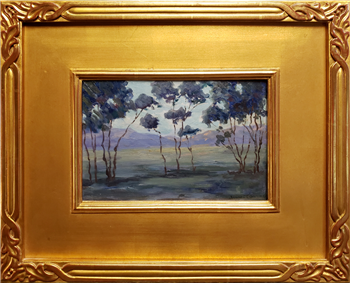 John Marshall Gamble was born on November 25, 1863 in Morristown, New Jersey. His father worked on the Pacific Mail Steamship Company which carried U.S. mail via the San Francisco-Panama City route. His grandfather, John Marshall Gamble (1791-1836), after whom the artist was named, was a Brevet Lieutenant Colonel in the U.S. Marines and the only known U.S. Marine to ever command a U.S. Navy ship. Lieutenant Colonel Gamble commanded the prize ships Greenwich and Sir Andrew Hammond while in naval actions in the Pacific during the War of 1812.
When John Gamble was a teenager, he and his family moved to Auckland, New Zealand. In 1883, at age twenty, he moved to San Francisco. With an interest in art studies, John Gamble enrolled at the San Francisco School of Design (now, San Francisco Art Institute) where he studied under the school’s Director, Virgil Williams 1830-1886), followed by Emil Carlsen (1853-1932), who succeeded Virgil Williams as Director. From 1890 to 1893 Gamble studied in Paris at the Académie Julian under two of the most influential teachers, Jean-Paul Laurens (1838-1921) and Benjamin Constant (1845-1902).
Along with many other artists, Gamble’s San Francisco studio was destroyed in the 1906 earthquake and fire. He planned to move south to Los Angeles to join his friend and fellow artist Elmer Wachtel (1864-1929). However, while en route, he became enamored with Santa Barbara’s colorful countryside blanketed with wildflowers and decided to stay. In Santa Barbara, Gamble painted plein air scenes of the pastoral landscape, surrounding mountains and coastal areas in his inimitable rich colors, loose brush, and atmospheric light. He became active in the Santa Barbara community. He served as a teacher and President of the Board of the Santa Barbara School of the Arts, and for twenty-five years he was a color consultant for the Santa Barbara Board of Architectural Review.
Gamble’s work is primarily known for pristine California landscapes, often including fields of poppies, lupines, and wildflowers over green rolling hills with backgrounds of purple mountains. His brilliant landscapes were so beloved by the local community that he became known as the dean of Santa Barbara painters.
John Marshall Gamble passed away in his Santa Barbara studio from a stroke on April 7, 1957.
SELECTED COLLECTIONS:
Crocker Art Museum, Sacramento, California
The Irvine Museum, Irvine, California
Laguna Art Museum, Laguna Beach, California
Los Angeles County Museum of Art
Auckland Museum of Art, New Zealand
The Oakland Museum, California
Santa Barbara Historical Society, California
California Historical Society, San Francisco
Birmingham Museum of Art, Birmingham, Alabama
Elaine Adams
Director, American Legacy Fine ArtsBiography from The Redfern Gallery
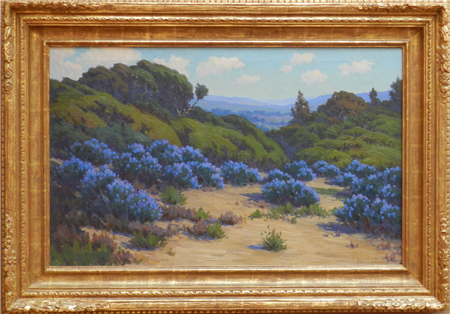 John Gamble was from a family where the father worked for the Pacific Mail Steamship Company, and when John was a teenager he moved with his family to Auckland, New Zealand. At age 20 he moved to San Francisco and began art training at the School of Design under Virgil Williams and Emil Carlsen. After further training in Paris at Academie Julian under Jean Paul Laurens and Benjamin-Constant, he returned to San Francisco and opened a studio.
When his studio and most of the city went up in flames in 1906, he relocated to Santa Barbara and remained there for the rest of his life. Gamble did no commercial art work and earned his living throughout his career from the sale of his paintings. For 25 years he served as color consultant for the Santa Barbara Board of Architectural Review.
Nationally known for his landscapes, his paintings often include poppies, lupine, and other wild flowers against the greens and purples of the California hills.
MEMBERSHIPS
San Francisco Art Association
Santa Barbara Art Association
American Federation of Arts
Foundation of Western Artists
EXHIBITIONS
California Midwinter International Expo, 1894
Mark Hopkins Institute, 1898, 1906
Alaska-Yukon Expo, Seattle, 1909 (gold medal)
San Francisco Art Association, 1916
Stendahl Galleries, LA, 1938
Golden Gate International Exposition, 1939.
PUBLIC COLLECTIONS:
California Historical Society
Oakland Museum
Crocker Museum, Sacramento
Shasta State Park
Museum of Art, Auckland, New Zealand
Fox Arlington Theater, Santa Barbara (murals)
(Source: Hughes, Edan Milton, "Artists in California: 1786-1940," San Francisco: Hughes Publishing Company, 1989.)Biography from William A. Karges Fine Art
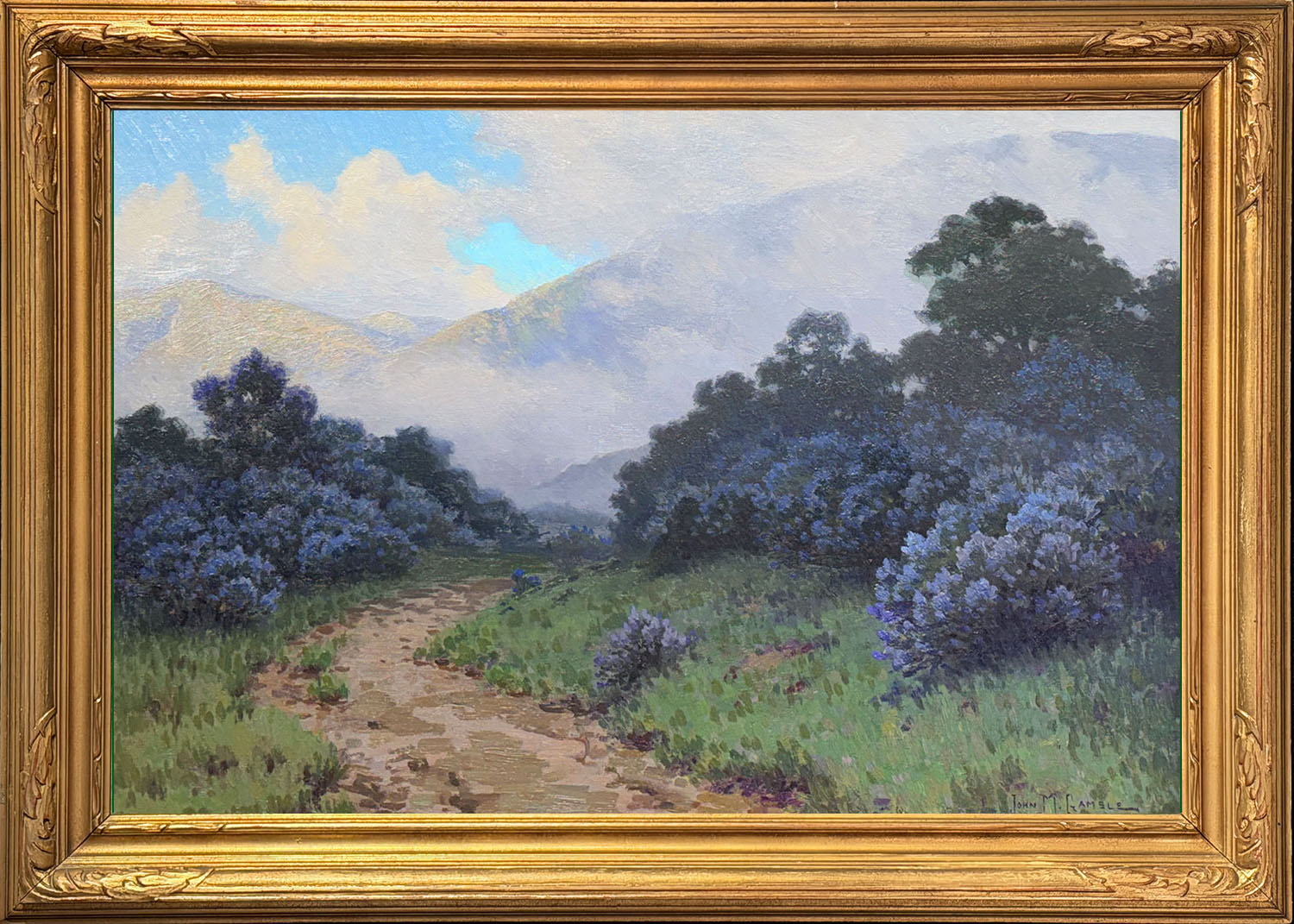 One of Southern California's premier Impressionist artists, John Gamble is best known for his idyllic plein-air landscape paintings. His works set in the Santa Barbara area that feature fields of poppies and lupines, such as this very fine example, are especially sought after by collectors.
Gamble was born in 1863 in New Jersey, later spending time with his family in Auckland, New Zealand before moving to San Francisco in 1883. He studied at the San Francisco School of design with Virgil William and Emil Carlsen before heading to Paris to study at the acclaimed Academie Julian.
He was strongly influenced by French Impressionist artists, especially Claude Monet. Gamble worked in the classic impressionist style, with rich, bold colors, close attention to light and atmospheric effects, and loose brushstrokes.
Gamble had a studio in San Francisco that was lost in the 1906 earthquake and fire. He relocated to Santa Barbara at that time, where he became one of the most prominent plein-air landscape artists in the area. His preferred subjects included coastal scenes, sunsets, and simple, rustic pastoral views of the countryside.
His paintings can be seen in the public collections of the Irvine Museum, the Oakland Museum of California, the Crocker Art Museum, and the Fleischer Museum of American Art.Biography from Greg Thompson Fine Art
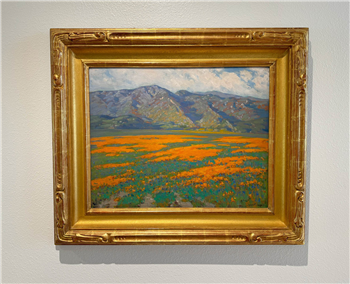 John Marshall Gamble, American (1863-1957)
John Marshall Gamble was an American Impressionist painter who focused on California landscapes and wildflowers. Best known for his plein-air paintings, Gamble worked in the classic Impressionist style showcasing rich colors and loose brushwork with a focus on light and atmospheric effects.
Born in Morristown, New Jersey, Gamble received his early art training at the San Francisco School of Design under Virgil Williams and Emil Carlsen. He later moved to Paris and attended the acclaimed Académie Julian under Jean-Paul Laurens and Benjamin Constant. While in Paris, he also studied at the Académie Colarossi and became inspired by the French Impressionist artists, especially Claude Monet.
Following his studies abroad, Gamble set up a studio in San Francisco where he worked for over a decade. In 1906, the artist’s career hit a turning point when the devastating San Francisco earthquake struck and destroyed his studio. As a result, Gamble relocated to Santa Barbara where he became one of the most prominent plein-air landscape artists in California.
Collectors of Gamble’s art include the Fine Arts Museums of San Francisco, the Crocker Art Museum, the Birmingham Museum of Art and the Los Angeles County Museum among others.Biography from Helene Halperin (formerly DeRu's Fine Arts)
John Marshall Gamble was born in Morristown, New Jersey on November 25, 1863. When John was a teenager he moved with his family to Auckland, New Zealand. At age 20 he moved to San Francisco and began art training at the School of Design under Virgil Williams and Emil Carlsen.
After further training in Paris at Academie Julian under Jean Paul Laurens and Benjamin-Constant, he returned to San Francisco and opened a studio. When his studio and most of the city went up in flames in 1906, he relocated to Santa Barbara and remained there for the rest of his life. Gamble did no commercial artwork and earned his living throughout his career from the sale of his paintings.
For 25 years he served as color consultant for the Santa Barbara Board of Architectural Review. He suffered a stroke in his studio and died on April 7, 1957. Nationally known for his landscapes, his paintings often include poppies, lupine and other wild flowers against the greens and purples of the California hills.