Page loaded successfully. Showing biography for John Wenger.
John Wenger BIOGRAPHY
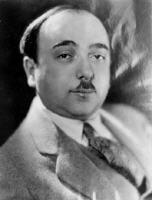
1887 Elizabethgrad, Russia - 1976 New York, New York. Known for: Cityscape (New York scenes), still live, portrait, theatrical paintings, stage set design.
The following biography is submitted by Bob Blumenthal, nephew of the artist:. John Wenger was born on June 16, 1887 in Elizabethgrad, Russia. Wenger was born an artist, and at the age of three was... Read full biography
The following biography is submitted by Bob Blumenthal, nephew of the artist:. John Wenger was born on June 16, 1887 in Elizabethgrad, Russia. Wenger was born an artist, and at the age of three was painting (playing) with brushes and paint while his father, a local artist who painted scenery for... Read full biography
The following biography is submitted by Bob Blumenthal, nephew of the artist:. John Wenger was born on June 16, 1887 in Elizabethgrad, Russia. Wenger was born an artist, and at the age of three was painting (playing) with brushes and paint while his father, a local artist who painted scenery for the traveling theater, worked on drop scenes. His mother disapproved of this and tried to keep her son from playing with these "toys." . When John Wenger was several years older, he attended Gihnazia,... Read full biography
The following biography is submitted by Bob Blumenthal, nephew of the artist:. John Wenger was born on June 16, 1887 in Elizabethgrad, Russia. Wenger was born an artist, and at the age of three was painting (playing) with brushes and paint while his father, a local artist who painted scenery for the traveling theater, worked on drop scenes. His mother disapproved of this and tried to keep her son from playing with these "toys." . When John Wenger was several years older, he attended Gihnazia, which is equivalent to high school but on a college level. Throughout his education Wenger excelled in visual arts. The staff at the Gihnazia school encouraged him to apply to the Imperial Art Academy of Odessa for a scholarship. At the age of... Read full biography
The following biography is submitted by Bob Blumenthal, nephew of the artist:. John Wenger was born on June 16, 1887 in Elizabethgrad, Russia. Wenger was born an artist, and at the age of three was painting (playing) with brushes and paint while his father, a local artist who painted scenery for the traveling theater, worked on drop scenes. His mother disapproved of this and tried to keep her son from playing with these "toys." . When John Wenger was several years older, he attended Gihnazia, which is equivalent to high school but on a college level. Throughout his education Wenger excelled in visual arts. The staff at the Gihnazia school encouraged him to apply to the Imperial Art Academy of Odessa for a scholarship. At the age of thirteen, John Wenger became a student at the academy. For Wenger, this was his first time away from home and he found it to be difficult for seve... Read full biography
Artist Biography
Biography page for John Wenger ((1887 - 1976)), known for Cityscape (New York scenes), still live, portrait, theatrical paintings, stage set design. Showing 2 biographical entries and 0 sample artworks.
John Wenger - Artist Info
About John Wenger
Biography from the Archives of askART
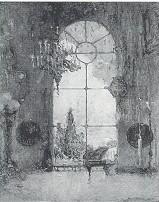 John Wenger was born in 1887 in the small town of Elizabethgrad, near Odessa, in modern-day Ukraine. His father Samuel was a painter. As a young man, John studied at the Imperial Art School of Odessa and was apprenticed to a "dramatic stock company" which played Tolstoy, Ibsen, Chekhov, "Uncle Tom's Cabin" and works of Shakespeare (Migot, 1922; Saturday Evening Post, 1929). This early training planted the seeds of his later artistic successes as one of the United States's great set designers in operatic and theatrical productions.
Wenger moved to the United States around 1908, settling in Newark, where he studied art at the National Academy of Design. He worked as a painter and occasionally exhibited works at the Fulson Galleries in New York. He got his real start as a set designer in 1916 when he became a pioneer of the use of theatrical gauze, a cotton fabric that appears opaque when lit from the front but is see-through when lit from behind.
He went on to have a long career as a painter and set designer for opera houses in Boston and New York, especially the Metropolitan Opera House, and on Broadway, including in the Capitol, Rivoli, and Roxy Theatres and the Radio City Music Hall. He eventually became artistic director at the Rivoli and Rialto theatres. The Brooklyn Daily Eagle described him as an "indefatigable painter who likes to turn out large and ambitiously planned watercolor compositions when he is not otherwise engaged in the designing of theatrical sets" (Brooklyn Daily Eagle, 1936). His most famous productions include "Petrushka" and "Hansel and Gretel" at the Met, "Romeo and Juliet" at Radio City, and George Gershwin musicals like "Oh, Kay!" and "Funny Face" (New York Herald Tribune, 1961).
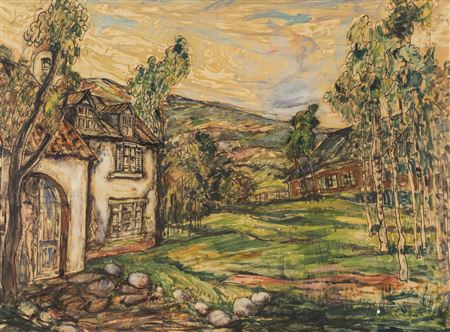
As a painter, he belonged to the "impressionist school with a trend to fluid form" and made "pigments gleam and sparkle like jewels" in the words of the Brooklyn Eagle. In the 1960s, the small Middle Eastern state of Sharjah created a collection of stamps honoring great American artists, featuring John Singer Sargent, Grant Wood, John Wenger, Winslow Homer, James M. Whistler, Gilbert Stuart, and Frederic Remington. Wenger's stamp was of Beethoven.
Notable works in Museum collections include:
Coney Island, 1931, Brooklyn Museum, Brooklyn NY
Come to the Moon, National Collection of Fine Arts, Smithsonian Institution, Washington DC
Mysterioso, Metropolitan Museum of Art, New York, NY
Jazz, 1924, Museum of the City of New York
Bridge of Distance, 1925, Museum of the City of New York
Good Boy, 1926, Museum of the City of New York
Riverside Church, Los Angeles City College
Street of Make Believe, St Vincent College, Latrobe, PA
Over his long career as a painter he exhibited works at the Metropolitan Museum of Art, the Brooklyn Museum, the New York Public Library, the National Academy, the Pennsylvania Academy, the Chicago Art Institute, the Milwaukee Art Institute, the Worcester Art Museum, the 1939 World's Fair, the Architectural League, the Memorial Gallery (Rochester, NY), Corcoran Galleries (Washington DC), and the Stendahl Gallery (Los Angeles, CA), among many other places.
Wenger passed away in 1976 leaving behind his wife Bessie Gordon, children Kenneth Wenger, Estelle Folman, and Lee Krisel, and sister Martha Blumenthal.
References:
Archives of American Art. John Wenger Papers, 1922–1977. Smithsonian Institution. https://www.aaa.si.edu/collections/john-wenger-papers-10109 (also https://edan.si.edu/slideshow/viewer/?eadrefid=AAA.wengjohn_ref9 and https://edan.si.edu/slideshow/viewer/?eadrefid=AAA.wengjohn_ref6)
Brooklyn Daily Eagle. 1936. "One-Man Shows Inaugurate the Season." October 4, 1936.
John Wenger: Artist File — Study Photographs and Reproductions of Works of Art with Accompanying Documentation, 1920–2000.
Migot, Edwin. 1922. "John Wenger." Art Review, October 1922.
New York Herald Tribune. 1934. "Gordon Grant and John Wenger." October 14, 1934
New York Herald Tribune. 1961. "Theater of the Twenties." April 28, 1961.
New York Times. 1976. "John Wenger, 89, A Scenic Artist." August 26, 1976.
Saturday Evening Post. 1929. "Scenery Wizard to Show Paintings." May 6, 1929.
Source/Submitted by: David Lagakos (September 2026)Biography from the Archives of askART
 The following biography is submitted by Bob Blumenthal, nephew of the artist:
John Wenger was born on June 16, 1887 in Elizabethgrad, Russia. Wenger was born an artist, and at the age of three was painting (playing) with brushes and paint while his father, a local artist who painted scenery for the traveling theater, worked on drop scenes. His mother disapproved of this and tried to keep her son from playing with these "toys."
When John Wenger was several years older, he attended Gihnazia, which is equivalent to high school but on a college level. Throughout his education Wenger excelled in visual arts. The staff at the Gihnazia school encouraged him to apply to the Imperial Art Academy of Odessa for a scholarship. At the age of thirteen, John Wenger became a student at the academy. For Wenger, this was his first time away from home and he found it to be difficult for several months.
When he came to America in 1903, John earned his living by designing ladies' costumes and jewelry at his uncle's store in Newark, New Jersey. He then resumed his art studies at Cooper Union and The National Academy of Design.
While in New York, Wenger found an interest in how music and theater connected to art. He rebelled against the heavy sets and hard lines of stage scenery of the time. One day he noticed light upon a mosquito netting on a baby carriage. As the light shifted across the gauze the baby became visible. He took this idea and developed skrim, a gauze-like drop used in theatrical stage design, a device for which Wenger became famous.
John Wenger's first one man show was at the "Folsom Galleries" on 57th St., NY, in 1916. After this show, Wenger received wonderful reviews. A gentleman walked into the gallery on the last day of the show. This gentleman, Frank Conroy, was known as an actor of great fame at the time and had the ability to get Wenger an important job. He left his card with the director of the gallery to give to John Wenger. Wenger didn't pay any attention to the card until a friend came across it and had him call to make an appointment. Frank Conroy was building the Greenwich Village Theater and would open it with an original play, "Ile." Conroy asked Wenger to design a setting for the play and John Wenger agreed. On the opening night of the play, when the curtains rose, a great applause came from the audience for the magnificent setting. After the performance was over, Eugene O'Neill, the writer of the play, embraced Wenger and said, "Young man, the whole world will know about you."
His vast understanding of color and lighting led him to designing stage settings for the Metropolitan Opera Company, the Boston Opera Company, the Greenwich Village Theater, and the Capitol, Rivoli, Rialto, and Roxy Theaters. He also did settings for the Ziefeld Follies, for many of the Metropolitan Opera productions and for numerous ballets and plays. Among his most famous designs were his sets for Gershwin's "Funny Face" at the Alvin Theater in 1927 and "Rhapsody in Blue." He also designed the background for the 1929 movie "Paramount on Parade," in which Maurice Chevalier appeared.
His work has been exhibited internationally over the years, with his paintings represented in numerous art collections, both public and private, throughout the world. In the late 1960's the small Trucial State of Sharjah honored Wenger in the company of 6 other great American artists such as Grant Wood, James Whistler, and Frederic Remington, by issuing a postage stamp featuring one of his paintings. Some of his works are in the permanent collections of the Museum of the City of New York, the Metropolitan Museum, the Brooklyn Museum, The Museum of Modern Art, and the Smithsonian Institute. Other works can be found in Israel at Temple Emeth, Ain Harod Museum, Sholem Aschy Museum, Safad Museum, Mishkah Leomanuth Museum, Clicentein Museum, and the Museum of Tel Aviv.
All of John Wenger's artwork had its own unique style. He was able to provide a profound spirituality and a sense of enchantment through his works.
John Wenger's art came to an end when he died in 1976 at the age of 89, "Leaving a wealth of loveliness in a magnificent collection of his paintings". Wenger was a loving man to his family, friends, and his work. His inspiration of art has been passed from generation to generation throughout his family. If he were still alive, many say, "he would continue to make masterpieces for those to come".