Page loaded successfully. Showing biography for Jose De Creeft.
Jose De Creeft BIOGRAPHY
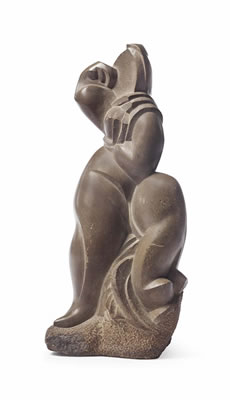
1884 Guadalajara, Spain - 1982 New York City. Known for: Modernist stone sculpture, expressionist sketches, religious images, teaching.
Modernist sculptor, Jose De Creeft was born in Guadalajara, Spain in 1884. Interested in sculpture as a child, De Creeft made and sold works in the streets as a teenager. Before leaving for Paris in... Read full biography
Modernist sculptor, Jose De Creeft was born in Guadalajara, Spain in 1884. Interested in sculpture as a child, De Creeft made and sold works in the streets as a teenager. Before leaving for Paris in 1905 to study further, he was apprenticed, in 1895, to a maker of religious images; in 1898, to the... Read full biography
Modernist sculptor, Jose De Creeft was born in Guadalajara, Spain in 1884. Interested in sculpture as a child, De Creeft made and sold works in the streets as a teenager. Before leaving for Paris in 1905 to study further, he was apprenticed, in 1895, to a maker of religious images; in 1898, to the firm of Masriera and Campin; and in 1900, to the government's official sculptor, Don Augustin Querol. De Creeft left for Paris in 1905, studying briefly at the Academie Julian and in 1911, attended... Read full biography
Modernist sculptor, Jose De Creeft was born in Guadalajara, Spain in 1884. Interested in sculpture as a child, De Creeft made and sold works in the streets as a teenager. Before leaving for Paris in 1905 to study further, he was apprenticed, in 1895, to a maker of religious images; in 1898, to the firm of Masriera and Campin; and in 1900, to the government's official sculptor, Don Augustin Querol. De Creeft left for Paris in 1905, studying briefly at the Academie Julian and in 1911, attended the Maison Greber to learn to reproduce in stone works initially made in clay and plaster. De Creeft broke with his training in modeling and casting in 1915 and turned to direct carving of wood and stone. Through direct carving, his desire to preserve... Read full biography
Modernist sculptor, Jose De Creeft was born in Guadalajara, Spain in 1884. Interested in sculpture as a child, De Creeft made and sold works in the streets as a teenager. Before leaving for Paris in 1905 to study further, he was apprenticed, in 1895, to a maker of religious images; in 1898, to the firm of Masriera and Campin; and in 1900, to the government's official sculptor, Don Augustin Querol. De Creeft left for Paris in 1905, studying briefly at the Academie Julian and in 1911, attended the Maison Greber to learn to reproduce in stone works initially made in clay and plaster. De Creeft broke with his training in modeling and casting in 1915 and turned to direct carving of wood and stone. Through direct carving, his desire to preserve the natural qualities of the material met his interests in the sculptural arts of Pre-Columbian America and Africa. Respected in academ... Read full biography
Artist Biography
Biography page for Jose De Creeft ((1884 - 1982)), known for Modernist stone sculpture, expressionist sketches, religious images, teaching. Showing 3 biographical entries and 0 sample artworks.
Jose De Creeft - Artist Info
About Jose De Creeft
Name variants
Jose Decreeft
Biography from the Archives of askART
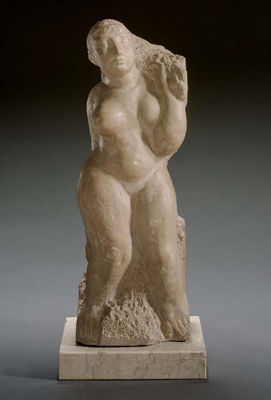 Modernist sculptor, Jose De Creeft was born in Guadalajara, Spain in 1884. Interested in sculpture as a child, De Creeft made and sold works in the streets as a teenager. Before leaving for Paris in 1905 to study further, he was apprenticed, in 1895, to a maker of religious images; in 1898, to the firm of Masriera and Campin; and in 1900, to the government's official sculptor, Don Augustin Querol.
De Creeft left for Paris in 1905, studying briefly at the Academie Julian and in 1911, attended the Maison Greber to learn to reproduce in stone works initially made in clay and plaster. De Creeft broke with his training in modeling and casting in 1915 and turned to direct carving of wood and stone. Through direct carving, his desire to preserve the natural qualities of the material met his interests in the sculptural arts of Pre-Columbian America and Africa.
Respected in academic circles, De Creeft was commissioned in 1918 to sculpt a granite war memorial in Saugues (Puy de Dome) dedicated to the French foot soldier, "Le Poilu." In 1925, and for a short time after, he experimented with assemblage techniques, but De Creeft remained a carver. From 1927 to 1929, he created two hundred stone carvings for Roberto Romonje's Forteleza in Majorca, Spain. De Creeft began exhibiting regularly in modernist exhibitions such as the Salon d'Automne between 1919-28.
He emigrated to America in 1929 with his reputation as a direct carver already secure and had his first solo exhibition at Feragil Galleries in New York. De Creeft helped to popularize both direct-carving methods and, beginning the following year, the use of ballpeen hammers to make three-dimensional forms from lead sheets (Les Deux Amis, 1941, Norton Gallery, and School of Art, West Palm Beach, Florida). In styles ranging from Art Moderne to Expressionism, he projected an opulence of gesture.
De Creeft was also a teacher of sculpture in New York City at the New School of Social Research, 1932-39; the Art Students League, 1944-48; and Black Mountain College, the summer of 1944. De Creeft earned United States citizenship in 1940.
In 1951, Jose De Creeft sculpted the Poet for Philadelphia's Fairmount Park Association.
De Creeft never lost his interest in casting despite the strong appeal of direct carving. New Being is a brass casting that retains the rough textures of the red Spanish marble version (Kingsborough Community College, Brooklyn, New York). New Being possesses a distinctive Pre-Columbian character, possibly the inspiration of the Mayan Chac Mool figures at Chichen Itza, which also influenced Henry Moore.
De Creeft once said, "Sculpture is the creation of three-dimensional form in space. In my opinion, the most fundamental principle required to obtain that end is the use of massive volume and contour. I cannot believe that sculpture is a mechanical toy, a feat of engineering, or a series of spaces in material."
Source:
Matthew Baigell, Dictionary of American Artists
Wichita State University, http://webs.wichita.eduBiography from Levis Fine Art
Starting from his humble beginnings in Spain to his early international success in Paris, which was subsequently surpassed in America, Jose de Creeft forged his name in stone as a major American artist by the early 1940's. Known as one of the major contributors in developing key techniques in modernist sculpting, de Creeft drew from a wide variety of resources, among them primitivism, tribalism, abstraction, linearism, Folk Art, and his imagination, to create works which duly supported his ingenuity as an artist and capitalized on his versatility in successfully using any medium, style and theme. Most importantly, de Creeft's oeuvre retains all of the nuances and elements of human expression in its most intimate and fleeting moments. He successfully captured the soul of the medium and subject matter, transcending his emotional energy through his carving.
In 1915 de Creeft was living in Paris among the modernist artists of the first wave of modernism. Picasso, Gris, Miro and Braque were all instrumental in the European and American modernist movements and the Parisian ambiance set the stage for invaluable discussions on art, criticism and methodology. Desiring to formulate his own personal aesthetic, de Creeft departed from the traditional techniques and traditions of sculpting, which helped frame the conservative academic institutions worldwide, and instead wholeheartedly applied himself to the process of "taille direct", direct carving.
This method of carving allowed de Creeft to be a part of the entire process of creating a finished piece, one which was not defined as the result of a preconceived determination, but instead as a result of the unbridled spontaneity necessary for artistic fulfillment. Each sculpture embodies his philosophy that the relationship between the artist and his body of work is "reciprocal rather than hierarchical", allowing each to evolve from the relationship between the artisan and the innate personality of each material.
In addition to sculpting, de Creeft thoroughly enjoyed the art of painting, and drawing specifically, because it allowed him the most rapid documentation of his thoughts. It provided a means of expressing that which was too laborious to carve. The two-dimensional mediums and techniques allowed him to create an imaginary world, filled with animals, characters and landscapes, all which attested to his unwavering interest in "expressing his beliefs and feelings about life and to elevate mankind by demonstrating man's creative aspirations". (De Creeft, 1945). These works incorporate an imaginative world of both land and sea animals, both entangled and disassociated, delivering only the most necessary of features, a clear testament to his primitive and African influences.
Within his lifetime de Creeft was awarded the opportunity for several important public commissions including two hundred stone sculptures for the Fortaleza in Mallorca (1927-29), the Alice and Wonderland bronze group in New York City (1957-59), and the Nurses mosaic mural at the Bronx Municipal Hospital (1961-62) to name a few.
His work was included in numerous solo exhibitions around the world including a major retrospective at the Fundació Joan Miró in Barcelona in 1980, which circulated throughout seven different cities in Spain, a retrospective at the Whitney Museum of American Art in 1960 and major exhibition at the National Museum of Art, Washington D.C. in 1983. In addition, de Creeft has a long group exhibition history at landmark institutions such as the Art Institute of Chicago, The Brooklyn Museum, the Metropolitan Museum of Art and the Museum of Modern Art in Manhattan.
© 2008 Levis Fine Art, Inc.Biography from The Johnson Collection
JOSÈ MARIANO DE CREEFT (1884–1982)
Modernist sculptor José Mariano de Creeft was a strong advocate for “direct carving” or taille directe—allowing chisel marks to remain visible—rather than being polished away—and serve as an expressive element of a finished work. In a review of the Spaniard’s oeuvre, Southern author Eudora Welty observed in the Magazine of Art that “de Creeft’s imagination, abundant and profound, generous, daring, ardent, yet always coherent, above all utilizes the material at his hand.” Later in his career, de Creeft drew praise for his assemblages of found objects, a practice that brought him much satisfaction: “From my earliest youth I have always found pleasure in giving life to old objects that have lost their usefulness . . . to deliver them from obscurity.”
Born in Guadalajara, Spain, de Creeft’s family relocated to Barcelona shortly after his birth. Because the family was poor, six-year-old José took a job moving stones at the site of Antonio Gaudi’s famed La Sagrada Familia. He later began to craft small religious figures in clay before taking an apprenticeship with a man who carved wooden figures. In his mid-teens, de Creeft went to Madrid and was employed in the workshop of Spain’s official sculptor, Don Augustin Querol Subirats.
In 1905, de Creeft moved once again, this time to Paris where he was befriended by fellow Spaniards Juan Gris and Pablo Picasso. He was encouraged by Auguste Rodin to enroll at the Académie Julian, and soon began to exhibit pieces in avant-garde venues. To support himself financially, he worked from 1911 to 1914 at a firm that repaired statues using traditional sculptural methods. World War I brought several lean years, but at its conclusion, de Creeft was commissioned to carve an eighteen-foot-tall French infantry soldier or “doughboy” in granite; Le Poilu still stands in the town center of Saugues. He spent three years during the 1920s on the island of Majorca overseeing the restoration of La Fortaleza, his friend Roberto Ramojé's 17th century fortress, during which time he carved over two hundred pieces. After his 1929 marriage to American Alice Robertson Carr, a sculptor known for her bronze portraits of notable horses, Jose and Alice immigrated to the United States and participated in several exhibitions before the stock market crash dampened patronage for sculpture. Simultaneously, he began to suffer pulmonary difficulties as a consequence of his prolonged exposure to stone dust. Although the marriage didn’t last, Jose and Alice had two children before divorcing in 1939.
During the 1930s, de Creeft’s career was reinvigorated; he pursued direct carving as well as beaten lead in simplified figurative works that return again and again to the female form, and often reflect the influence of such non-western cultures as African and Mayan. He began teaching in 1932, first at the New School for Social Research in New York, followed by a long stint at the Art Students League. Called “Pepe” by his friends, de Creeft was recognized for his sense of humor, a quality that served him well at Black Mountain College near Asheville, North Carolina, during the summer of 1944, a term filled with shortages and internal strife. He managed to provide some comic relief by staging a mock bullfight replete with matadors, toreadors, and beautiful Spanish ladies. At Black Mountain College, de Creeft also met sculptor Lorrie Goulet, and the two were married in 1945.
According to his obituary, work by de Creeft was featured in thirty-seven one-man exhibitions, culminating in 1960 with a retrospective at the Whitney Museum of American Art that traveled to thirteen additional venues. In 1973, he was one of three American sculptors chosen for inclusion at the Vatican Museum of Modern Art in Rome. His most beloved sculpture, however, is the 1959 bronze statue, Alice in Wonderland, which serves as the child-friendly centerpiece of a fountain in New York’s Central Park.
The Johnson Collection, Spartanburg, South Carolina
thejohnsoncollection.org