Page loaded successfully. Showing biography for Joseph A Fiore.
Joseph A Fiore BIOGRAPHY
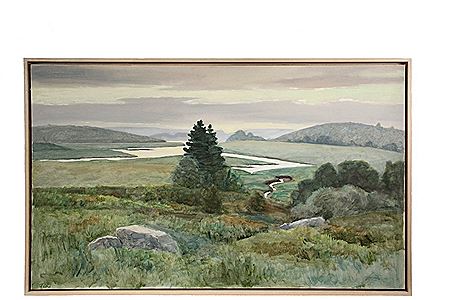
1925 Cleveland, Ohio - 2008 New York City. Known for: Abstract painting-modernist-leaning landscape, teaching.
While working and teaching at the Artists for Environment program in what later became the Delaware Water Gap National Recreation Area, Fiore began to include landscape painting in his own work, and... Read full biography
While working and teaching at the Artists for Environment program in what later became the Delaware Water Gap National Recreation Area, Fiore began to include landscape painting in his own work, and in 1959, he and his wife began spending summers in Maine, where they bought an old farmhouse and... Read full biography
While working and teaching at the Artists for Environment program in what later became the Delaware Water Gap National Recreation Area, Fiore began to include landscape painting in his own work, and in 1959, he and his wife began spending summers in Maine, where they bought an old farmhouse and subsequently spent time for over 50 years. He became an active member of the art community in Maine, showing his work at galleries and museums. Joseph Fiore died at home in New York City on September 18,... Read full biography
While working and teaching at the Artists for Environment program in what later became the Delaware Water Gap National Recreation Area, Fiore began to include landscape painting in his own work, and in 1959, he and his wife began spending summers in Maine, where they bought an old farmhouse and subsequently spent time for over 50 years. He became an active member of the art community in Maine, showing his work at galleries and museums. Joseph Fiore died at home in New York City on September 18, 2008. Source:. Obituary, Village Soup, September 24, 2008... Read full biography
While working and teaching at the Artists for Environment program in what later became the Delaware Water Gap National Recreation Area, Fiore began to include landscape painting in his own work, and in 1959, he and his wife began spending summers in Maine, where they bought an old farmhouse and subsequently spent time for over 50 years. He became an active member of the art community in Maine, showing his work at galleries and museums. Joseph Fiore died at home in New York City on September 18, 2008. Source:. Obituary, Village Soup, September 24, 2008... Read full biography
Artist Biography
Biography page for Joseph A Fiore ((1925 - 2008)), known for Abstract painting-modernist-leaning landscape, teaching. Showing 4 biographical entries and 0 sample artworks.
Joseph A Fiore - Artist Info
About Joseph A Fiore
Biography from the Archives of askART
 While working and teaching at the Artists for Environment program in what later became the Delaware Water Gap National Recreation Area, Fiore began to include landscape painting in his own work, and in 1959, he and his wife began spending summers in Maine, where they bought an old farmhouse and subsequently spent time for over 50 years. He became an active member of the art community in Maine, showing his work at galleries and museums.
Joseph Fiore died at home in New York City on September 18, 2008.
Source:
Obituary, Village Soup, September 24, 2008Biography from Carlson Gallery
Joseph A. Fiore studied at Black Mountain College under Josef Albers, Ilya Bolotowsky and Willem de Kooning from 1946-1948. Fiore studied at the California School of Fine Art from 1948-49 and taught at Black Mountain College, 1949-1956. He served as the Chairman of the Art Department at Black Mountain College, 1951-1956; Philadelphia College of Art, 1962-1970; National Academy of Design, New York, spring, 1979; Parsons, summer 1979.
Solo Exhibitions: Staempfli Gallery, New York, 1960; Schoelkopf Gallery, 1965, 1969; Green Mountain Gallery, 1973; John B. Myers Gallery, 1974; Fischbach Gallery, 1977, 1981; Art at Black Mountain, Grey Gallery, New York University, 1987; others.
Selected Group Exhibitions: 68th Annual Painting and Sculpture Exhibition of the San Francisco Art Association at the San Francisco Museum of Art, 1949
Public Collections: Whitney Museum of American Art; Chase Manhattan Collection, New York; Corcoran Gallery, Washington, D.C.; National Academy of Design
Literature: Fairfield Porter, The Oriental in American Art, Art in its Own Terms; Mary E. Harris, The Arts at Black Mountain College; Peter Hastings Falk, Editor, Who was Who in American Art.Biography from Anita Shapolsky Gallery
Born in 1925, Joseph Fiore studied and taught at Black Mountain College in North Carolina. Later teaching positions included those at the Philadelphia College of Art, Maryland College of Art and the National Academy.
At Black Mountain College, Mr. Fiore studied with Josef Albers and Ilya Bolotowsky. Later, he studied with Willem de Kooning, Jacob Lawrence and Jean Varda.
Joseph Fiore was a member of the 10th Street Art Scene in the late '50s and '60s, a group of galleries that showed his work and the work of Alex Katz, Lois Dodd, Bernard Langlais, and others.
He has had one-person shows in New York at Staempfli Gallery (reviewed by Fairfield Porter), Schoelkoph Gallery, Fischbach Gallery, and others. His work is in the permanent collections of the Whitney Museum, Corcoran Gallery and the National Academy, among others.
In May of 2001, Joseph Fiore was awarded the Andrew Carnegie Prize at the National Academy of Design in New York. The Carnegie Prize is awarded "for painting," at the National Academy's Members' Show and carries a stipend.Biography from The Johnson Collection
JOSEPH ALBERT FIORE (1925–2008)
Joseph Albert Fiore ascended the ranks of Black Mountain College, first as a summer student, then full-time enrollee, and later as one of the school’s longest tenured professors. Throughout his nearly sixty-year artistic career, Fiore experimented with a multitude of techniques—from gestural brushwork, geometric shapes, and amorphous forms—never fully committing to any particular mode. Born in Cleveland, Ohio, Fiore belonged to a family that embraced the arts: his grandfather was an Italian architectural painter, and his father Salvatore played the violin for the Cleveland Orchestra. Studio classes at the Cleveland Museum of Art piqued his interest, but it was an article about an experimental liberal arts college in North Carolina, Black Mountain College, that prompted Fiore to pursue a formal arts education. His conscription into the army during World War II delayed his matriculation, which finally took place in 1946.
Fiore’s initial acceptance was limited to the college’s summer session, during which time he studied under director Josef Albers as well as Jacob Lawrence, whose use of color intrigued him. Under the auspices of the G.I. Bill, Fiore reapplied as a regular student and started classes that fall. Fiore found himself drawn to Albers’s sabbatical replacement, Ilya Bolotowksy. The gregarious Russian émigré permitted greater creative autonomy than the more regimented Albers allowed and was quite popular with the student body. From 1948 to 1949, Fiore attended the California School of Fine Art (later the San Francisco Art Institute), but returned to Asheville in the summer of 1949. He was appointed to the college’s faculty member that autumn, a position he would hold for the next seven years. Tragedy struck in 1953 when a fire destroyed most of Fiore’s belongings; as a result, few works made during the artist’s time at Black Mountain survive.
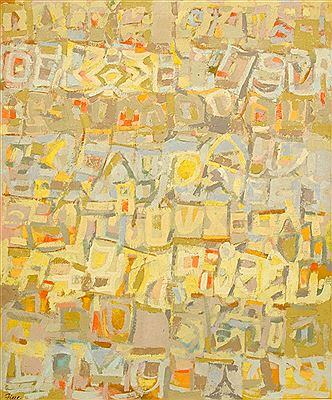
After the college’s dissolution in 1957, Fiore and his wife, a former Black Mountain student, moved to New York. Through connections he had made in North Carolina, Fiore began exhibiting his work—which included representational and abstract compositions, as well as collages—to critical acclaim. He continued to teach, filling faculty posts at the Philadelphia College of Art and the Maryland College of Art. By the 1960s, Fiore’s style had shifted, and he started to produce semi-realistic landscape paintings. Writing about Fiore’s solo show at New York’ Staempfli Gallery in the November 5, 1960 edition of The Nation, noted critic Fairfield Porter praised the artist’s interpretations of “a fragment of Nature’s whole” which Porter said emphasized relationships over objects. Fiore’s new focus may have been inspired by the purchase of a summer house in Maine and his growing interest in environmental issues. In 1980, Fiore taught a summer program sponsored by Parsons School of Design at Les Eyzies in southwestern France. The Dordogne region is home to several prehistoric sites, and Fiore soon began to incorporate pictograms and petroglyphs into his paintings.
Joseph Fiore was honored with the National Academy of Design’s prestigious Andrew Carnegie Prize in 2001. His work can be found in the collections of the National Gallery of Art and the Whitney Museum of American art, among others. His commitment to conservation lives on through the Joseph A. Fiore Art Center at Rolling Hills Farm, a program of the Maine Farmland Trust which hosts art residencies and mounts exhibitions.
The Johnson Collection, Spartanburg, South Carolina
thejohnsoncollection.org