Page loaded successfully. Showing biography for Joseph Hecht.
Joseph Hecht BIOGRAPHY
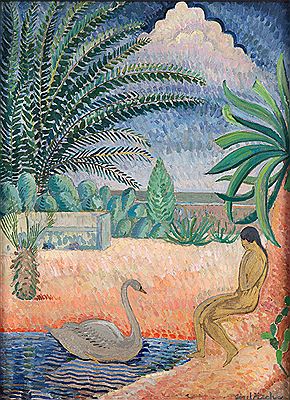
1891 - 1951. Known for: Sculpture.
Although his works are included in the most prestigious collections in Europe and the United States, he is almost completely unknown in his homeland. Only printmaking enthusiasts nod knowingly when... Read full biography
Although his works are included in the most prestigious collections in Europe and the United States, he is almost completely unknown in his homeland. Only printmaking enthusiasts nod knowingly when his name is mentioned. His paintings are largely absent from studies of 20th-century Polish art,... Read full biography
Although his works are included in the most prestigious collections in Europe and the United States, he is almost completely unknown in his homeland. Only printmaking enthusiasts nod knowingly when his name is mentioned. His paintings are largely absent from studies of 20th-century Polish art, likely due to his often groundbreaking artistic solutions and lack of adherence to mainstream artistic movements. Why has one of the most outstanding Poles active in Paris during the interwar period been... Read full biography
Although his works are included in the most prestigious collections in Europe and the United States, he is almost completely unknown in his homeland. Only printmaking enthusiasts nod knowingly when his name is mentioned. His paintings are largely absent from studies of 20th-century Polish art, likely due to his often groundbreaking artistic solutions and lack of adherence to mainstream artistic movements. Why has one of the most outstanding Poles active in Paris during the interwar period been forgotten in his native country? Józef (Mojzesz) Hecht was born in 1891 in Lódz, into a Jewish family. His family belonged to the middle class, most likely associated with the textile trade. In 1909, young Hecht, not yet eighteen, began his studies... Read full biography
Although his works are included in the most prestigious collections in Europe and the United States, he is almost completely unknown in his homeland. Only printmaking enthusiasts nod knowingly when his name is mentioned. His paintings are largely absent from studies of 20th-century Polish art, likely due to his often groundbreaking artistic solutions and lack of adherence to mainstream artistic movements. Why has one of the most outstanding Poles active in Paris during the interwar period been forgotten in his native country? Józef (Mojzesz) Hecht was born in 1891 in Lódz, into a Jewish family. His family belonged to the middle class, most likely associated with the textile trade. In 1909, young Hecht, not yet eighteen, began his studies at the Academy of Fine Arts in Kraków. He chose the studio of Wojciech Weiss, a Symbolist who, along with Józef Pankiewicz, was an authority on artis... Read full biography
Artist Biography
Biography page for Joseph Hecht ((1891 - 1951)), known for Sculpture. Showing 2 biographical entries and 0 sample artworks.
Joseph Hecht - Artist Info
About Joseph Hecht
Biography from Polswissart
Although his works are included in the most prestigious collections in Europe and the United States, he is almost completely unknown in his homeland. Only printmaking enthusiasts nod knowingly when his name is mentioned. His paintings are largely absent from studies of 20th-century Polish art, likely due to his often groundbreaking artistic solutions and lack of adherence to mainstream artistic movements. Why has one of the most outstanding Poles active in Paris during the interwar period been forgotten in his native country? Józef (Mojzesz) Hecht was born in 1891 in Lódz, into a Jewish family. His family belonged to the middle class, most likely associated with the textile trade. In 1909, young Hecht, not yet eighteen, began his studies at the Academy of Fine Arts in Kraków. He chose the studio of Wojciech Weiss, a Symbolist who, along with Józef Pankiewicz, was an authority on artistic innovations brought from Paris. At the time, Kraków was gripped by the decadent Young Poland movement. However, this climate would not dominate the young artist's work; he would seek his own artistic solutions. He would find inspiration in his travels across Europe, which he began while still a student. He would visit, among other places, Capri, one of the artistic meccas of the time, where he would encounter the latest trends emerging in the French capital. His mind will be stimulated by the still lifes of Paul Gauguin and the landscapes of Vincent van Gogh. Hecht arrived in Paris, the most coveted place for young artists to study, in the spring of 1920. Thanks to a friendship with Moïse Kogan, a sculptor associated with the École de Paris, he rented a studio in the Montparnasse district, at 14 Cité Falguiére. A whole colony of artists inhabited the street, including Pablo Picasso, Amedeo Modigliani, and Tsuguharu Foujita. A few steps away was the famous art studio "La Ruche," with works by Cubists, Expressionists, and other avant-garde artists. Among the Poles in Montparnasse, Moses Kisling, Hecht's older classmate from the Krakow Academy, was the leading figure. Mela Muter, Leopold Gottlieb, and Eugeniusz Zak also lived there. At the beginning of his stay in Paris, the Lódz native painted a series of Cubist cityscapes using a simplified palette. He captured the Boulevard Edgar Quinet, Cité Falguiére, Rue Dauphine, and Moulin de la Galette. These famous views of the French capital would also become the subject of his later graphic art portfolio. In 1922, together with other Polish émigré artists, Hecht participated in the 1st International Exhibition of New Art in Düsseldorf – a show showcasing the latest trends in European art at the time. Four years later, his first solo exhibition took place at the renowned Berthe Weill Gallery, which popularized the most avant-garde Parisian art. It was then that the artist met William Stanley Hayter, who would soon become his student and devoted friend. This relationship led to the founding of Atelier 17, which would play a significant role in the development of modern and contemporary graphic art. What distinguishes Józef Hecht's work? Initially in Paris, he explored similar themes and drew inspiration from artists considered part of the Paris School. There are certain parallels with the work of Mojzesz Kisling, who drew from the same Krakow experiences, particularly in his nudes and landscapes depicting Mediterranean nature. Gradually, however, Hecht's work took on an increasingly original expression. Stylized forms emerged, resembling Art Deco aesthetics, along with simplifications and the intensification of colors so readily employed by the Fauvists to enhance the work's expressiveness. In addition to typical landscapes, an increasing number of his works incorporate symbolic elements, with wild animals becoming their protagonists. While residing in the intercultural melting pot of Paris, the painter maintained no close ties with the Polish artistic colony. He pursued his own, individual path.Biography from Desa Unicum
After military service, Józef Hecht, thanks to the help of his family, devoted himself entirely to artistic creation. In the years 1909-1914 he studied at the Academy of Fine Arts in Kraków. At that time, he also made artistic trips to Vienna, Rome and Capri. At the outbreak of the Great War, Hecht arrived in Berlin, from where he went to Norway and stayed until 1919. There he came into contact with the expressionist painter Isaac Grünewald. Living in a small town near Oslo, he created oil paintings, drawings and graphics, and the Oslo Kunstforening hosted two exhibitions of his works (1918 and 1919).
After arriving in Paris, he joined the artistic life of an international art colony. Enjoying the friendship of the sculptor Moses Kogan, he entered the milieu of artists working in Cité Falguière. In the interwar period, the main theme of his work was animals, which he was able to study at the Jardin des Plantes. At that time, he probably developed the most as a graphic designer and illustrator. The presented still life reveals Hecht's color and compositional virtuosity. Multicolored fields have been filled with synthetic forms, sometimes with circular brushstrokes, sometimes with wide impasto characteristic of the painter.
In the presented work, the reference to Henri Matisse's painting seems to be clear. Multicolored fields have been filled with synthetic forms, sometimes with circular brushstrokes, sometimes with wide impasto characteristic of the painter. In the presented work, the reference to Henri Matisse's painting seems to be clear. Multicolored fields have been filled with synthetic forms, sometimes with circular brushstrokes, sometimes with wide impasto characteristic of the painter. In the presented work, the reference to Henri Matisse's painting seems to be clear.