Page loaded successfully. Showing biography for Joseph Jacinto Mora.
Joseph Jacinto Mora BIOGRAPHY

1876 Montevideo, Uruguay - 1947 Monterey, California. Known for: Photogdraphy, illustration, sculpture.
Devoting his life to exploration of subjects as diverse as vaqueros, Hopi Kachina figures, the Arizona landscape, and California missions, Joseph Mora also excelled as a writer, photographer,... Read full biography
Devoting his life to exploration of subjects as diverse as vaqueros, Hopi Kachina figures, the Arizona landscape, and California missions, Joseph Mora also excelled as a writer, photographer, designer, children's book illustrator, and map maker. Mora was born in Montevideo, Uruguay, and was the son... Read full biography
Devoting his life to exploration of subjects as diverse as vaqueros, Hopi Kachina figures, the Arizona landscape, and California missions, Joseph Mora also excelled as a writer, photographer, designer, children's book illustrator, and map maker. Mora was born in Montevideo, Uruguay, and was the son of Domingo Mora, a well-known painter and sculptor who brought his family to the United States in the mid 1890s and then became a teacher in New York at the Art Students League. Joseph and his artist... Read full biography
Devoting his life to exploration of subjects as diverse as vaqueros, Hopi Kachina figures, the Arizona landscape, and California missions, Joseph Mora also excelled as a writer, photographer, designer, children's book illustrator, and map maker. Mora was born in Montevideo, Uruguay, and was the son of Domingo Mora, a well-known painter and sculptor who brought his family to the United States in the mid 1890s and then became a teacher in New York at the Art Students League. Joseph and his artist brother Luis Mora (1874-1940) grew up being much influenced by the creative atmosphere of their father's studio. Joseph studied at the Pingry Academy in Elizabeth, New Jersey; the Art Students League with his father in New York City; and then in... Read full biography
Devoting his life to exploration of subjects as diverse as vaqueros, Hopi Kachina figures, the Arizona landscape, and California missions, Joseph Mora also excelled as a writer, photographer, designer, children's book illustrator, and map maker. Mora was born in Montevideo, Uruguay, and was the son of Domingo Mora, a well-known painter and sculptor who brought his family to the United States in the mid 1890s and then became a teacher in New York at the Art Students League. Joseph and his artist brother Luis Mora (1874-1940) grew up being much influenced by the creative atmosphere of their father's studio. Joseph studied at the Pingry Academy in Elizabeth, New Jersey; the Art Students League with his father in New York City; and then in Boston at the Cowles Art School, and with William Merritt Chase. He worked as a staff artist and cartoonist for the Boston Herald a... Read full biography
Artist Biography
Biography page for Joseph Jacinto Mora ((1876 - 1947)), known for Photogdraphy, illustration, sculpture. Showing 2 biographical entries and 0 sample artworks.
Joseph Jacinto Mora - Artist Info
About Joseph Jacinto Mora
Biography from the Archives of askART
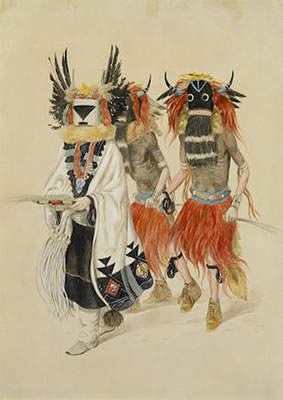 Devoting his life to exploration of subjects as diverse as vaqueros, Hopi Kachina figures, the Arizona landscape, and California missions, Joseph Mora also excelled as a writer, photographer, designer, children's book illustrator, and map maker.
Mora was born in Montevideo, Uruguay, and was the son of Domingo Mora, a well-known painter and sculptor who brought his family to the United States in the mid 1890s and then became a teacher in New York at the Art Students League.
Joseph and his artist brother Luis Mora (1874-1940) grew up being much influenced by the creative atmosphere of their father's studio. Joseph studied at the Pingry Academy in Elizabeth, New Jersey; the Art Students League with his father in New York City; and then in Boston at the Cowles Art School, and with William Merritt Chase. He worked as a staff artist and cartoonist for the Boston Herald and then in 1894, when he was age 18, took a four-year horseback sketching and writing tour of Mexico, the American Southwest, and Texas. On this trip, he worked as a cow puncher on ranches along the way to earn money.
In 1903, he headed West again and joined his parents who were living in San Jose, California. In 1904, he returned to Arizona and New Mexico and lived with Hopi and Navajo tribes, learning their languages and painting depictions of their ceremonies, especially the Kachina ceremonial dances.
One of the results of his western travels was a series of humorous maps that were spoofs of the national parks and that were made into posters. In the 1930s, the maps sold for 25 cents each and were distributed through souvenir shops at the parks. He also painted a watercolor series, "Horsemen of the West" and wrote two books, Trail Dust and Saddle Leather and Californios.
In 1907, he married and bought a ranch in the Santa Clara Valley where he and his father worked together on sculpture commissions until the father died in 1911. In 1914, Mora and his wife moved to San Francisco, and then in 1920 to Carmel, where he completed his most famous work, the Father Serra group of sculpted figures that was placed at the San Carlos Mission.
Joseph Mora died in Pebble Beach on October 10, 1947.
In 1998, the Monterey Museum of Art held a retrospective of his work which includes sculpture and architectural adornments.
Source:
Edan Hughes, Artists in California, 1786-1940
Santa Fe Auction catalogue, 11/09/2002
Peter Hassrick, Drawn to Yellowstone
Peter Hastings Falk, Editor, Who Was Who in American Art
Peggy and Harold Samuels, Encyclopedia of Artists of the American WestBiography from Hubbell Trading Post National Historic Site
Joseph Jacinto Mora was a painter and sculptor who was born in Montevideo, Uruguay on October 22, 1876. He was a pupil of his father Domingo Moro, the famed Spanish painter and sculptor, and a French mother, Laura Laillard Mora. His early life was spent in Uruguay, South America. His parents brought him to the United States; where his father taught art at Perth Amboy, New Jersey; Boston and New York City.
Mora's art career was encouraged and fostered by his father, of whom he was a pupil. He also studied under J. DeCamp and J.C. Beckwith. At the turn of the century he began sketching the southwestern states, camping first near Walpi on the Hopi Reservation. From there he ranged far, studying and sketching both the Navajo and the Hopi. "Keams Canyon Trading Post" and "Navajo Riding" are among the watercolors Mora gave to Lorenzo Hubbell when he visited his trading post at Ganado, Arizona.
When Mora moved to Monterey, California, he followed the route of the padres along El Camino Real, camping and sketching along the way. His illustrated book about the mission era, Californios, was published in 1949. He was a member of the National Sculpture Society. His sculpture, "Cervantes Monument" can be found in San Francisco, California; "Doughboy" in San Rafael, California; "Bret Harte Memorial" at the Bohemian Club in San Francisco; and "Junipero Serro Sarcophagus" in Mission San Carlos in Carmel, California to name a few.
Mora died in Monterey, California at his Pebble Beach home on October 10, 1947.
REFERENCES:
Brody, J.J. Pueblo Indian Painting: Tradition and Modernism in New Mexico, 1900-1930. Santa Fe: School of American Research Press. 1997.1985.
Dawdy, Doris Ostrander. Artists of the American West: A Biographical Dictionary. [1974] 3 vols. Chicago: Swallow Press. 1985.
Hughes, Edan Milton. Artists in California: 1786-1940. San Francisco: Hughes Publishing Company. 1986.
Samuels, Peggy and Harold. Samuels' Encyclopedia of Artists of the American West. New Jersey: Castle. 1985.