Page loaded successfully. Showing biography for Joseph Parrocel.
Joseph Parrocel BIOGRAPHY
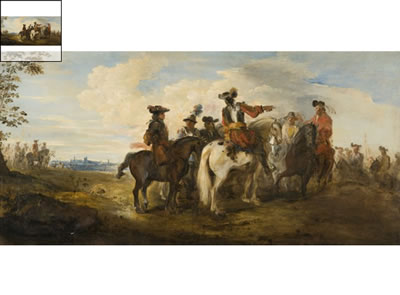
1646 Paris - 1704. Known for: Genre scene ink drawings, religious themes, figures in landscape paintings.
Son of art, Joseph Parrocel belongs to a family of high-ranking artists, more or less known for the small number of works received. Among these, it is worth mentioning: Georges Parrocel (c.... Read full biography
Son of art, Joseph Parrocel belongs to a family of high-ranking artists, more or less known for the small number of works received. Among these, it is worth mentioning: Georges Parrocel (c. 1540-1614), Barthélemy Parrocel (1595-1660), Jean Barthélemy Parrocel and Louis Parrocel (1634-1694). On the... Read full biography
Son of art, Joseph Parrocel belongs to a family of high-ranking artists, more or less known for the small number of works received. Among these, it is worth mentioning: Georges Parrocel (c. 1540-1614), Barthélemy Parrocel (1595-1660), Jean Barthélemy Parrocel and Louis Parrocel (1634-1694). On the death of his father in 1660, from whom he had learned the art of painting, Joseph moved to Marseille, where his talent as a painter was soon noticed. He received a commission to produce a number of... Read full biography
Son of art, Joseph Parrocel belongs to a family of high-ranking artists, more or less known for the small number of works received. Among these, it is worth mentioning: Georges Parrocel (c. 1540-1614), Barthélemy Parrocel (1595-1660), Jean Barthélemy Parrocel and Louis Parrocel (1634-1694). On the death of his father in 1660, from whom he had learned the art of painting, Joseph moved to Marseille, where his talent as a painter was soon noticed. He received a commission to produce a number of paintings depicting scenes from the life of Saint Anthony of Padua for the church of San Martino. Subsequently, after being in Paris, he left for a trip to Italy, where he stayed for eight years. In Rome he met Jacques Courtois, known as Borgognone,... Read full biography
Son of art, Joseph Parrocel belongs to a family of high-ranking artists, more or less known for the small number of works received. Among these, it is worth mentioning: Georges Parrocel (c. 1540-1614), Barthélemy Parrocel (1595-1660), Jean Barthélemy Parrocel and Louis Parrocel (1634-1694). On the death of his father in 1660, from whom he had learned the art of painting, Joseph moved to Marseille, where his talent as a painter was soon noticed. He received a commission to produce a number of paintings depicting scenes from the life of Saint Anthony of Padua for the church of San Martino. Subsequently, after being in Paris, he left for a trip to Italy, where he stayed for eight years. In Rome he met Jacques Courtois, known as Borgognone, and he refined his pictorial technique, becoming a painter of battles. Also in Rome he has the opportunity to study the works of Salvator... Read full biography
Artist Biography
Biography page for Joseph Parrocel ((1646 - 1704)), known for Genre scene ink drawings, religious themes, figures in landscape paintings. Showing 1 biographical entries and 0 sample artworks.
Joseph Parrocel - Artist Info
About Joseph Parrocel
Name variants
Joseph Paroccel
Biography from Lucas Aste
Son of art, Joseph Parrocel belongs to a family of high-ranking artists, more or less known for the small number of works received. Among these, it is worth mentioning: Georges Parrocel (c. 1540-1614), Barthélemy Parrocel (1595-1660), Jean Barthélemy Parrocel and Louis Parrocel (1634-1694).
On the death of his father in 1660, from whom he had learned the art of painting, Joseph moved to Marseille, where his talent as a painter was soon noticed. He received a commission to produce a number of paintings depicting scenes from the life of Saint Anthony of Padua for the church of San Martino. Subsequently, after being in Paris, he left for a trip to Italy, where he stayed for eight years.
In Rome he met Jacques Courtois, known as Borgognone, and he refined his pictorial technique, becoming a painter of battles. Also in Rome he has the opportunity to study the works of Salvator Rosa, by which he was particularly influenced. He left Rome for Venice, where he planned to settle, but after suffering an assassination attempt, he returned to Paris.
Here, he soon became a member of the Académie royale de peinture et de sculpture. Although opposed by Charles Le Brun, director and co-founder of the academy, thanks to the Marquis de Louvois he decorates one of the dining rooms of the Hôtel des Invalides in Paris, with scenes from the conquests of Louis XIV.
Thanks to the success of this intervention, Joseph received other prestigious commissions, such as the decoration of the castle of Marly and the palace of Versailles. In the period from 1685 to 1688 he painted eleven paintings for the Salle du Grand Couvert at the Château de Versailles. Joseph Parrocel owes his fame above all to his battle scenes, but he also performed works with a historical and religious theme, such as praying St. John the Baptist and St. Augustine helping the sick.
After 1700, he collaborated by executing battle scenes on portrait backgrounds, with Hyacinthe Rigaud and Gabriel Blanchard. The canvas in question shows the artist's original technique, characterized by a free, darting and vibrant style, where each form is perfectly defined but dissolves into the surrounding environment. Two important confirmations of the attribution thesis can be found in Scene of ancient history, of the Los Angeles County Museum of Art and Historical scene with king on a war chariot, private collection. Both works are dated 1680-90: