Page loaded successfully. Showing biography for Joseph Raffael.
Joseph Raffael BIOGRAPHY

1933 Brooklyn, New York - 2021. Known for: Post real painting-figure, still life, and fish, photography.
Joseph Raffael, painter and printmaker, was born in Brooklyn, New York in 1933. He studied at Cooper Union, New York City, 1953-54, and received a Summer Fellowship to the Yale-Norfolk School in... Read full biography
Joseph Raffael, painter and printmaker, was born in Brooklyn, New York in 1933. He studied at Cooper Union, New York City, 1953-54, and received a Summer Fellowship to the Yale-Norfolk School in 1954. He received his BFA degree from the Yale University School of Art, 1954-56, studying with Josef... Read full biography
Joseph Raffael, painter and printmaker, was born in Brooklyn, New York in 1933. He studied at Cooper Union, New York City, 1953-54, and received a Summer Fellowship to the Yale-Norfolk School in 1954. He received his BFA degree from the Yale University School of Art, 1954-56, studying with Josef Albers. His early 1960s Photo-Realist paintings depicted nature based on photographs of animals, ponds and foliage. Large-scale close-ups of animal faces, such as Lizard Head, and human faces like... Read full biography
Joseph Raffael, painter and printmaker, was born in Brooklyn, New York in 1933. He studied at Cooper Union, New York City, 1953-54, and received a Summer Fellowship to the Yale-Norfolk School in 1954. He received his BFA degree from the Yale University School of Art, 1954-56, studying with Josef Albers. His early 1960s Photo-Realist paintings depicted nature based on photographs of animals, ponds and foliage. Large-scale close-ups of animal faces, such as Lizard Head, and human faces like "African Lady," were said to reflect a deep concern for nature. Raffael states his interest in "observing fertile and fantastic things that have within them the power to erupt, like Vesuvius." . Raffael's media changed from oil to watercolor, pastel and... Read full biography
Joseph Raffael, painter and printmaker, was born in Brooklyn, New York in 1933. He studied at Cooper Union, New York City, 1953-54, and received a Summer Fellowship to the Yale-Norfolk School in 1954. He received his BFA degree from the Yale University School of Art, 1954-56, studying with Josef Albers. His early 1960s Photo-Realist paintings depicted nature based on photographs of animals, ponds and foliage. Large-scale close-ups of animal faces, such as Lizard Head, and human faces like "African Lady," were said to reflect a deep concern for nature. Raffael states his interest in "observing fertile and fantastic things that have within them the power to erupt, like Vesuvius." . Raffael's media changed from oil to watercolor, pastel and lithography as his interpretations of natural phenomena evolved from being photo... Read full biography
Artist Biography
Biography page for Joseph Raffael ((1933 - 2021)), known for Post real painting-figure, still life, and fish, photography. Showing 3 biographical entries and 0 sample artworks.
Joseph Raffael - Artist Info
About Joseph Raffael
Name variants
Joseph Raphael
Biography from the Archives of askART
 Joseph Raffael, painter and printmaker, was born in Brooklyn, New York in 1933. He studied at Cooper Union, New York City, 1953-54, and received a Summer Fellowship to the Yale-Norfolk School in 1954. He received his BFA degree from the Yale University School of Art, 1954-56, studying with Josef Albers.
His early 1960s Photo-Realist paintings depicted nature based on photographs of animals, ponds and foliage. Large-scale close-ups of animal faces, such as Lizard Head, and human faces like "African Lady," were said to reflect a deep concern for nature. Raffael states his interest in "observing fertile and fantastic things that have within them the power to erupt, like Vesuvius."
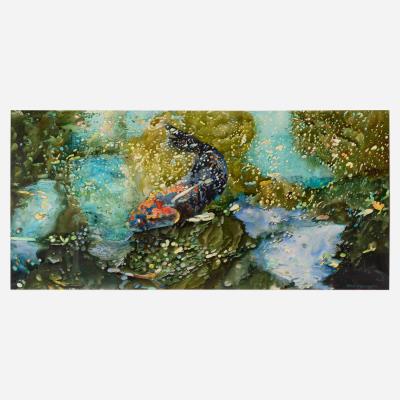
Raffael's media changed from oil to watercolor, pastel and lithography as his interpretations of natural phenomena evolved from being photo-realistic to more impressionistic, as in Luxembourg Gardens: Memory, a watercolor. Raffael comments, "I like to think I paint feeling. I am interested in spirit as expressed in nature, the invisible made visible."
Raffael received a Fulbright Fellowship to Florence and Rome in 1958-59, and a Tiffany Foundation Fellowship in 1960. He received First Prize at the Tokyo International Biennial, Japan in 1974, and a Purchase Prize, Concours d'Antiques, Oakland Museum, California, 1975.
His teaching experience includes the University of California, Davis, 1966; School of Visual Arts, New York City, 1967-69; University of California, Berkeley, Summer, 1969; and California State University at Sacramento, 1969-74.
Raffael has exhibited at the Whitney Museum of American Art, New York City; and the San Francisco Museum of Modern Art. His work may be found in the collections of the Metropolitan Museum of Art, New York City; and the Smithsonian Institution, Washington, D.C.
EXHIBITIONS:
1998-99 The Canton Museum of Art, Ohio
"The Spirit in Art and Nature: Joseph Raffael Paintings, Watercolors, Prints," Naples Philharmonic Center, Florida
"Reflections: The Water-Related Works of Joseph Raffael," Hunter Museum of Art, Chattanooga, Tennessee
1991 "The Flower Paintings of Joseph Raffael," The Butler Institute of American Art, Youngstown, Ohio
1985-90 "Joseph Raffael: Figure Paintings, France" Phyllis Rothman Gallery, Fairleigh Dickinson University, Madison, New Jersey
1987-88 "Secret Silence/The Art of Joseph Raffael," Davenport Museum of Art, New York
1985-86 "Watercolors by Joseph Raffael," Nicolaysen Art Museum, Casper, Wyoming
Salt Lake Art Center, Utah; Yellowstone Art Center, Billings, Montana
New York Academy of Sciences, New York
"Joseph Raffael Prints," University of Austin, Texas
Delaware Art Museum Downtown, Wilmington
Jacksonville Art Museum, Florida
Norton Gallery and School of Art, West Palm Beach, Florida
"Joseph Raffael: Monotypes and Lithographs," Saddleback Community College, Mission Viejo, California;
Santa Ana Community College, Santa Ana, California
Museum of Fine Arts, Racine, Wisconsin.
"Joseph Raffael in Four Southern Museums," Birmingham Museum of Art, Alabama
The Columbus Museum, Georgia; Mint Museum, Charlotte, North Carolina Mississippi Museum of Art, Jackson.
COLLECTIONS:
The Butler Institute of American Art, Youngstown, Ohio
California College of Arts and Crafts, Oakland
Canton Art Museum, Ohio
The Cleveland Museum of Art, Ohio
University of Connecticut, Bridgeport
The Contemporary Museum, Honolulu
Crocker Art Museum, Sacramento, California
Delaware Art Museum, Wilmington
The Denver Art Museum, Colorado
Des Moines Art Center, Iowa
Everson Museum of Art, Syracuse, New York
Fort Worth Art Museum, Texas
University of Georgia, Athens
Hirshhorn Museum and Sculpture Garden, Smithsonian Institution, Washington, D.C.
Jacksonville Art Museum, Florida
Glenn C. Janss Collection, Sun Valley, Idaho
Joslyn Art Museum, Omaha, Nebraska
Krannert Art Museum, Champaign, Illinois
Library of Congress, Washington, D.C.
Long Beach Museum, California
Los Angeles County Museum of Art, California
Lowe Art Museum, University of Miami, Coral Gables, Florida
University of Massachusetts, Amherst
The Metropolitan Museum of Art, New York
Mint Museum, Charlotte, North Carolina
Museum of Contemporary Art, Chicago, Illinois
Museum of Fine Arts, St. Petersburg, Florida
The Museum of Outdoor Arts, Englewood, Colorado
National Collection of Fine Arts, Smithsonian Institution, Washington, D.C.
University of New Mexico, Albuquerque
The Oakland Museum, California
Philadelphia Museum of Art, Pennsylvania
Rahr West Art Museum, Manitowoc, Wisconsin
San Francisco Ballet, California
San Francisco Museum of Modern Art, California
Santa Barbara Museum of Art, California
J.B. Speed Art Museum, Louisville, Kentucky
The Toledo Museum of Art, Ohio
University Art Museum, Berkeley, California
Utah Museum of Fine Arts, Salt Lake City
Virginia Museum of Fine Arts, Richmond
Walker Art Center, Minneapolis, Minnesota
Washington County Museum of Fine Arts, Maryland
Whitney Museum of American Art, New York
From
Les Krantz, American Artists: An Illustrated Survey of Leading Contemporary Americans, 263
http://www.nancyhoffmangallery.com/bio/b_raff.htmlBiography from the Archives of askART
 Joseph Raffael was born in Brooklyn, New York in 1933. He studied at Cooper Union in New York City in 1953 and 1954 and received a Summer Fellowship to the Yale-Norfolk School in 1954. He received a Bachelor of Fine Arts degree from the Yale University School of Art where he studied from 1954 until 1956 with Josef Albers.
He first won reknown with fragmented, pop-oriented paintings of animals which, when he analyzed them later, he felt were attempts to paint about pain. He had experimented with marijuana, astrology, numerology and spiritualism, along with bi-weekly visits to a mental therapist. He led a relatively sedate life with his wife Lannis and her two children on a farm in Bennington, Vermont. They had two more children. He went to the University of California at Berkeley to teach, and they decided to stay and bought a studio in the redwoods of Marin County.
Raffael's medium changed from oil to watercolor, pastel and lithography as his interpretations of natural phenomena evolved from being photo-realist to a more impressionistic style. His teaching experience includes the University of California at Davis in 1966; School of Visual Arts, New York City from 1967 through 1969; University of California at Berkeley during the Summer of 1969 and California State University at Sacramento from 1969 until 1974.
Raffael found that California did not so much alter his style as allow him to work less self-consciously within it. He works from photographs, re-creating, not enlarging; he is obsessed by light, its sparkle, sheen and transparency. He works making a multitude of pictorial decisions with a tender virtuosity without parallel in other American figurative painting.
Written and submitted by Jean Ershler Schatz, artist and researcher from Laguna Woods, California.
Joseph Raffael passed away on July 12, 2021.
Sources include:
Robert Hughes in Time Magazine, October 15, 1973
Time Magazine, April 11, 1969
From the Internet, www.AskART.comBiography from Childress Gaffney Auctions (CLOSED)
Joseph Raffael was born in Brooklyn in 1933.
Joseph Raffael is known for post realistic and impressionistic painting of figure, still life, and fish. His early photo-realist paintings depicted nature based on photographs of animals, ponds and foliage.
Large-scale close-ups of animal faces, such as Lizard Head, and human faces like "African Lady," were said to reflect a deep concern for nature. Raffael states his interest in "observing fertile and fantastic things that have within them the power to erupt, like Vesuvius."
Raffael's media changed from oil to watercolor, pastel and lithography as his interpretations of natural phenomena evolved from being photo-realistic to more impressionistic, as in Luxembourg Gardens: Memory, a watercolor. Raffael comments, "I like to think I paint feeling. I am interested in spirit as expressed in nature, the invisible made visible."