Page loaded successfully. Showing biography for Joshua (Johnston) Johnson.
Joshua (Johnston) Johnson BIOGRAPHY
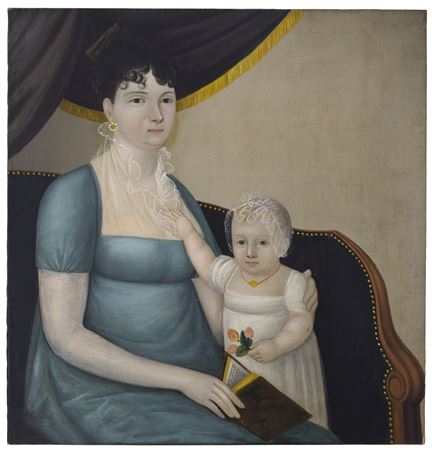
1765 near Baltimore, Maryland - 1830. Known for: Naive family portrait painting, often with pets.
Reportedly America's first professional black artist that was a free man, Joshua Johnson, whose name is written both as Johnson and Johnston, was originally from the West Indies and then came to the... Read full biography
Reportedly America's first professional black artist that was a free man, Joshua Johnson, whose name is written both as Johnson and Johnston, was originally from the West Indies and then came to the American South. He was an itinerant portrait painter among wealthy plantation owners in Maryland and... Read full biography
Reportedly America's first professional black artist that was a free man, Joshua Johnson, whose name is written both as Johnson and Johnston, was originally from the West Indies and then came to the American South. He was an itinerant portrait painter among wealthy plantation owners in Maryland and Virginia, and his style was derived from the conventional English portrait style of bust-length poses and arranged backdrops. His portrait figures are stiff, prim and flat in appearance, and quite... Read full biography
Reportedly America's first professional black artist that was a free man, Joshua Johnson, whose name is written both as Johnson and Johnston, was originally from the West Indies and then came to the American South. He was an itinerant portrait painter among wealthy plantation owners in Maryland and Virginia, and his style was derived from the conventional English portrait style of bust-length poses and arranged backdrops. His portrait figures are stiff, prim and flat in appearance, and quite often have a dog posed on the lap of the sitter. He was the first known African-American professional portrait painter to work in the United States. According to his advertisement in the Baltimore Intelligencer, December 19, 1798, he was a "self-taught... Read full biography
Reportedly America's first professional black artist that was a free man, Joshua Johnson, whose name is written both as Johnson and Johnston, was originally from the West Indies and then came to the American South. He was an itinerant portrait painter among wealthy plantation owners in Maryland and Virginia, and his style was derived from the conventional English portrait style of bust-length poses and arranged backdrops. His portrait figures are stiff, prim and flat in appearance, and quite often have a dog posed on the lap of the sitter. He was the first known African-American professional portrait painter to work in the United States. According to his advertisement in the Baltimore Intelligencer, December 19, 1798, he was a "self-taught genius." . He was listed in the Baltimore directory as a portrait painter, 1796 to 1824, and after... Read full biography
Artist Biography
Biography page for Joshua (Johnston) Johnson ((1765 - 1830)), known for Naive family portrait painting, often with pets. Showing 3 biographical entries and 0 sample artworks.
Joshua (Johnston) Johnson - Artist Info
About Joshua (Johnston) Johnson
Name variants
Joshua Johnston
Biography from the Archives of askART
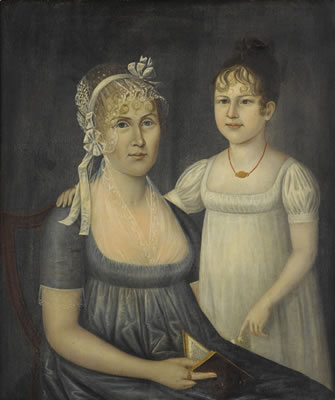 Reportedly America's first professional black artist that was a free man, Joshua Johnson, whose name is written both as Johnson and Johnston, was originally from the West Indies and then came to the American South. He was an itinerant portrait painter among wealthy plantation owners in Maryland and Virginia, and his style was derived from the conventional English portrait style of bust-length poses and arranged backdrops. His portrait figures are stiff, prim and flat in appearance, and quite often have a dog posed on the lap of the sitter.
He was the first known African-American professional portrait painter to work in the United States. According to his advertisement in the Baltimore Intelligencer, December 19, 1798, he was a "self-taught genius."
He was listed in the Baltimore directory as a portrait painter, 1796 to 1824, and after 1824, his name disappears from public record. Likely he was influenced by Charles Peale Polk, a Baltimore painter, and one scholar, Caroline Weekly in Antiques Magazine of September 1987, suggested that he was brought to Baltimore as a young slave-child by artist Charles Peale Polk, brother-in-law of Charles Willson Peale. The will of Charles Peale Polk mentioned an unnamed Negro boy as does correspondence of the artist.
Although much speculation exists and much research has been done, little factual information is known about Johnston's actual birth place and his early life. Possibly he purchased his freedom with his art work as an entry in the Baltimore Directory of 1816-1817 lists him as a "Free Householder with Colour."
Of his found work, there is one signed portrait whose subject is Mrs. Sarah Ogden Gustin and 82 attributed paintings that indicate he had a career full of commissions from wealthy Baltimore families.
Source:
Peter Hastings Falk, Editor, Who Was Who in American ArtBiography from the Archives of askART
 The AskART biography by Peter Falk for Joshua Johnson says:
"Although much speculation exists and much research has been done, little factual information is known about Johnston's actual birth place and his early life. Possibly he purchased his freedom with his art work as an entry in the Baltimore Directory of 1816-1817 lists him as a "Free Householder with Colour." "
FYI - It was correct when the source was published, but in the 1990's Joshua Johnson's 1782 manumission papers were discovered among some old court records that were being tossed. The Maryland Historical Society owns the record regarding a slave in Baltimore County, named Joshua Johnson who was apprenticed to a blacksmith. His freedom was bought by his own father, a Mr. Wheeler, and the record required that Joshua be freed at the end of his apprenticeship, or when he turned 20, whichever came first.
The next document shows him in the 1790's advertising as an artist in Baltimore. He must have been mulatto since his father was white, and his mother an African American slave. The artist had been described at least once as a mulatto, so this helps the case that the manumission papers are referring to the same Joshua Johnson that we know as an artist.
Submitted November, 2010 by Jon KassoBiography from The Johnson Collection
JOSHUA JOHNSON (JOHNSTON) (born circa 1763; active 1796-1824)
The earliest documented professional African American artist, Joshua Johnson, was born into slavery in or near Baltimore, Maryland. An enigmatic figure, Johnson’s exact life dates are unknown, and even the spelling of his last name is debated. Active as a portraitist in Maryland and Virginia between the years of 1789 to 1825, Johnson is, at present, known to have executed over eighty-three verified works; only one canvas bears his signature. With the exception of two portraits of African American males, Johnson’s subjects are white men and women, many of them affluent Baltimoreans. A self-proclaimed “self-taught genius,” Johnson advertised that he had “experienced many insuperable obstacles in the pursuit of his studies,” challenges he overcame to pave the way for future African Americans to pursue careers in the arts.
The son of an enslaved woman and a white man, Johnson obtained his freedom around 1782 at the age of nineteen, when his father formally acknowledged his paternity. Following an apprenticeship to a blacksmith—a stipulation of his eventual emancipation—Johnson taught himself to paint, and was noted in Baltimore city directories as a “limner” or “portrait painter” between 1796 and 1824. Johnson’s very inclusion in these registries, which did not list slaves, underscores his independence, and he is specifically categorized among "free householders of Color" in an 1817 edition. One of Johnson’s first clients was Colonel John Moale, the very judge who had signed the artist’s manumission years earlier. These directories also reveal that Johnson had no less than eight different residences in Baltimore, suggesting the itinerant nature of his profession. All records of the artist’s addresses and activities cease by 1827, and it is unknown where or when he died.
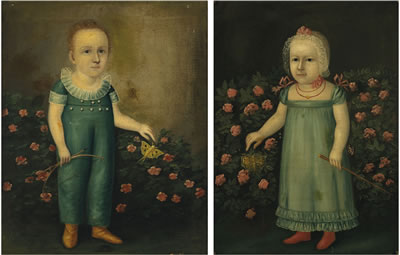
Johnson’s portraits share distinct qualities and are identifiable by the minimal modeling of subjects’ oval faces, tapered lips, and an overall flat formality. Fixed with straightforward gazes, his sitters pose stiffly in a three-quarter view before a plain background. Several props make recurring appearances, including books, gloves, parasols, flowers, fruit, and dogs. Translucent glazes of oil paint in rich palettes result in a luminosity that enhances skin tones and luxurious fabrics like rich brocade and gossamer lace. These elements—subject position, dress, accoutrements, and thinly painted surfaces—connect Johnson to prevailing portrait practices of the day, most notably the style employed by the extended Peale/Polk family of painters in Philadelphia or the Earls of Connecticut. Such similarities—and, more significantly—Johnson’s undeniable mastery contribute to speculation that he received some form of training during his career. Fragmentary records and erroneous accounts over the centuries have made further scholarly research and documentation nearly impossible.
The subjects of these pendant portraits are Hilmer Schumacher, a Baltimore sugar refiner, and his wife Rachel Cloberg Schumacher. Believed to have been executed during one of Johnson’s most active seasons, the deep green spandrels that encircle the portrayals are typical of the artist’s work. Descended through the Schumacher family, these portraits are among a small group of paintings documented by Dr. J. Hall Pleasants, an authority on Maryland’s early painters, in the 1930s.
Johnson’s paintings are rare and are in prominent collections of the National Gallery of Art, the Metropolitan Museum of Art, the Smithsonian Museum of American Art, and the Virginia Museum of Fine Arts.
The Johnson Collection, Spartanburg, South Carolina
thejohnsoncollection.org