Page loaded successfully. Showing biography for Julian Scott.
Julian Scott BIOGRAPHY
1846 Johnson, Vermont - 1901 Plainfield, New Jersey. Known for: Illustrator, genre-military-Indian.
The following from Peter Bissell is by Ben Bassham in his review of the book Julian Scott: Artist of the Civil War and Native America. Born in the northern Vermont town of Johnson, one of eight... Read full biography
The following from Peter Bissell is by Ben Bassham in his review of the book Julian Scott: Artist of the Civil War and Native America. Born in the northern Vermont town of Johnson, one of eight children of a jeweler and watchmaker, Julian Scott at fifteen years old lied about his age and enlisted... Read full biography
The following from Peter Bissell is by Ben Bassham in his review of the book Julian Scott: Artist of the Civil War and Native America. Born in the northern Vermont town of Johnson, one of eight children of a jeweler and watchmaker, Julian Scott at fifteen years old lied about his age and enlisted in the Third Vermont. Too small for soldiering, he became a drummer in Company E, which took part in the Battle of Lee's Mills during the Peninsular Campaign. Exercising his duty as a non-combatant,... Read full biography
The following from Peter Bissell is by Ben Bassham in his review of the book Julian Scott: Artist of the Civil War and Native America. Born in the northern Vermont town of Johnson, one of eight children of a jeweler and watchmaker, Julian Scott at fifteen years old lied about his age and enlisted in the Third Vermont. Too small for soldiering, he became a drummer in Company E, which took part in the Battle of Lee's Mills during the Peninsular Campaign. Exercising his duty as a non-combatant, Scott braved heavy fire to save nine wounded men, an act of heroism for which he was awarded the Medal of Honor, thus earning the first citation for an individual act of battlefield courage in the Civil War. At the Battle of White Oak Swamp Scott was... Read full biography
The following from Peter Bissell is by Ben Bassham in his review of the book Julian Scott: Artist of the Civil War and Native America. Born in the northern Vermont town of Johnson, one of eight children of a jeweler and watchmaker, Julian Scott at fifteen years old lied about his age and enlisted in the Third Vermont. Too small for soldiering, he became a drummer in Company E, which took part in the Battle of Lee's Mills during the Peninsular Campaign. Exercising his duty as a non-combatant, Scott braved heavy fire to save nine wounded men, an act of heroism for which he was awarded the Medal of Honor, thus earning the first citation for an individual act of battlefield courage in the Civil War. At the Battle of White Oak Swamp Scott was severely wounded in the hip by a Minie ball and was sent to a hospital on Long Island Sound for a long period of recovery. (Th... Read full biography
Artist Biography
Biography page for Julian Scott ((1846 - 1901)), known for Illustrator, genre-military-Indian. Showing 1 biographical entries and 0 sample artworks.
Julian Scott - Artist Info
About Julian Scott
Biography from the Archives of askART
 The following from Peter Bissell is by Ben Bassham in his review of the book Julian Scott: Artist of the Civil War and Native America.
Born in the northern Vermont town of Johnson, one of eight children of a jeweler and watchmaker, Julian Scott at fifteen years old lied about his age and enlisted in the Third Vermont. Too small for soldiering, he became a drummer in Company E, which took part in the Battle of Lee's Mills during the Peninsular Campaign.
Exercising his duty as a non-combatant, Scott braved heavy fire to save nine wounded men, an act of heroism for which he was awarded the Medal of Honor, thus earning the first citation for an individual act of battlefield courage in the Civil War.
At the Battle of White Oak Swamp Scott was severely wounded in the hip by a Minie ball and was sent to a hospital on Long Island Sound for a long period of recovery. (The Civil War took its toll on the Scott family: Julian's brother Charles, who served as a bugler, suffered a serious head wound, which disabled him for the rest of his life, and brother Lucian was captured and spent the last months of the war in Richmond's Libby Prison, where he almost starved to death.) While Julian was convalescing he was noticed by a visitor, who took a liking to him and supplied the youngster with drawing materials.
When Scott was back on his feet, he was introduced to New York City, and many of the city's leading artists, by his new-found sponsor. Following his discharge in the spring of 1863, Scott met still another important friend and patron, the businessman William E. Dodge, who began supporting the artist's study at the National Academy of Design and at a medical college in the city, where Scott studied anatomy.
Scott started frequenting the famous Tenth Street Studio Building and there met the artists John F. Kensett, Louis Lang, and Emanuel Leutze. In fact the German-born Leutze, the painter of Washington Crossing the Delaware, became Scott's first formal art teacher.
Scott returned to the war in the spring of 1864, but this time solely as an artist. He was named an honorary aide-de-camp to Gen. William F. ("Baldy") Smith in Gen. Benjamin Butler's "Army of the James" near Richmond. After Appomattox, Scott returned to the Virginia battlefields to sketch and to gather materials for his projected life's work, the production of meticulously detailed canvases on which he depicted major engagements in the war or the quiet moments of camp life and the marches between the battles.
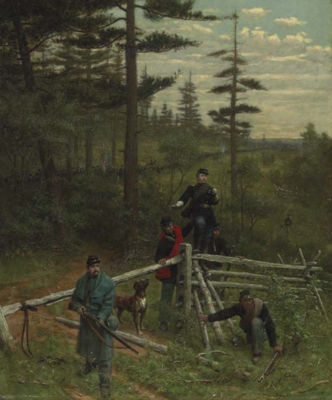
Typical of the second group are "Civil War Drummer Boys Playing Cards" (almost certainly a remembrance of his own wartime hours of boredom) and "The Compassionate Enemy," in which a Rebel guard shares a crust of bread with Union prisoners. In these pictures and in all of his work Scott combined a fidelity to the facts (assisted often by photographs) with a measure of quiet human drama. But Scott's style was in every way conventional, and he never changed it as art forms evolved dramatically in the late nineteenth century.
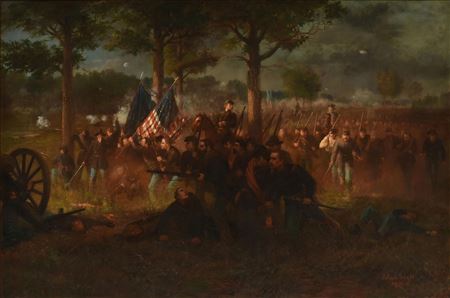
The major production of Scott's career was a huge (ten by twenty foot) canvas representing the proudest moment of the Third Vermont, the Battle of Cedar Creek, a picture which Scott worked on for years and eventually installed in the Vermont State House. Unfortunately, what should have been the triumph of the artist's career was marred by his unsuccessful efforts to persuade the Vermont legislature to pay him more than the price originally agreed upon.
Following a trip to Paris in the summer after the war to see the museums and to enjoy a brief fling at "La Vie Boheme," Scott established a studio in New York City and set forth on a steady if undistinguished career as a painter of Civil War subjects. Although he married in 1870, the artist's dedication to domestic life was half-hearted, he was always at his happiest in the company of other men, especially with a drink or a tankard in his hand.
So enamored of "club life" was Scott that he joined virtually every social club in the New York City as well as in Plainfield, New Jersey, where he and his family moved in 1875. His almost pathological obsession with socializing would be humorous but for the fact that it led to the alcoholism that blighted the middle years of the artist's life and cost him his family and perhaps the opportunity for a more successful professional career.
Scott salvaged an otherwise rudderless life when he took a temperance pledge and was later selected, along with fellow artists Walter Shirlaw, Peter Moran, Gilbert Gaul, and Henry R. Poor, to serve as a "special agent" for the 1890 census of Native Americans. Scott, whose duties were to preserve in his artwork and in photographs the "fast disappearing phases of Indian life," traveled to the Indian Territory (later Oklahoma), then on to the pueblos of Laguna and Acoma in New Mexico, and finally to the Hopi communities of northeast Arizona.
Titterton's biography gains in interest as it details the story of Scott's travels among the Indian tribes of the Southwest, for these experiences kindled in the artist a renewed enthusiasm for life and inspired a compassion for the misunderstood and largely mistreated peoples of the reservations and pueblos. Scott saw firsthand the corruption of Indian agents and the disregard for Indian traditions in the policies of the Bureau of Indian Affairs and he spoke out frankly in his reports against such practices as compulsory boarding schools for Indian children, a program that broke up families.
Scott argued that the Indians of the Southwest should be left largely alone to follow their ancient customs. A number of Scott's drawings and photographs illustrate the 683 pages of the Report on Indians Taxed and Indians Not Taxed; this may be his most significant achievement. Scott also made a trip to the Dakotas and a return trip to the Hopi pueblos before he closed, one imagines with some regret, the most challenging and interesting chapter of his life. Scott died alone, mostly forgotten, and in poverty, surrounded by his canvases and the many Indian artifacts he brought home from the Southwest, in 1901.