Page loaded successfully. Showing biography for Julius Adam II.
Julius Adam II BIOGRAPHY
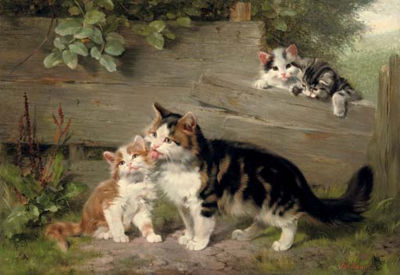
1852 Munich, Germany - 1913 Munich, Germany. Known for: Cat subject painting.
Julius Adam (1852 - 1913) . Born in Munich, 1852. First studied under his father, Julius Adam. Came to South America, and lived for six yars in Rio de Janiero. Upon returning to Germany, he gave... Read full biography
Julius Adam (1852 - 1913) . Born in Munich, 1852. First studied under his father, Julius Adam. Came to South America, and lived for six yars in Rio de Janiero. Upon returning to Germany, he gave himself entirely to painting, and also studied under Echter and W. Diez. He has achieved a reputation as... Read full biography
Julius Adam (1852 - 1913) . Born in Munich, 1852. First studied under his father, Julius Adam. Came to South America, and lived for six yars in Rio de Janiero. Upon returning to Germany, he gave himself entirely to painting, and also studied under Echter and W. Diez. He has achieved a reputation as a painter of cats. Submitted by Edward P. Bentley, Art Researcher, East Lansing, Michigan. Source:. "Loan exhibition of paintings owned by residents of Rochester: the Memorial Art Gallery. June -... Read full biography
Julius Adam (1852 - 1913) . Born in Munich, 1852. First studied under his father, Julius Adam. Came to South America, and lived for six yars in Rio de Janiero. Upon returning to Germany, he gave himself entirely to painting, and also studied under Echter and W. Diez. He has achieved a reputation as a painter of cats. Submitted by Edward P. Bentley, Art Researcher, East Lansing, Michigan. Source:. "Loan exhibition of paintings owned by residents of Rochester: the Memorial Art Gallery. June - September, 1915."... Read full biography
Julius Adam (1852 - 1913) . Born in Munich, 1852. First studied under his father, Julius Adam. Came to South America, and lived for six yars in Rio de Janiero. Upon returning to Germany, he gave himself entirely to painting, and also studied under Echter and W. Diez. He has achieved a reputation as a painter of cats. Submitted by Edward P. Bentley, Art Researcher, East Lansing, Michigan. Source:. "Loan exhibition of paintings owned by residents of Rochester: the Memorial Art Gallery. June - September, 1915."... Read full biography
Artist Biography
Biography page for Julius Adam II ((1852 - 1913)), known for Cat subject painting. Showing 3 biographical entries and 0 sample artworks.
Julius Adam II - Artist Info
About Julius Adam II
Biography from the Archives of askART
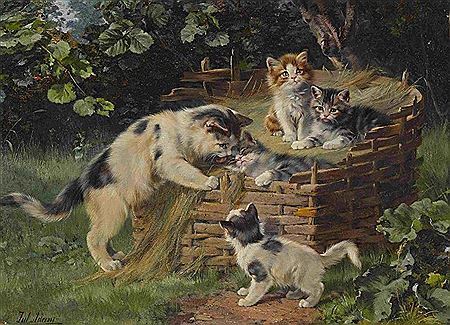 Julius Adam (1852 - 1913)
Born in Munich, 1852. First studied under his father, Julius Adam. Came to South America, and lived for six yars in Rio de Janiero. Upon returning to Germany, he gave himself entirely to painting, and also studied under Echter and W. Diez. He has achieved a reputation as a painter of cats.
Submitted by Edward P. Bentley, Art Researcher, East Lansing, Michigan
Source:
"Loan exhibition of paintings owned by residents of Rochester: the Memorial Art Gallery. June - September, 1915."Biography from Cantor Fine Art
Julius Adam, II was born in Munich, Germany in 1852. Born into a long line of painters, his first artistic experience came under the teaching of his father, who was in the photography business. His first job was for his father's company as a retoucher of photographic images.
The young Julius Adam II worked for his father's company in South America, Rio de Janeiro, for nearly six years, from 1866-1872. In 1872 upon returning to Germany, he enrolled himself to paint and study with the professors Echter and W. Diez. This was his first formal training in arts and crafts. He would later study with Wilhelm, where he would hone his reputation as a painter of cats. He studied with Wilhelm for more than six years.
By the latter part of the nineteenth century two male painters of cats surfaced as the leaders along with Henriette Ronner (1821-1909) , who at the time was the queen of cat painters, that being Julius Adam II and Eugene Lambert (1824-1902). Adam was a younger generation of the famous family of Munich animal painters; his older relations such as Albrecht Adam had been successful horse painters along traditional lines, and it was perhaps a sign of the times that he should now forsake horseflesh for the domestic cat. Cat painting was the art of the new urban society, living a pampered life in apartments and town-houses; horse painting harked back to the more rural days. At all events, Julius Adam clearly had a feeling for his subject; his often seen self-portrait shows him manfully working on at his easel while a family of kittens climb over him.
Listed:
Popular Nineteenth Century Painting, A Dictionary of European Genre Painters, by Phillip Hook and Mark Poltimore. Page 116, 117. Ill. Page 118.
Thieme / Becker, Allgemeines Lexikon der bildenden Kunstler, Volume ½, page 65.
E. Benezit, Dictionnaire Des Peintres, Sculpturs, Dessinateeurs Et Graveurs. Volume 1, page 30.
Museums:
National Museum, Washington, D.C.Biography from Ketterer Kunst, Munich
Julius (II) Adam was born son of the lithographer and photographer Julius (I) Adam and grandson of the animal and war painter Albrecht Adam in Munich on May 18, 1852. He entered his father's business at an early point and was trained as photographer.
At the age of fourteen he went to Rio de Janeiro and stayed for six years. He worked as a landscape photographer and retoucher. After his return in 1872, Adam began studying at the Munich School of Applied Arts under Michael Echter and in 1874 he transferred to the Nature and Landscape class at the Academy.
In the following years, he mainly studied with Wilhelm von Diez. After the death of his father, he took on odd jobs, such as poster designer and wood engraver in order to support the family financially. Until 1882 the artist mainly devoted himself to genre painting, deliberately abandoning the depictions of animals that prevailed in the Adam painter family.
In the mid-1880s, however, a picture of a cat he had made was so well received by the Munich Kunstverein that he began to devote himself almost exclusively to cat painting. Thus, the artist became known among his contemporaries as "Cat Raphael" or "Cat Adam". He worked on the same subject with consistently high artistic standards, combining the precise light and color observations of the Diez school with great empathy for the portrayed animals.
Several of his paintings were awarded the Golden Medal at the International Art Exhibition in Munich. Julius (II) Adam died in his hometown of Munich on September 23, 1913.
He occupied a significant position among the Munich animal painters of the Wilhelminian era. [FS]