Page loaded successfully. Showing biography for Julius Seyler.
Julius Seyler BIOGRAPHY
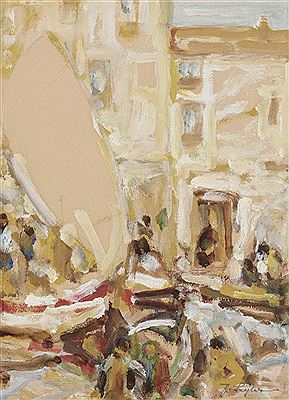
1873 Munich, Germany - 1955 Munich, Germany. Known for: Painting, figure-Indian in Montana 1913-16, landscape, animal, genre.
Born in Munich, Germany, Julius Seyler became a painter and teacher who spent most of his career in Germany but also spent time on the American frontier in the early 20th century. It was written that... Read full biography
Born in Munich, Germany, Julius Seyler became a painter and teacher who spent most of his career in Germany but also spent time on the American frontier in the early 20th century. It was written that he "found his greatest satisfaction painting the Blackfoot Indians of Montana". (1). Seyler was a... Read full biography
Born in Munich, Germany, Julius Seyler became a painter and teacher who spent most of his career in Germany but also spent time on the American frontier in the early 20th century. It was written that he "found his greatest satisfaction painting the Blackfoot Indians of Montana". (1). Seyler was a student at the Munich Academy of Fine Arts and there received classical training. In 1909, when he was age 36, he went to Paris to study and came under the influence of Barbizon painters including Jean... Read full biography
Born in Munich, Germany, Julius Seyler became a painter and teacher who spent most of his career in Germany but also spent time on the American frontier in the early 20th century. It was written that he "found his greatest satisfaction painting the Blackfoot Indians of Montana". (1). Seyler was a student at the Munich Academy of Fine Arts and there received classical training. In 1909, when he was age 36, he went to Paris to study and came under the influence of Barbizon painters including Jean Millet and Camille Corot. It is thought that his painting career would have continued in that tradition, except that he married Helga Boekmann, an art student from St. Paul, Minnesota. In 1910, he went to America with her to meet her family that... Read full biography
Born in Munich, Germany, Julius Seyler became a painter and teacher who spent most of his career in Germany but also spent time on the American frontier in the early 20th century. It was written that he "found his greatest satisfaction painting the Blackfoot Indians of Montana". (1). Seyler was a student at the Munich Academy of Fine Arts and there received classical training. In 1909, when he was age 36, he went to Paris to study and came under the influence of Barbizon painters including Jean Millet and Camille Corot. It is thought that his painting career would have continued in that tradition, except that he married Helga Boekmann, an art student from St. Paul, Minnesota. In 1910, he went to America with her to meet her family that included James J. Hill, the founder of the Northern Pacific Railroad and one of the wealthiest men in the upper Midwest. Returning to Paris,... Read full biography
Artist Biography
Biography page for Julius Seyler ((1873 - 1955)), known for Painting, figure-Indian in Montana 1913-16, landscape, animal, genre. Showing 3 biographical entries and 0 sample artworks.
Julius Seyler - Artist Info
About Julius Seyler
Biography from the Archives of askART
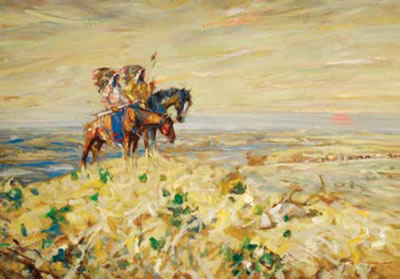 Born in Munich, Germany, Julius Seyler became a painter and teacher who spent most of his career in Germany but also spent time on the American frontier in the early 20th century. It was written that he "found his greatest satisfaction painting the Blackfoot Indians of Montana". (1)
Seyler was a student at the Munich Academy of Fine Arts and there received classical training. In 1909, when he was age 36, he went to Paris to study and came under the influence of Barbizon painters including Jean Millet and Camille Corot. It is thought that his painting career would have continued in that tradition, except that he married Helga Boekmann, an art student from St. Paul, Minnesota. In 1910, he went to America with her to meet her family that included James J. Hill, the founder of the Northern Pacific Railroad and one of the wealthiest men in the upper Midwest.
Returning to Paris, Seyler came under the modernist influences of Paul Cezanne and Vincent Van Gogh, and as a result, Seyler's painting became a composite of Impressionism, Expressionism and Realism.
When Seyler returned to St. Paul for the second time, he accompanied Louis Hill, Sr., the son of James J. Hill to Glacier Park where the Hill family was just beginning to promote the park as a stopping place for their railroad. With a program called "See America First", James J. Hill was hiring painters to create landscapes of Glacier Park, and Seyler did a number of those subjects. He loved the dramatic scenery and also became interested in the exotic and colorful costumes of the Indians and the concept of them living so freely on land that seemed boundless. He had plenty of opportunity for observation as he stayed at Glacier Park Lodge between the Blackfoot and Flathead Indian Reservations.
From 1914 to 1921, Seyler was in Balsam Lake, Wisconsin on a farm owned by his father-in-law because he could not return to Germany during the war. He had little time to paint because he did hard labor, but many times during that time he returned to Montana.
In Germany in 1924, he became a Professor at the Munich Academy, and he continued his own painting career from his studio. However, in 1944, his studio and many of his paintings were destroyed in a World War II bombing. Four years later, his eyesight failed, and he had to give up painting, his passion in life.
Seyler died in 1955 in his sleep at his home in Munich. His legacy was paintings of the American West executed with the sophistication of European modernist styles.
Source:
Ray Steele, Executive Director of the C M Russell Museum, Essay in exhibition catalogue, "Artistic Abstraction. . . A Shimmer of Colored Light", 1987.
Courtesy, Sigrid Reisch, Kitzbuhel, GermanyBiography from Richter & Kavitz
Painter of landscapes and animal motifs, depictions of the working people in the country, of the sea and coast, and of the world of the North American Indians. Represented in numerous museums.
Since 1882 studies at the Munich Academy, first with Julius Diez, then with Ludwig von Herterich and Heinrich von Zügel. The influence of Zügel becomes clear in Julius Seyler's world of motifs as well as in his pleinairistic landscape capture. He is concerned with the painterly translation of the atmosphere of nature in a landscape.
The whole, the cosmic (Kroll B., p. 14), should be felt in his paintings. Typical of the paintings of Julius Seyler, who sees himself as an "open-air painter", is the extreme reduction of the nature surrounding him to color and light values.Biography from Yves Siebers Auktionen
Julius Seyler was born in Munich in 1873. He was a German landscape and animal painter who studied at the AdBK in Munich with Wilehlm von Diez and Heinrich von Zügel.