Page loaded successfully. Showing biography for Karl Dillinger.
Karl Dillinger BIOGRAPHY

1882 Stuttgart, Germany - 1941 Durmstein, Germany. Known for: Modernist landscape and figure painting, teaching.
Karl Dillinger 1882-1941 . The aspiring artist was a son of a brew master in Stuttgart Germany. As a young person he enjoyed sketching as a pastime. At the age of seventeen he was admitted to the... Read full biography
Karl Dillinger 1882-1941 . The aspiring artist was a son of a brew master in Stuttgart Germany. As a young person he enjoyed sketching as a pastime. At the age of seventeen he was admitted to the School of Applied Arts, located in Karlsruhe, Germany. He studied art rudiments at that institution... Read full biography
Karl Dillinger 1882-1941 . The aspiring artist was a son of a brew master in Stuttgart Germany. As a young person he enjoyed sketching as a pastime. At the age of seventeen he was admitted to the School of Applied Arts, located in Karlsruhe, Germany. He studied art rudiments at that institution from 1899-1902. During those years his desire to learn was insatiable. After leaving the school of applied arts, he was resting uneasily. Moreover, Karl desired to increase his knowledge of the fine... Read full biography
Karl Dillinger 1882-1941 . The aspiring artist was a son of a brew master in Stuttgart Germany. As a young person he enjoyed sketching as a pastime. At the age of seventeen he was admitted to the School of Applied Arts, located in Karlsruhe, Germany. He studied art rudiments at that institution from 1899-1902. During those years his desire to learn was insatiable. After leaving the school of applied arts, he was resting uneasily. Moreover, Karl desired to increase his knowledge of the fine arts. During the period of 1902-1906 he extended his studies, by attending the Academe in Stuttgart. For a while he came under the influence of Adolph Hozel. In the next epoch he was committed to survive the difficulties associated with a career in in... Read full biography
Karl Dillinger 1882-1941 . The aspiring artist was a son of a brew master in Stuttgart Germany. As a young person he enjoyed sketching as a pastime. At the age of seventeen he was admitted to the School of Applied Arts, located in Karlsruhe, Germany. He studied art rudiments at that institution from 1899-1902. During those years his desire to learn was insatiable. After leaving the school of applied arts, he was resting uneasily. Moreover, Karl desired to increase his knowledge of the fine arts. During the period of 1902-1906 he extended his studies, by attending the Academe in Stuttgart. For a while he came under the influence of Adolph Hozel. In the next epoch he was committed to survive the difficulties associated with a career in in art. Finally, Karl challenged his own abilities, by attending the liberal Academy Julian*, being so popular it had set up studio loca... Read full biography
Artist Biography
Biography page for Karl Dillinger ((1882 - 1941)), known for Modernist landscape and figure painting, teaching. Showing 1 biographical entries and 0 sample artworks.
Karl Dillinger - Artist Info
About Karl Dillinger
Biography from the Archives of askART
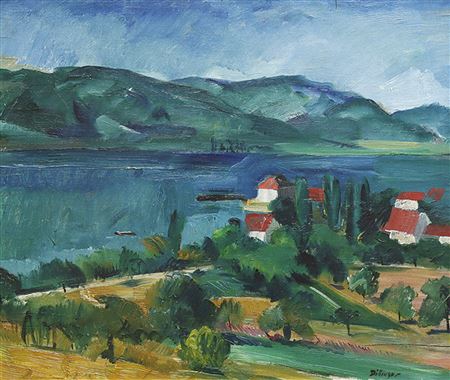 Karl Dillinger 1882-1941
The aspiring artist was a son of a brew master in Stuttgart Germany. As a young person he enjoyed sketching as a pastime. At the age of seventeen he was admitted to the School of Applied Arts, located in Karlsruhe, Germany. He studied art rudiments at that institution from 1899-1902. During those years his desire to learn was insatiable.
After leaving the school of applied arts, he was resting uneasily. Moreover, Karl desired to increase his knowledge of the fine arts. During the period of 1902-1906 he extended his studies, by attending the Academe in Stuttgart. For a while he came under the influence of Adolph Hozel. In the next epoch he was committed to survive the difficulties associated with a career in in art. Finally, Karl challenged his own abilities, by attending the liberal Academy Julian*, being so popular it had set up studio locations within Paris.
The Academie differed as it was noted for its acceptance of females and foreigners. Nevertheless the crucial point is how professors of the institution had inspired a good number of successful and enlightened painters, who later developed and worked in their own unique styles. The contemporary Art Mecca was founded by noted Art Director, Rudolph Julian. All the same, previous to Dillinger’s Paris Years, he had attained a reasonable level of success.
It’s unsure how many testimonials the foreign student, may have rattled out. As a teaching point, he learned to paint from the cast as well as memory, on the other hand, he encouraged his students to study from nature as much as possible. Moreover, he gained the desired knowledge along with the skill.
Dillinger completed his studies under Adolph Holzel, a contemporary abstractionist, noted for, a pallet of vibrant colors.Von Haug was also noted as the teacher of Emil Nolde. In contrast, he worked under Robert von Haug, who was a noted book illustrator, fresco* painter and muralists. Eventually Dillinger melded the varied principles of aesthetics, learned from his teachers in a way that gave his own work a unique and vibrant character.
After leaving Paris, returned to Germany to undertake a career as a freelance painter. Meanwhile, as a means of additional security, he became an art instructor, at Badische Landeskunst, in 1924. Shortly after Karl had received a professorship. However the straight and narrow was not for him. He advocated that careful observations, along with well-planned drawing, and color applications are the only valid means accorded the artist to convey his impressions. Meanwhile, Dillinger’s landscapes typify this direct approach, and are not simply a photographic imitation’s of nature.
Finally, Dillinger had acquired a solid reputation, along with seven year tenure at the Baden School of Arts, in Karlsruhe. Furthermore, because of the Nazi takeover, he was labelled as a dissenter, at this point he felt as if he were standing on quicksand and being absorbed slowly. The message for dismissal, was repeated several times, by Hans Adolph Buhler, who was the School's new director. Dillinger as well as several others was quickly terminated from their positions in 1933. The new leader, as chairman of a cliquey organization, purged his facility of so called, Modernist, thus eliminating his despised artistic rivals. Buhler efficiently replaced Dillinger, and others with his choice of handpicked members of the German Art Society.
Moreover, because of desperate times, he suffered from the multiplicity of mental encounters with his peers, along with the confusion created out of his own fear and despair. Furthermore, the Socialist leaders saw to it, that he as well as others was regarded with disfavor. Finally, our perception of the situation, upon analysis could take on endless variations.
It should be pointed out that for the next eight years Karl Dillinger was able to overcome the trauma, as he continued to paint a series of well-done portraits, along with a group of decidedly accomplished Impressionist landscapes. Moreover, efforts at self - expression without reference to the natural elements are usually stilted. Not so, when considering Karl Dillinger’s works.
His final days in Dirmstien, were spent painting works similar to his, Fruit Trees in the Garden and Cornfield in the Summer. Eventually the rejected and weary artist fell ill, and died in Durmstein, 1941, in the same year that Adolph Hitler had declared war on the United States.
Written and compiled by James R. Kieley, Woodbury, CT.
February 3, 2017
Sources:
Wikipedia
Galarie Bassenge, Berlin Germany
Hennery’s auction House, Mutterstad, Germany
* For more in-depth information about these terms and others, see AskART.com. Glossary http://www.askart.com/AskART/lists/Art_Definition.aspx