Page loaded successfully. Showing biography for Karl Knaths.
Karl Knaths BIOGRAPHY

1891 Eau Claire, Wisconsin - 1971 Provincetown, Massachusetts. Known for: Cubist still life-figure, non-ob, printmaking.
A painter recognized for his highly individual interpretation of Cubism, Karl Knaths was born in Eau Claire, Wisconsin, in 1891. He grew up in the Midwest, and in 1912, he moved to Chicago, where he... Read full biography
A painter recognized for his highly individual interpretation of Cubism, Karl Knaths was born in Eau Claire, Wisconsin, in 1891. He grew up in the Midwest, and in 1912, he moved to Chicago, where he studied at the School of the Art Institute for four years. In 1913, he saw the Chicago exhibition of... Read full biography
A painter recognized for his highly individual interpretation of Cubism, Karl Knaths was born in Eau Claire, Wisconsin, in 1891. He grew up in the Midwest, and in 1912, he moved to Chicago, where he studied at the School of the Art Institute for four years. In 1913, he saw the Chicago exhibition of the groundbreaking Armory Show and was immediately drawn to the modernist work from Paris, especially the art of Paul Cézanne. Massachusetts in 1919. His earliest work was inspired by the art of the... Read full biography
A painter recognized for his highly individual interpretation of Cubism, Karl Knaths was born in Eau Claire, Wisconsin, in 1891. He grew up in the Midwest, and in 1912, he moved to Chicago, where he studied at the School of the Art Institute for four years. In 1913, he saw the Chicago exhibition of the groundbreaking Armory Show and was immediately drawn to the modernist work from Paris, especially the art of Paul Cézanne. Massachusetts in 1919. His earliest work was inspired by the art of the Impressionists. However, after fraternizing with many of the local artists who had experienced the progressive art life of Paris, and by studying the examples of advanced European art in books and magazines, Knaths became deeply influenced by Cubism.... Read full biography
A painter recognized for his highly individual interpretation of Cubism, Karl Knaths was born in Eau Claire, Wisconsin, in 1891. He grew up in the Midwest, and in 1912, he moved to Chicago, where he studied at the School of the Art Institute for four years. In 1913, he saw the Chicago exhibition of the groundbreaking Armory Show and was immediately drawn to the modernist work from Paris, especially the art of Paul Cézanne. Massachusetts in 1919. His earliest work was inspired by the art of the Impressionists. However, after fraternizing with many of the local artists who had experienced the progressive art life of Paris, and by studying the examples of advanced European art in books and magazines, Knaths became deeply influenced by Cubism. By the late 1920s, he had evolved a very personal approach to this aesthetic, basing his abstract, but still recognizable compositions on... Read full biography
Artist Biography
Biography page for Karl Knaths ((1891 - 1971)), known for Cubist still life-figure, non-ob, printmaking. Showing 2 biographical entries and 0 sample artworks.
Karl Knaths - Artist Info
About Karl Knaths
Name variants
Karl Knaths, Otto Karl Knaths
Biography from Spanierman Gallery (retired)
A painter recognized for his highly individual interpretation of Cubism, Karl Knaths was born in Eau Claire, Wisconsin, in 1891. He grew up in the Midwest, and in 1912, he moved to Chicago, where he studied at the School of the Art Institute for four years. In 1913, he saw the Chicago exhibition of the groundbreaking Armory Show and was immediately drawn to the modernist work from Paris, especially the art of Paul Cézanne.
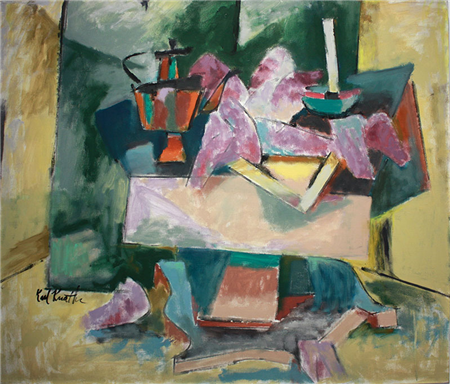
Massachusetts in 1919. His earliest work was inspired by the art of the Impressionists. However, after fraternizing with many of the local artists who had experienced the progressive art life of Paris, and by studying the examples of advanced European art in books and magazines, Knaths became deeply influenced by Cubism. By the late 1920s, he had evolved a very personal approach to this aesthetic, basing his abstract, but still recognizable compositions on seascapes and still life subjects.
During the 1930s, Knaths developed a complex theoretical basis for his painting. He began to structure his pictures according to strict rules of composition and color, inspired by the ideas of such artists as Piet Mondrian and Wassily Kandinsky. Using the classification system of colors developed by Wilhelm Ostwald, he would preselect the colors for his palette before starting to paint, for in Knath's view, color, like music, could be organized according to a system of notation. In this respect, each of Knath's canvases became a unique color composition, since the artist never used the same arrangement more than once.
Throughout his career, Knaths drew his iconography from his Provincetown environment, depicting the local fisherfolk, docks, shanties, dunes, and moors, and the familiar objects in his house. As his commitment to Abstraction developed, he was invited to exhibit with the American Abstract Artists group in 1936. He was also active as a teacher and lecturer, giving annual courses at the Phillips Collection in Washington, D.C. from 1937 until 1950, and was affiliated, at various times, with Black Mountain College and the Skohegan (Maine) School of Painting and Sculpture.
Duncan Phillips, Knaths first and for many years his only patron, did much to establish the artist's reputation. Despite Knath's innovative attitudes, he did work in relative isolation for much of his career, making only the occasional visit to New York or Boston and never feeling the need to travel to Europe.
Knaths died in Provincetown in 1971. Examples of his poetic, Cubist-inspired paintings can be found in the collections of the Metropolitan Museum and the Whitney Museum of American Art in New York, as well as at the Art Institute of Chicago, the Museum of Fine Arts in Boston, and many more. In 1973, a major retrospective of his work was circulated to six American museums by the International Exhibitions Foundation.
CL
©The essay herein is the property of Spanierman Gallery LLC and is copyrighted by Spanierman Gallery LLC and may not be reproduced in whole or in part, without written permission from Spanierman Gallery LLC nor shown or communicated to anyone without due credit being given to Spanierman Gallery LLC.Biography from ACME Fine Art
 Karl Knaths
1891-1971
Education:
Art Institute of Chicago (1912-1916)
Milwaukee Art Institute
Member:
National Academy
American Abstract Artists (1936)
Exhibitions:
Society of Independent Artists, 1921
Salons of America, 1922, '23
Art Institute of Chicago, 1928-'47
Corcoran Gallery of Art, biennials 1930-'63
Carnegie Institute
Whitney Museum of American Art, 1932-'67
Pennsylvania Academy of Fine Art, annuals 1933-'34, '41-'56, '60-'66
American Abstract Artists, 1936
Metropolitan Museum of Art, 1950
National Academy of Design
Collections:
Metropolitan Museum of Art
Art Institute of Chicago
Museum of Modern Art
Pennsylvania Academy of Fine Art
Whitney Museum of American Art
Phillips Collection
Los Angeles County Museum of Art
Museum of Fine Arts, Boston
Wadsworth Atheneum
Albright Knox Gallery
Munson-Williams-Proctor Institute
Brooklyn Museum
Detroit Institute of Arts
Metropolitan Museum of Art
Whitney Museum of American Art
Philadelphia Museum of Art
Art Institute of Chicago