Page loaded successfully. Showing biography for Karl Schmidt-Rottluff.
Karl Schmidt-Rottluff BIOGRAPHY
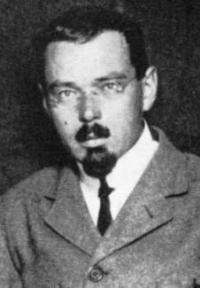
1884 Rottluff, Chemnitz, Germany - 1976 Berlin, Germany. Known for: Expressionist painting, woodcuts, linocuts, intaglio, teaching.
Born in 1884 with the name of Karl Schmidt in Rottluff, he added in 1905 the name of Rottluff to his sir name for his birthplace of Rottluff, a district in the town of Chemnitz in Saxony, Germany.... Read full biography
Born in 1884 with the name of Karl Schmidt in Rottluff, he added in 1905 the name of Rottluff to his sir name for his birthplace of Rottluff, a district in the town of Chemnitz in Saxony, Germany. That same year, he was part of a group of German architecture students who, in Dresden, first... Read full biography
Born in 1884 with the name of Karl Schmidt in Rottluff, he added in 1905 the name of Rottluff to his sir name for his birthplace of Rottluff, a district in the town of Chemnitz in Saxony, Germany. That same year, he was part of a group of German architecture students who, in Dresden, first exhibited together with the name Die Brucke* (The Bridge), an organization that existed until 1913 and whose goal was to "bridge" their modernist, avant-garde* style with the prevalent Romanticism* and other... Read full biography
Born in 1884 with the name of Karl Schmidt in Rottluff, he added in 1905 the name of Rottluff to his sir name for his birthplace of Rottluff, a district in the town of Chemnitz in Saxony, Germany. That same year, he was part of a group of German architecture students who, in Dresden, first exhibited together with the name Die Brucke* (The Bridge), an organization that existed until 1913 and whose goal was to "bridge" their modernist, avant-garde* style with the prevalent Romanticism* and other traditional movements of the past. As a group focused on harsh social realities and inner emotional responses, it had a major impact on paving the way to acceptance of 20th Century modernist art movements. Founding members in addition to... Read full biography
Born in 1884 with the name of Karl Schmidt in Rottluff, he added in 1905 the name of Rottluff to his sir name for his birthplace of Rottluff, a district in the town of Chemnitz in Saxony, Germany. That same year, he was part of a group of German architecture students who, in Dresden, first exhibited together with the name Die Brucke* (The Bridge), an organization that existed until 1913 and whose goal was to "bridge" their modernist, avant-garde* style with the prevalent Romanticism* and other traditional movements of the past. As a group focused on harsh social realities and inner emotional responses, it had a major impact on paving the way to acceptance of 20th Century modernist art movements. Founding members in addition to Schmidt-Rottluff were Fritz Bleyl (1880-1966), Erich Heckel (1883-1970) and Ernst Ludwig Kirchner (1880-1938). Schmidt-Rottluff, wh... Read full biography
Artist Biography
Biography page for Karl Schmidt-Rottluff ((1884 - 1976)), known for Expressionist painting, woodcuts, linocuts, intaglio, teaching. Showing 5 biographical entries and 0 sample artworks.
Karl Schmidt-Rottluff - Artist Info
About Karl Schmidt-Rottluff
Biography from the Archives of askART
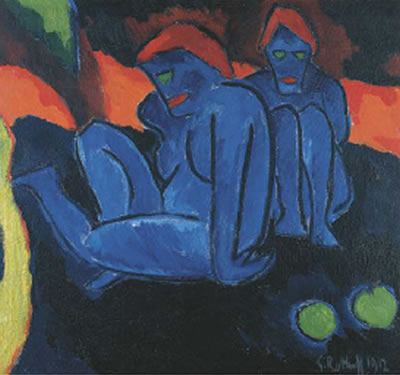 Born in 1884 with the name of Karl Schmidt in Rottluff, he added in 1905 the name of Rottluff to his sir name for his birthplace of Rottluff, a district in the town of Chemnitz in Saxony, Germany. That same year, he was part of a group of German architecture students who, in Dresden, first exhibited together with the name Die Brucke* (The Bridge), an organization that existed until 1913 and whose goal was to "bridge" their modernist, avant-garde* style with the prevalent Romanticism* and other traditional movements of the past. As a group focused on harsh social realities and inner emotional responses, it had a major impact on paving the way to acceptance of 20th Century modernist art movements.
Founding members in addition to Schmidt-Rottluff were Fritz Bleyl (1880-1966), Erich Heckel (1883-1970) and Ernst Ludwig Kirchner (1880-1938). Schmidt-Rottluff, who had been much inspired by the expressive power of art he saw at the Ethnographic Museum in Dresden, is credited for naming the group "after a quote by Nietzsche's Thus Spoke Zarathustra: 'What is great in man is that he is a bridge and not an end." (Germanexpressionism.com) Of the group it is said that Schmidt-Rottluff was the most independent minded and that he, in contrast to the others, was apolitical, and often chose religious themes.
Schmidt-Rottluff had known Heckel since high school and met with him and the others when they all were students at the technical university (Konigliche Technische Hochschule) in Dresden. They spent much time discussing the inhibiting influence of the academic way in which they were taught art and determined to counter these conservative methods with artwork that brought together German influences of the past with what they foresaw as the future. Die Brucke artists, leaving their studies at the university, reached back to the influences of German printmaker Albrecht Durer (1471-1528), religious painter Matthias Grunewald (1470-1528), and painter and print maker Lucas Cranach the Elder, (1472-1553). They reached forward by looking within themselves and and doing much to create the style of Expressionism*. They also invented the printmaking method of linocuts*, utilizing linoleum sheets.
Initially members of Die Brucke lived solo in working class neighborhoods in Dresden to be near 'real' people in rejection of their own privileged upbringings. They used an empty butcher's shop as a studio, an arrangement made by Erich Heckel. The studio became a place of casual bohemian living with group 'life-drawing sessions' that became frolicking parties with young female models. Between 1907 and 1911, they summered at Moritzburg Lakes in Saxony and also went to the island of Fehmarn in the Baltic Sea, off the eastern coast of Schleswig-Holstein, Germany.
In the fall of 1911, Schmidt-Rottluff and the Die Brucke members moved to Berlin where they met and were reinforced by many other avant-garde leaning artists. In 1912, Schmidt-Rottluff had his first solo exhibition, which was held at a venue in Hamburg. The next year, Die Brucke disbanded in a formal sense, but their influence outlived all of them.
During World War I Schmidt-Rottluff volunteered for service, and was stationed on the Eastern front in staff headquarters. He did wood sculpture in his spare time, and increasingly his work expressed the horrors of the war he saw firsthand. He also lived through the building up of Nazi aggression. In 1937, over six hundred of his paintings were seized by the Nazis and exhibited as "degenerate art"*.
In 1947, Schmidt-Rottluff became a professor at the University of Arts in Berlin-Charlottenburg. In 1967, he founded the Brucke Museum in Berlin.
He died in Berlin in 1976.
His ongoing reputation of excellence is for expressive painting but is especially associated with printmaking. He completed 446 woodcuts, 121 lithographs, and 96 intaglios. Most of this work was done between 1905 and 1927, and after that he abandoned graphics.
Sources:
Wikipedia: http://en.wikipedia.org/wiki/Karl_Schmidt-Rottluff; http://en.wikipedia.org/wiki/Die_Brücke
Germanexpressionism.com: Karl Schmidt-Rottluff Biography
*For more in-depth information about these terms and others, see AskART.com Glossary at http://www.askart.com/AskART/lists/Art_Definition.aspxBiography from Ketterer Kunst, Munich
Karl Schmidt-Rottluff became intensively occupied with watercolor painting during a summer stay in Dangast on the North Sea in summer 1909. He rendered the landscape around the small tranquil coastal village in many works, putting focus on capturing the atmosphere with the newly attained expressiveness. Remarkable creations came into existence, among them "Kühler Morgen" (Cool Morning). Entirely autonomous and free from any notions of randomness, they are at eye level with his paintings, an intention that he also underlined with the large formats he chose for these works. Early watercolors are characterized by a swift and strongly gestural flow, while the grounding remains visible between the color fields. Even though these works are created from the colors, strong traces of a graphic flow can still be observed, the direction of the brushstroke determines the composition. The contrasting complementary colors red-green and blue-yellow increase the impression of freshness and a spontaneous execution, at the same time their visual aggressiveness is significant for a radical break with the tradition.
1909 was the year that Karl Schmidt-Rottluff began to define pictorial elements with black contour lines. The liberation of watercolor art from its shadowy existence and a rebirth in its true element pure color was the merit of the artists of Expressionism.
Significant watercolors from these years are in museum ownership nowadays, such as the work "Fabrik" (1909) at the Berlin Brücke-Museum. Magdalena Moeller states: "Watercolors from1909 must be regarded as a homogeneous group of works. They count among Schmidt-Rottluff's most fascinating accomplishments." (M. Moeller, in: Ex. cat. Werke aus der Slg. des Brücke-Museums Berlin, Hypo Kulturstiftung, Munich 1997, p. 19).
By restoring the force of expression of the watercolor, Karl Schmidt-Rottluff achieved nothing less than a renaissance of an art form in danger of drowning in decorative colorist painting. From that point onward it was on an equal footing with the paintings and drawings of its era. [EH]Biography from Everard Auctions & Appraisals
Karl Schmidt-Rottluff was a German Expressionist artist. Born with the name Karl Schmidt in 1884 in Rottluff, Germany, he later added the suffix Rottluff to his surname in 1905. In the early 1900's Schmidt-Rottluff was a member of a the group of German architecture students in Dresden who exhibited together under the name Die Brucke. The groups focused on bridging the gap between modernist and avant-garde art movements with more traditional art movements, and they had a major impact of the mainstream acceptance of 20th century modernist art movements. In Die Brucke Schmidt-Rottluff worked among artist such as Fritz Bleyl, Erich Heckel, an Ernst Ludwig Kirchner until the group disbanded in 1913. Before he left Die Brucke Schmidt-Rottluff had his first solo exhibition in Hamburg, Germany in 1912. After living through both World Wars, Karl Schmidt-Rottluff become a professor at the University of Arts in Berlin-Charlottenburge in 1947, and in 1967 he founded the Brucke Museum in Berlin. Schmidt-Rottluff's work is now in the collection of notable museums such as the Stadel Museum in Frankfurt, the Tate Gallery London, The Museum of Modern Art in New York, and the Albertina in Vienna, among many others.Biography from Karl & Faber Kunstauktionen
Karl Schmidt-Rottluff had a great love for Ascona. From 1927 to 1929 he spent the spring on Lake Maggiore. In the 1950s he revived his passion for this region and returned several times to Ascona. The present work was created during his first travel phase in 1928. The artist captured the place with its striking tower, the houses and the promenade in the foreground. You can only guess at the lake behind the tower. The mountains that dominate his other Ascona pictures lose some of their dominant and sometimes intimidating position and remain discreetly in the background.Biography from Karl & Faber Kunstauktionen
The watercolor plays a central role in Schmidt-Rottluff's work. It was in this medium that he made his decisive contribution to the “Brücke style” in 1909; its fluidity and lightness became the model for the group, also for work in oil. The present sheet is a particularly powerful and shining example of his work in this technique. Black contours, quickly set with a broad brush, determine the ornamental sweep of the composition, which he then additionally enlivens with strong colors and so impressively accentuates the church.