Page loaded successfully. Showing biography for Kay Sage.
Kay Sage BIOGRAPHY
1898 Albany, New York - 1963 Woodbury, Connecticut. Known for: Surreal, symbolist and dream image painting, sculpture.
Exhibition Review, . "Los Angeles County Museum on Fire: Kay Sage, Painter of an Odd Future". April 30, 2012 by William Poundstone . Consider Kay Sage (1898-1963) the anti-Thomas Kinkade. She was... Read full biography
Exhibition Review, . "Los Angeles County Museum on Fire: Kay Sage, Painter of an Odd Future". April 30, 2012 by William Poundstone . Consider Kay Sage (1898-1963) the anti-Thomas Kinkade. She was America’s great painter of menace, dread, and the post-apocalyptic future. Her trademark was “the... Read full biography
Exhibition Review, . "Los Angeles County Museum on Fire: Kay Sage, Painter of an Odd Future". April 30, 2012 by William Poundstone . Consider Kay Sage (1898-1963) the anti-Thomas Kinkade. She was America’s great painter of menace, dread, and the post-apocalyptic future. Her trademark was “the sulphurous light before a thunderstorm,” observed biographer Régine Tessier. Like a thunderstorm, Sage’s art could be depressing and exhilarating. A true contrarian might nominate Sage as the best of all... Read full biography
Exhibition Review, . "Los Angeles County Museum on Fire: Kay Sage, Painter of an Odd Future". April 30, 2012 by William Poundstone . Consider Kay Sage (1898-1963) the anti-Thomas Kinkade. She was America’s great painter of menace, dread, and the post-apocalyptic future. Her trademark was “the sulphurous light before a thunderstorm,” observed biographer Régine Tessier. Like a thunderstorm, Sage’s art could be depressing and exhilarating. A true contrarian might nominate Sage as the best of all the Western Hemisphere surrealists. Frida, move over? . Born in Albany, Sage had one of her first gallery shows in Los Angeles, at the Tone Price gallery in 1940. Despite that, no Sage paintings have made their way into local museum collections.... Read full biography
Exhibition Review, . "Los Angeles County Museum on Fire: Kay Sage, Painter of an Odd Future". April 30, 2012 by William Poundstone . Consider Kay Sage (1898-1963) the anti-Thomas Kinkade. She was America’s great painter of menace, dread, and the post-apocalyptic future. Her trademark was “the sulphurous light before a thunderstorm,” observed biographer Régine Tessier. Like a thunderstorm, Sage’s art could be depressing and exhilarating. A true contrarian might nominate Sage as the best of all the Western Hemisphere surrealists. Frida, move over? . Born in Albany, Sage had one of her first gallery shows in Los Angeles, at the Tone Price gallery in 1940. Despite that, no Sage paintings have made their way into local museum collections. That’s remedied temporarily by LACMA’s “In Wonderland: The Surrealist Adventures of Women Artists in Mexico and the United... Read full biography
Artist Biography
Biography page for Kay Sage ((1898 - 1963)), known for Surreal, symbolist and dream image painting, sculpture. Showing 2 biographical entries and 0 sample artworks.
Kay Sage - Artist Info
About Kay Sage
Name variants
Katherine Lynn (Sage) Tanguy, Kay (Sage) Tanguy
Biography from the Archives of askART
 Exhibition Review,
"Los Angeles County Museum on Fire: Kay Sage, Painter of an Odd Future"
April 30, 2012 by William Poundstone
Consider Kay Sage (1898-1963) the anti-Thomas Kinkade. She was America’s great painter of menace, dread, and the post-apocalyptic future. Her trademark was “the sulphurous light before a thunderstorm,” observed biographer Régine Tessier. Like a thunderstorm, Sage’s art could be depressing and exhilarating. A true contrarian might nominate Sage as the best of all the Western Hemisphere surrealists. Frida, move over?
Born in Albany, Sage had one of her first gallery shows in Los Angeles, at the Tone Price gallery in 1940. Despite that, no Sage paintings have made their way into local museum collections. That’s remedied temporarily by LACMA’s “In Wonderland: The Surrealist Adventures of Women Artists in Mexico and the United States,” which contains a mini-Sage retrospective. That alone is reason to see “In Wonderland” before it closes May 6.
Kay Sage spent almost her whole career in the shadow of husband Yves Tanguy, also a surrealist painter and considerably better known. It was widely assumed that Tanguy’s wealthy American wife had amused herself by turning out knockoffs. Some of the collections that own Sage’s work catalogue it as “Kay Sage Tanguy” — a hyphenate she didn’t use, more suited to a Junior League cookbook.
The reality is more interesting and even more romantic. The surrealist couple first fell in love with each other’s paintings. That would qualify as “meet cute,” were we not talking about paintings of scorched-earth weirdness. Tanguy was entranced by a show of Sage’s work, not yet knowing the artist’s gender. Sage adored the first Tanguy she saw, Je vous attends (translated “I Await You” or “I’m Waiting for You,” 1934). That early masterpiece is now owned by LACMA.
Undeniably, there is a broad similarity between Sage’s and Tanguy’s brand of surrealism. Each produced landscapes populated by unrecognizable objects against smoggy skies. The brushwork was crisp and Leiden fine-painterish. It’s said that Salvador Dali stole the meticulous technique from Tanguy. Dali applied it to figures and objects of Freudian dreams, reaching a larger, sometimes less discerning audience. If Tanguy and Sage’s painting represent dreams, they must be fevered ones.
Disambiguation. Tanguy painted odd rocks, pebbles, microbes, or biomorphs. Whatever they are, they appear to be small, possibly microscopic. The landscapes of Tanguy are underwater, under a cover slip, or on a planet that is not-too-earthlike. There is no human presence. In the postwar period, Tanguy’s pebblescapes were read as melted remnants of atomic blasts. Tanguy himself maintained a Duchamp poker-face on all of this.
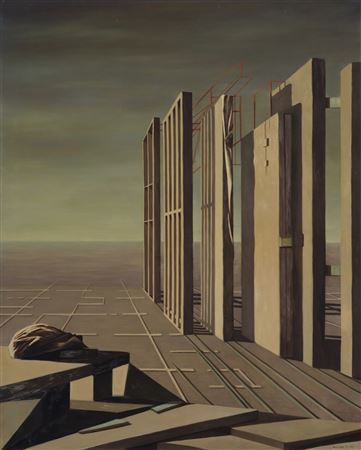
Sage’s art, in contrast, has a monumental quality. Her landscapes feel big, windswept, and lonely, with a nod to the American West (she married Tanguy in Reno). There is a human absence. Sage’s paintings, such as Tomorrow for Example (left), have an architectural quality not found in Tanguy. Her peculiar constructions are unfinished, off-kilter, or ruined, the work of unseen humanoids. Occasionally Sage’s works include wind-blown drapery implying a human figure. Art historian Whitney Chadwick found in Sage “a sense of motionlessness and impending doom found nowhere else in Surrealism.”
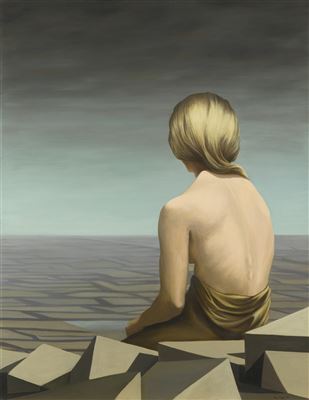
Tanguy died from an unexpected stroke in 1955. That almost put an end to Sage’s painting career. The following year she produced Le Passage, extraordinary for showing a female figure among the rockscape. The invisible face has been interpreted as a self-portrait.
One of Sage’s last paintings, included in the LACMA show, is Watching the Clock from 1958. The title sounds like the despair of the bereaved. It is a back-of-canvas trompe l’oeil, such as the Dutch Masters did, and such as Roy Lichtenstein would do a generation later. Sage’s painting has two bullet holes in the canvas.
In her last years Sage made small sculptures of wire and bullets. On January 8, 1963, she shot herself in the heart. Her suicide note explained: “The first painting by Yves that I saw, before I knew him, was called ‘I’m Waiting for You.’ I’ve come. Now he’s waiting for me again — I’m on my way.”
Source:
"Kay Sage, Painter of an Odd Future," Blouin Art Info Blogs, Web, March 2016Biography from the Archives of askART
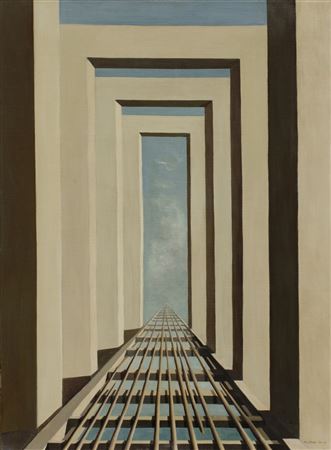 A noted surrealist painter of dream-image landscapes with muted colors, architectural forms, and mood suggestive of mystery and potentially weird happenings to come, Sage had a dramatic, tumultuous life. Her artistic career was overshadowed by her well-known husband, Yves Tanguy, and like so many women artists of the early 20th century, she became more accepted in later years.
She was raised in New York where her father was a state senator. Her parents divorced, and she traveled extensively in Europe with her mother and attended the prestigious Brearley and Foxcroft schools in England.
At age twenty five, she went to Italy to recover from a love affair with an older man and began teaching herself to paint. From 1925 to 1935, she was married to Italian Prince Ranieri de San Faustino, but this union ended in divorce. She returned to Paris and resumed her painting career and became involved with surrealist painters including Yves Tanguy, whom she married in 1940.
The couple moved to Woodbury, Connecticut but kept in close touch with their Paris friends and helped many of them escape during World War II. During her marriage to Tanguy, she did what has come to be regarded as some of her best work.
In 1955, her husband died, and she suffered depression and became totally reclusive. Four years later, she attempted suicide and then succeeded in 1963, shooting herself in the heart.
Source: "American Women Artists" by Charlotte Streifer Rubinstein