Page loaded successfully. Showing biography for Kenneth D Snelson.
Kenneth D Snelson BIOGRAPHY
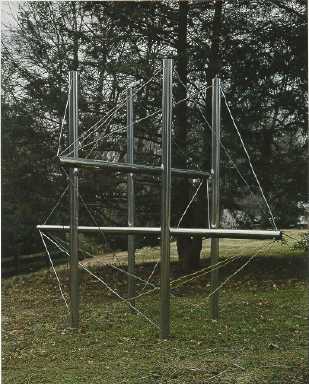
1927 Pendleton, Oregon - 2016 Manhattan, New York. Known for: Geometric form sculpture, assemblage, graphics.
"Kenneth Snelson, Sculptor Who Fused Art, Science and Engineering, Dies at 89". By William Grimes, December 23, 2016, The New York Times, Art & Design Section. Kenneth Snelson, a sculptor who... Read full biography
"Kenneth Snelson, Sculptor Who Fused Art, Science and Engineering, Dies at 89". By William Grimes, December 23, 2016, The New York Times, Art & Design Section. Kenneth Snelson, a sculptor who stitched together aluminum tubes with flexible stainless-steel wires to create seemingly lighter-than-air... Read full biography
"Kenneth Snelson, Sculptor Who Fused Art, Science and Engineering, Dies at 89". By William Grimes, December 23, 2016, The New York Times, Art & Design Section. Kenneth Snelson, a sculptor who stitched together aluminum tubes with flexible stainless-steel wires to create seemingly lighter-than-air towers, arcs and cantilevers, died on Thursday at his home in Manhattan. He was 89. The cause was prostate cancer, his wife, Katherine, said. Mr. Snelson was a painting student at Black Mountain... Read full biography
"Kenneth Snelson, Sculptor Who Fused Art, Science and Engineering, Dies at 89". By William Grimes, December 23, 2016, The New York Times, Art & Design Section. Kenneth Snelson, a sculptor who stitched together aluminum tubes with flexible stainless-steel wires to create seemingly lighter-than-air towers, arcs and cantilevers, died on Thursday at his home in Manhattan. He was 89. The cause was prostate cancer, his wife, Katherine, said. Mr. Snelson was a painting student at Black Mountain College in North Carolina in the late 1940s when he became enchanted by the lectures on geometric forms delivered by a last-minute substitute teacher, Buckminster Fuller, the futurist inventor and father of the geodesic dome. In an experiment, Early X... Read full biography
"Kenneth Snelson, Sculptor Who Fused Art, Science and Engineering, Dies at 89". By William Grimes, December 23, 2016, The New York Times, Art & Design Section. Kenneth Snelson, a sculptor who stitched together aluminum tubes with flexible stainless-steel wires to create seemingly lighter-than-air towers, arcs and cantilevers, died on Thursday at his home in Manhattan. He was 89. The cause was prostate cancer, his wife, Katherine, said. Mr. Snelson was a painting student at Black Mountain College in North Carolina in the late 1940s when he became enchanted by the lectures on geometric forms delivered by a last-minute substitute teacher, Buckminster Fuller, the futurist inventor and father of the geodesic dome. In an experiment, Early X Piece (1948), Mr. Snelson took two X’s made from propeller-shaped pieces of plywood and suspended one over t... Read full biography
Artist Biography
Biography page for Kenneth D Snelson ((1927 - 2016)), known for Geometric form sculpture, assemblage, graphics. Showing 3 biographical entries and 0 sample artworks.
Kenneth D Snelson - Artist Info
About Kenneth D Snelson
Biography from the Archives of askART
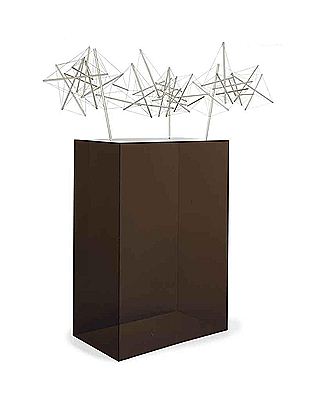 "Kenneth Snelson, Sculptor Who Fused Art, Science and Engineering, Dies at 89"
By William Grimes, December 23, 2016, The New York Times, Art & Design Section
Kenneth Snelson, a sculptor who stitched together aluminum tubes with flexible stainless-steel wires to create seemingly lighter-than-air towers, arcs and cantilevers, died on Thursday at his home in Manhattan. He was 89.
The cause was prostate cancer, his wife, Katherine, said.
Mr. Snelson was a painting student at Black Mountain College in North Carolina in the late 1940s when he became enchanted by the lectures on geometric forms delivered by a last-minute substitute teacher, Buckminster Fuller, the futurist inventor and father of the geodesic dome.
In an experiment, Early X Piece (1948), Mr. Snelson took two X’s made from propeller-shaped pieces of plywood and suspended one over the other using a matrix of nylon tension lines.
This was something new, an advance on the kinetic sculptures he had been making.
“While forfeiting mobility, I managed to gain something even more exotic: solid elements fixed in space, one-to-another, held together only by tension members,” he wrote in a letter published in the International Journal of Space Structures in 1990. “I was quite amazed at what I had done.”
So was Fuller. He asked Mr. Snelson to make a variation on Early X Piece, which he later exhibited — without crediting his student — at an important exhibition at the Museum of Modern Art in 1959.
Mr. Snelson had called the principle behind his work “floating compression.” Fuller, around the time of the MoMA exhibition, combined “tension” and “structural integrity” in a new word, “tensegrity,” which became identified with his and Mr. Snelson’s work.
Delicate and airy, Mr. Snelson’s creations assumed a bewildering variety of guises. They hugged the ground, lizardlike, stretched horizontally from the sides of buildings, exploded outward like frozen pick-up sticks or rose vertiginously skyward, like the 60-foot-tall Needle Tower (1968) at the Hirshhorn Museum and Sculpture Garden in Washington and Needle Tower II (1968), 90 feet tall, at the Kröller-Müller Museum in Otterlo, the Netherlands.
The engineering aspect of his work and his interest in the structure of the atom, the basis of a series of sculptures that he called circlespheres, led some critics to regard him as a quasi-scientist rather than an artist. Mr. Snelson rejected this interpretation emphatically.
“Engineers make structures for specific uses, to support something, to hold something, to do something,” he told Eleanor Heartney for her monograph Kenneth Snelson: Forces Made Visible (2009). “My sculptures serve only to stand up by themselves, and to reveal a particular form such as a tower or a cantilever or a geometrical order probably never seen before; all of this because of a desire to unveil, in whatever ways I can, the wondrous essence of elementary structure.”
Kenneth Duane Snelson was born on June 29, 1927, in Pendleton, Ore. His father, Jack, who was in the laundry business, opened a camera shop when his son was 6. His mother, the former Mildred Unger, was a homemaker.
Kenneth loved to build model airplanes and ships as a child, and he had the run of his father’s shop, learning to take still photographs and movies. After graduating from high school in 1945, he enlisted in the Navy, where he was trained as a radio technician and sent to Washington to work in naval intelligence. He served only 13 months, discharged when the Navy cut back on manpower after the end of World War II.
Eligible, just barely, for the G.I. Bill, he enrolled in the University of Oregon, where his courses on architectural drawing and design kindled an interest in painting.
When he found out that Josef Albers, a central figure in the Bauhaus movement, was the dean of Black Mountain College, he signed up for the summer program. Mr. Albers, noting his aptitude for three-dimensional design, asked him to help Fuller by constructing geometrical models for him to use in his lectures.
Mr. Snelson returned to Oregon, where he studied engineering for a time before spending another summer at Black Mountain. He later studied at the Institute of Design in Chicago and went to Paris to study with Fernand Léger at the Académie de Montmartre.
After moving to Manhattan he spent several years as a cinematographer, working on television documentaries and making small works in a variety of materials, all held together by internal tension. He also began using plastic rings, bound with nylon thread, and ceramic magnets to make the circlespheres that evolved into his experiments with atomic structure.
The 1964 New York World’s Fair provided him with a big commission. Synergetics, a company founded by Fuller, was chosen as the architects and engineers for the Tower of Light, a pavilion financed by public utility companies. Mr. Snelson created a huge work of sculpture, Photonium, measuring 30 by 35 feet, hung overhead in the pavilion’s Court of Light, near the entrance.
He began exhibiting at the Dwan Gallery in Manhattan, an important showcase for Minimalism, where he had his first solo show, in 1966. That same year his work was included in the Sculpture Annual at the Whitney Museum of American Art.
In 1972 he married Katherine Kaufmann, who survives him, as do their daughter, Andrea Fionda; two grandsons, and a step granddaughter. His first marriage ended in divorce. His second wife, the former Audrey Goldenstein, died in 1966.
In his later work, Mr. Snelson elaborated on his atomic structures using digital imagery, which allowed him to summon forth complex, intertwined forms bordering on the fantastical. He also returned to photography, using vintage cameras to take panoramic images of streets and neighborhoods in New York, Venice and Paris.
At the rebuilt One World Trade Center, he came close to completing a work that, in vertical terms, would have been the capstone of his career.
With the architects Skidmore, Owings & Merrill, he designed sculptural cladding for the building’s antenna. Called a radome, it was a tapering multifaceted structure of interlocking triangles rising more than 400 feet. But the developers, the Durst Organization, and the Port Authority of New York and New Jersey, dropped the idea, stating that the radome would be too difficult to maintain and repair.
In April the National Gallery of Art in Washington installed a 1968 Snelson work, V-X, on the terrace of the newly renovated East Wing.Biography from the Archives of askART
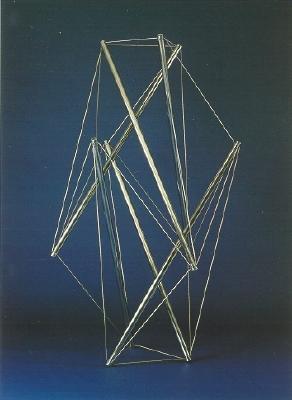 Born 1927 in Pendleton, Oregon, Kenneth Snelson "constructs his sculptures from stainless steel rods and tension wires, which he combines in modular configurations that repeat across each work. The rods and wires distribute a scheme of compression and tension, or push and pullthe rods refuse to collapse and the wires are stretched to their limits. The principle of structure by compression and tension, a method created by Snelson and which he has named "tensegrity," gives his forms an intrinsic stability through the choreography of what he calls "essential forces" (Mark Daniel Cohen).
The artist builds maquettes first, creating them by hand, piece by piece, proceeding by impulse. Snelson's education background includes: the University of Oregon, Eugene, Oregon; Black Mountain College, Black Mountain, N.C.; and Fernand Leger, Paris.
Recently, Snelson has become interested in the atom, "finding in our growing understanding of the atom's structure a source of inspiration for a new series of dynamic models, sculptures and computer graphics" (www.grunch.net).
His contemporary sculpture is held in museum collections throughout the world and has brought the artist a continuing series of honors and awards, including the 1971 Sculpture Award from the New York State Council on the Arts, a DAAD Fellowship for Berlin Künstlerprogram in 1976, and in 1981, the American Institute of Architects' Medal. In 1985, Snelson was awarded an honorary doctorate in Arts and Humane Letters by the Rensselaer Polytechnic Institute in Troy, New York. In 1999, he became a Biennial Honoree at the Neuberger Museum of Art, Purchase, New York, and will be given the International Sculpture Center's Lifetime Achievement in Contemporary Sculpture Award.
Source:
Mark Daniel Cohen, Sculpture Magazine at: www.sculpture.org information from an interview on August 8, 1999.
Preview Gallery, www.grunch.net
http://www.inetarena.com/pdx4d/snelson/Portrait.html
http://www.kennethsnelson.net/Biography from The Johnson Collection
KENNETH DUANE SNELSON (1927-2016)
As a child in Pendleton, Oregon, Kenneth Snelson loved to build model airplanes and ships, activities that anticipated his success as a sculptor of carefully engineered steel and aluminum pieces that conveyed, in the artist’s words, “the wondrous essence of elementary structure.” After finishing high school, he enlisted in the United States Navy, working as a radio technician and in naval intelligence in Washington. Following his discharge, he took advantage of the G.I. Bill and enrolled at the University of Oregon, where he pursued architectural drawing and design.
In 1948, Snelson attended the summer session at Black Mountain College. Noting the young man’s “aptitude for three-dimensional design,” Josef Albers guided him toward the experimental architect and faculty member Buckminster Fuller. Initially, the two men’s relationship was very compatible, and Snelson recalled being “electrified” by Fuller’s first lecture. That fall, Snelson returned to study engineering at the University of Oregon and then returned to western North Carolina for a second summer. He brought with him a kinetic model of plywood pieces suspended one over another by nylon tension lines, a piece he called Early X Piece. At Fuller’s instigation, the design was translated into metal and christened “tensegrity”—a combination of integrity and tension—and subsequently exhibited as Fuller’s own work.
Snelson went on to attend the Institute of Design in Chicago, an American offshoot of the Bauhaus, but found it lacked the conviviality of that he had experienced at Black Mountain. For a short period, he studied in Paris with Fernand Léger, a noted modernist who often painted floating figures. Snelson settled in New York after that and worked for a time as a cinematographer for television documentaries, while continuing to make small sculptures. In 1964, he was commissioned to create a major aerial piece measuring thirty by thirty-five feet for the public utilities pavilion at the World’s Fair in New York.
Although his work was represented in important museum exhibitions (including the 1966 Sculpture Annual at the Whitney Museum of American Art), critics often accused Snelson of being more an engineer than an artist. He responded in turn: “Engineers make structures for specific uses, to support something, to hold something, to do something. My sculptures serve only to stand up by themselves, and to reveal a particular form such as a tower or a cantilever or a geometrical order probably never seen before.” He developed a specialty of airy public outdoor sculptures constructed of stainless steel and aluminum, which illustrate his theories of compression and tension. He held five United States patents, and in 1999 the International Sculpture Center presented him with the Lifetime Achievement in Contemporary Sculpture Award.
The Johnson Collection, Spartanburg, South Carolina
thejohnsoncollection.org