Page loaded successfully. Showing biography for Kenneth Victor Young.
Kenneth Victor Young BIOGRAPHY
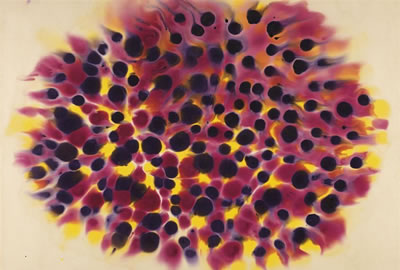
1933 Louisville, Kentucky - 2017. Known for: Abstract painting oval images of 'exploding' color.
KENNETH VICTOR YOUNG 1933-2017 . Although he is considered a member of the Washington Color School, Kenneth Victor Young sensed he was an outsider. “I felt like they didn’t recognize me as being part... Read full biography
KENNETH VICTOR YOUNG 1933-2017 . Although he is considered a member of the Washington Color School, Kenneth Victor Young sensed he was an outsider. “I felt like they didn’t recognize me as being part of their movement. I was an outsider. I don’t know–because I wasn’t from Washington? Because I... Read full biography
KENNETH VICTOR YOUNG 1933-2017 . Although he is considered a member of the Washington Color School, Kenneth Victor Young sensed he was an outsider. “I felt like they didn’t recognize me as being part of their movement. I was an outsider. I don’t know–because I wasn’t from Washington? Because I didn’t go to Black Mountain College? Those are things that get people into a movement.” . Kenneth Young’s birthplace was Louisville, Kentucky, also the hometown of Bob Thompson and Sam Gilliam, with whom... Read full biography
KENNETH VICTOR YOUNG 1933-2017 . Although he is considered a member of the Washington Color School, Kenneth Victor Young sensed he was an outsider. “I felt like they didn’t recognize me as being part of their movement. I was an outsider. I don’t know–because I wasn’t from Washington? Because I didn’t go to Black Mountain College? Those are things that get people into a movement.” . Kenneth Young’s birthplace was Louisville, Kentucky, also the hometown of Bob Thompson and Sam Gilliam, with whom he became friendly. Young met them at the University of Louisville where he studied design and physics and earned a bachelor of science degree. He did further studies at Indiana University and the University of Hawaii. Young served in the United... Read full biography
KENNETH VICTOR YOUNG 1933-2017 . Although he is considered a member of the Washington Color School, Kenneth Victor Young sensed he was an outsider. “I felt like they didn’t recognize me as being part of their movement. I was an outsider. I don’t know–because I wasn’t from Washington? Because I didn’t go to Black Mountain College? Those are things that get people into a movement.” . Kenneth Young’s birthplace was Louisville, Kentucky, also the hometown of Bob Thompson and Sam Gilliam, with whom he became friendly. Young met them at the University of Louisville where he studied design and physics and earned a bachelor of science degree. He did further studies at Indiana University and the University of Hawaii. Young served in the United States Navy in the early 1950s, and for a short period, he worked for the DuPont chemical company in Louisville. In 1964 Yo... Read full biography
Artist Biography
Biography page for Kenneth Victor Young ((1933 - 2017)), known for Abstract painting oval images of 'exploding' color. Showing 2 biographical entries and 0 sample artworks.
Kenneth Victor Young - Artist Info
About Kenneth Victor Young
Biography from The Johnson Collection
KENNETH VICTOR YOUNG 1933-2017
Although he is considered a member of the Washington Color School, Kenneth Victor Young sensed he was an outsider. “I felt like they didn’t recognize me as being part of their movement. I was an outsider. I don’t know–because I wasn’t from Washington? Because I didn’t go to Black Mountain College? Those are things that get people into a movement.”
Kenneth Young’s birthplace was Louisville, Kentucky, also the hometown of Bob Thompson and Sam Gilliam, with whom he became friendly. Young met them at the University of Louisville where he studied design and physics and earned a bachelor of science degree. He did further studies at Indiana University and the University of Hawaii. Young served in the United States Navy in the early 1950s, and for a short period, he worked for the DuPont chemical company in Louisville.
In 1964 Young moved to Washington, DC, and joined the staff of the Smithsonian Institution as its first black exhibit designer. At the Museum of History and Technology (now the National Museum of American History) he oversaw such projects as the Hall of Graphic Arts which included old printing presses, examples of various types of prints, and a job shop. It closed in December 2003.
Another exhibit was based on women and politics, and a third was about the centennial of Gandhi. In the evenings Young worked for the United States Information Agency designing and installing exhibitions in Italy, Egypt, and Africa. The agency was established in 1953 to “tell America’s story” through cultural events and Voice of America broadcasts; it was dissolved in 1999. This and subsequent travels had a profound effect on Young’s work throughout the remainder of his life. After thirty years, in 1994, Young retired from his position at the Smithsonian.
When he first moved to Washington, Young stayed with friends, including Gilliam, until he could find his own footing. In the mid-1960s, artists in the nation’s capital were exploring staining unprimed canvases, a trend that became known as the Washington Color School. Beginning in the late 1950s the artists affiliated with the movement, founded by Morris Louis and Kenneth Noland, did not function as a “school,” but rather they shared aesthetic goals and working methods. A more lyrical approach than Abstract Expressionism, they retained their predecessors’ large scale and immersive quality. Other artists like Young, Gilliam, Thomas Downing, and Alma Thomas painted in a similar fashion.
The sciences were interwoven in the imagery of Young’s work–conjuring images of nebulous forms, clouds, and cosmic abstractions, particularly in the 1970s. In Young’s early work, round shapes cluster together and appear to float and extend outward. After 2000 the paintings became more densely packed with less diluted forms. Young often applied his acrylic washes onto canvases laid on the floor, hence there are no drips, but rather an overall effect.
He described his working method: “I put the color down with a brush on raw canvas…I use acrylic dyes. I spray water on it and thin it in places…I take a sponge and take out the excess water in other places. Edges are important to me—the edges of the forms and shapes; the edge of the stretcher. Beginnings and endings are important to me… These in-between spaces hold up, giving format and liquid quality to the canvas surface. I equate this form of accident with patterns that happen with living things. The life of the color holds within it a mood quality that I feel is human.” This improvisational approach aligns with Jazz, the music he consistently played in his studio.
In the last decade or so of his life, Young had put painting on hold. After his wife’s death, Kenneth Young spent the last two years of his life traveling around the Caribbean with his daughter. His work is included in the National Gallery of Art and the Smithsonian Museum of American Art.
The Johnson Collection, Spartanburg, South Carolina
thejohnsoncollection.orgBiography from Swann Galleries
Born in Kentucky, Kenneth Young had a career that began in the sciences. He studied and taught physics at Indiana University and chemical engineering at the University of Louisville. In the early 1960s, Young switched his studies to a pursuit of visual art, joining a circle of artists at the University of Louisville that included G. Caliman Coxe, Sam Gilliam and Bob Thompson.
After moving to Washington, DC in 1964, he worked at the Smithsonian Institution for over 35 years as an exhibition installation designer. He was also an art instructor at the Corcoran Gallery of Art and the Duke Ellington School of the Arts in Washington, DC. Young also had solo exhibitions at the Carl Van Vechten Gallery at Fisk University in 1973, and at the Corcoran Gallery in Washington, DC in 1974. His paintings have also been included in exhibitions at the Smithsonian American Art Museum, the Corcoran Gallery and the Washington Project for the Arts, and are in the collection of the Smithsonian American Art Museum and the National Gallery of Art, Washington, DC.
Kenneth Young was associated in the early 1970s with the rise of the Washington Color School, and in 1969, had a solo exhibition at the Franz Bader Gallery in Washington, DC. Young worked at the Smithsonian Institution for over 35 years in exhibition installation and design after studying and teaching physics at Indiana University and chemical engineering at the University of Louisville. He was also an art instructor at the Corcoran Gallery of Art and the Duke Ellington School of the Arts in Washington, DC.
His paintings have been included in exhibitions at the Smithsonian American Art Museum, the Corocoran Gallery and the Washington Project for the Arts. His 1973 painting, in the permanent collection of the Smithsonian American Art Museum, was recently included in African-American Art, Harlem Renaissance, Civil Rights and Beyond, their 2012-14 traveling exhibition and illustrated in the catalogue.
Source:
Mecklenburg/Powell pp. 230-231