Page loaded successfully. Showing biography for Konrad Cramer.
Konrad Cramer BIOGRAPHY

1888 Wurzburg, Germany - 1963 Woodstock, New York. Known for: Modernist, abstract painting, photography.
Konrad Cramer was born and raised in Wurtzburg, Germany in an artistic family. His mother was an opera singer and an uncle was a well-known painter of still lifes. Cramer trained as an artist at the... Read full biography
Konrad Cramer was born and raised in Wurtzburg, Germany in an artistic family. His mother was an opera singer and an uncle was a well-known painter of still lifes. Cramer trained as an artist at the Karlsruhe Academy under Ludwig Schmidt-Reutte and Ernest Schurth. He became interested in the German... Read full biography
Konrad Cramer was born and raised in Wurtzburg, Germany in an artistic family. His mother was an opera singer and an uncle was a well-known painter of still lifes. Cramer trained as an artist at the Karlsruhe Academy under Ludwig Schmidt-Reutte and Ernest Schurth. He became interested in the German avant-garde early in his schooling as he was exposed to and encouraged by the experimental works of Wassily Kandinsky and Franz Marc. An additional influence on Cramer's artistic development was the... Read full biography
Konrad Cramer was born and raised in Wurtzburg, Germany in an artistic family. His mother was an opera singer and an uncle was a well-known painter of still lifes. Cramer trained as an artist at the Karlsruhe Academy under Ludwig Schmidt-Reutte and Ernest Schurth. He became interested in the German avant-garde early in his schooling as he was exposed to and encouraged by the experimental works of Wassily Kandinsky and Franz Marc. An additional influence on Cramer's artistic development was the Cubist landscapes of Paul Cézanne. In 1911 Cramer met and married the American artist Florence Ballin who was traveling in Germany that year. The couple first traveled through Germany, visiting the exhibitions and studios of the country's avant-guard... Read full biography
Konrad Cramer was born and raised in Wurtzburg, Germany in an artistic family. His mother was an opera singer and an uncle was a well-known painter of still lifes. Cramer trained as an artist at the Karlsruhe Academy under Ludwig Schmidt-Reutte and Ernest Schurth. He became interested in the German avant-garde early in his schooling as he was exposed to and encouraged by the experimental works of Wassily Kandinsky and Franz Marc. An additional influence on Cramer's artistic development was the Cubist landscapes of Paul Cézanne. In 1911 Cramer met and married the American artist Florence Ballin who was traveling in Germany that year. The couple first traveled through Germany, visiting the exhibitions and studios of the country's avant-guard artists. Cramer then settled with his wife in Woodstock, New York, where Ballin had painted with the Art Students League each summer sin... Read full biography
Artist Biography
Biography page for Konrad Cramer ((1888 - 1963)), known for Modernist, abstract painting, photography. Showing 3 biographical entries and 0 sample artworks.
Konrad Cramer - Artist Info
About Konrad Cramer
Name variants
Konrad Kramer
Biography from D. Wigmore Fine Art, Inc.
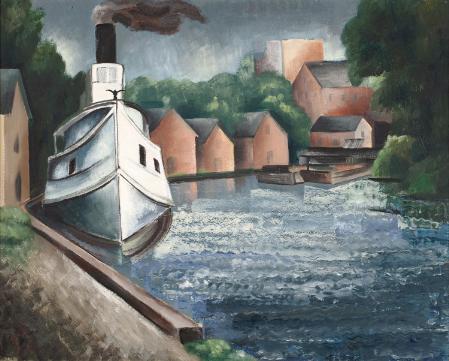 Konrad Cramer was born and raised in Wurtzburg, Germany in an artistic family. His mother was an opera singer and an uncle was a well-known painter of still lifes. Cramer trained as an artist at the Karlsruhe Academy under Ludwig Schmidt-Reutte and Ernest Schurth. He became interested in the German avant-garde early in his schooling as he was exposed to and encouraged by the experimental works of Wassily Kandinsky and Franz Marc. An additional influence on Cramer's artistic development was the Cubist landscapes of Paul Cézanne.
In 1911 Cramer met and married the American artist Florence Ballin who was traveling in Germany that year. The couple first traveled through Germany, visiting the exhibitions and studios of the country's avant-guard artists. Cramer then settled with his wife in Woodstock, New York, where Ballin had painted with the Art Students League each summer since 1906. Cramer established a reputation as one of Woodstock's most modern painters with an impressive series of abstract paintings exhibited at the MacDowell Club in 1913.
In the 1920s Cramer developed a personal representational style which blended modern and regional influences. Cramer received a Rockefeller grant in 1920 to study educational methods for craftsmen in Germany and France. In 1922 he took a teaching position at the Woodstock School of Painting and helped establish the Woodstock Artists Association, where he served as a director. While teaching and painting, Cramer also applied his artistic talent to illustration and textile design.
Konrad Cramer first exhibited at the Whitney Studio Club in 1924 and participated in the Whitney Museum of American Art's first and second biennials in 1933 and 1935. He was also included in the 1935 exhibition Abstract Painting in America at the Whitney. Cramer was later included in the Whitney Museum exhibition "Pioneers of Modern Art in America" in 1946. In the 1930s, Cramer participated in many other museum invitationals, including: the Carnegie International (1929, 1933, 1937, 1938); the Pennsylvania Academy of the Fine Arts (1934, 1936) and the Corcoran Gallery of Art (1935, 1937).
In 1934 Konrad Cramer and his wife traveled to Mexico where they produced many paintings and drawings. Back in Woodstock in 1935, Cramer briefly joined the Federal Art Project, administering the regional program in Woodstock. In the mid-1930s Cramer took up photography to clarify aesthetic issues in his painting. Cramer had gotten to know Alfred Stieglitz upon his arrival in America in 1911 and wrote an essay about 291 Gallery for Stieglitz's magazine Camera Work in 1914. Through Stieglitz and then in the 1930s fellow Woodstockers like Russell Lee, Cramer became interested in the possibilities of photography and began working with it as an artistic medium.
While continuing to paint in the late 1930s and 1940s, Cramer shared his passion for photography by founding the Woodstock School of Miniature Photography in 1936 ("Miniature" referred to the then-new format of 35 mm film). He also taught photography at Bard College from 1940 to 1946. In the 1950s Cramer collaborated on a traveling exhibition and book of abstract photographs with Manuel Komroff and Nathan Resnick titled The Third Eye, which was circulated by the Department of State in 1961-1962.
Konrad Cramer died in Woodstock in 1963.Biography from Phoenix Art Museum
 A painter of abstraction including numerous still life and non-objective work, Konrad Cramer became one of America's earliest modernist painters. He founded and directed the Woodstock, New York Art Association and the Woodstock School of Painting. In painting style, he was one of the more radical artists working there, adapting Cubism to the local landscape.
He divided his time between Woodstock and Manhattan and was highly prominent in progressive art circles. He was a close friend of Alfred Stieglitz, who interested him in photography, and this led to Cramer's directing and teaching at The Woodstock School of Miniature Photography. He was also a skillful illustrator and textile designer.
He was born in Wurtzburg, Germany, and was early influenced by the Munich expressionists called der "Blaue Reiter," translated "Blue Rider." The group was founded by Wassily Kandinsky and was the avant-garde art movement of its day. Cramer used oil, watercolor, and ink in a loose, free flowing style that depicted fish, nudes and other objects. From that subject matter, he switched to Cubism, inspired by Cezanne's planes of light.
In 1911, he married an American art student and emigrated to America, where he began his distinguished career. In 1913, he established his American reputation with a pioneering series of abstract paintings. His post World War I style became a fusion of European modernism with imagery of American culture such as common household objects in his still life.
His work is in numerous museums including the Phoenix Art Museum in Arizona.Biography from Christie's New York, Rockefeller Center
Konrad Cramer was born in Germany in 1888 and trained at the Karlsruhe Academy of Fine Arts before moving to the United States in 1911. Settling in Woodstock, New York, he blended his European heritage with American artistic influences, creating a unique style that combined Cubism, symbolism, and American Modernism. Cramer was also a talented photographer, associated with Alfred Stieglitz, and later became one of the first instructors of photography at Bard College. His works can be found in prestigious institutions such as the Getty Museum, the Metropolitan Museum of Art, and the Smithsonian American Art Museum.