Page loaded successfully. Showing biography for Kurt Seligmann.
Kurt Seligmann BIOGRAPHY
1900 Basel, Switzerland - 1962 Middletown, New York. Known for: Surreal narrative images, etcher.
Surreal artist, Kurt Seligmann worked in various media, drawings, and prints over a period of four decades and in several hundred works. Seligmann's work typically "depicts a kind of dance macabre in... Read full biography
Surreal artist, Kurt Seligmann worked in various media, drawings, and prints over a period of four decades and in several hundred works. Seligmann's work typically "depicts a kind of dance macabre in which anthropomorphic figures - comprised of an amalgamation of armour, heraldic devices, ribbons,... Read full biography
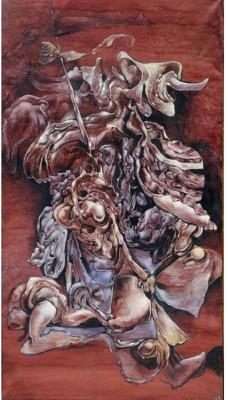
Surreal artist, Kurt Seligmann worked in various media, drawings, and prints over a period of four decades and in several hundred works. Seligmann's work typically "depicts a kind of dance macabre in which anthropomorphic figures - comprised of an amalgamation of armour, heraldic devices, ribbons, cloth, helmets, feathers, bone and ceremonial paraphernalia - cavort in unknown rituals in darkly cavernous, yet undetermined, space (Stephen Robeson Miller)." . His surreal art expressed his own... Read full biography
Surreal artist, Kurt Seligmann worked in various media, drawings, and prints over a period of four decades and in several hundred works. Seligmann's work typically "depicts a kind of dance macabre in which anthropomorphic figures - comprised of an amalgamation of armour, heraldic devices, ribbons, cloth, helmets, feathers, bone and ceremonial paraphernalia - cavort in unknown rituals in darkly cavernous, yet undetermined, space (Stephen Robeson Miller)." . His surreal art expressed his own "personality, background and temperament" along with the time and place. An "age in which he and other Surrealist artists of his generation responded to new developments in psychoanalysis, exploring irrational and unconscious sides of the human psyche in... Read full biography
Surreal artist, Kurt Seligmann worked in various media, drawings, and prints over a period of four decades and in several hundred works. Seligmann's work typically "depicts a kind of dance macabre in which anthropomorphic figures - comprised of an amalgamation of armour, heraldic devices, ribbons, cloth, helmets, feathers, bone and ceremonial paraphernalia - cavort in unknown rituals in darkly cavernous, yet undetermined, space (Stephen Robeson Miller)." . His surreal art expressed his own "personality, background and temperament" along with the time and place. An "age in which he and other Surrealist artists of his generation responded to new developments in psychoanalysis, exploring irrational and unconscious sides of the human psyche in a world seemingly gone mad with conflict on an unprecedented scale in two world wars (Stephen Robeson Miller)." . Seligmann's work is also... Read full biography
Artist Biography
Biography page for Kurt Seligmann ((1900 - 1962)), known for Surreal narrative images, etcher. Showing 3 biographical entries and 0 sample artworks.
Kurt Seligmann - Artist Info
About Kurt Seligmann
Biography from the Archives of askART
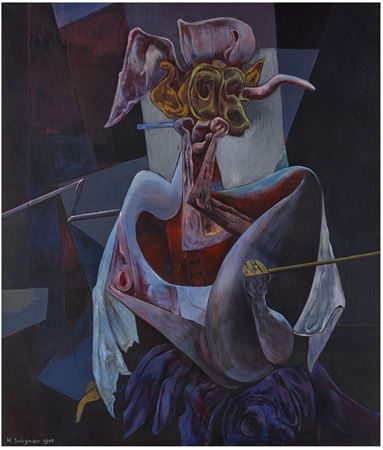 Surreal artist, Kurt Seligmann worked in various media, drawings, and prints over a period of four decades and in several hundred works. Seligmann's work typically "depicts a kind of dance macabre in which anthropomorphic figures - comprised of an amalgamation of armour, heraldic devices, ribbons, cloth, helmets, feathers, bone and ceremonial paraphernalia - cavort in unknown rituals in darkly cavernous, yet undetermined, space (Stephen Robeson Miller)."
His surreal art expressed his own "personality, background and temperament" along with the time and place. An "age in which he and other Surrealist artists of his generation responded to new developments in psychoanalysis, exploring irrational and unconscious sides of the human psyche in a world seemingly gone mad with conflict on an unprecedented scale in two world wars (Stephen Robeson Miller)."
Seligmann's work is also inspired by the "imagery of the Pre-Reformation artists of his Swiss homeland. There exists a kinship between the medieval fantasies of his Swiss and German forebears and his own armored images; between the vitality and cruelty of scenes of beheadings, combats, and impalements. . . . With this rich heritage, Seligmann's work links twentieth century forms of the unconscious to the spirit of Germanic art of the sixteenth century (Stephen Robeson Miller)."
During the 1940s, Seligmann lived and worked in New York City, at a time when the city was home to European refugee artists and intellectuals who escaped the Nazi threat in Europe. Seligmann played a crucial role in the "survival of an intellectual climate which would lead to cultural Renaissance in America. The result was the rise of the "New York School" and Surrealism's successor movement on the international stage, Abstract Expressionism (Stephen Robeson Miller)."
In September 1939, Seligmann and his wife Arlette arrived in New York for an exhibition of his work at the Karl Nierendorf Gallery. Seligmann was the first member of the Paris-based Surrealists to relocate to New York, therefore he was able to help get the paperwork that would help his fellow artists in Europe. The Seligmanns settled into an apartment in the Beaux Arts building at 40th Street near Bryant Park. There they became quickly established in the city's avant-garde art circles. During this time his work was exhibited regularly at Nierendorf, Durlacher and, later, the Ruth White Galleries. In addition, he designed sets and costumes for ballets by Hanya Holm and George Balanchine and began a distinguished teaching career at Briarcliff Junior College and Brooklyn College.
In 1940 the couple bought an old farm with sixty acres in the small village of Sugar Loaf. The location would be close to New York, and a two hour drive from Litchfield County in western Connecticut, where their other friends would soon settle. The barn in Sugar Loaf was even the site of "etching parties" where Calder, Tanguy, Zadkine, and Meyer Schapiro, among others, made etchings hand pulled on Kurt's own etching press.
In 1941, Seligmann participated in the exhibition "First Papers of Surrealism" for the war relief benefit of French children; the cover of the catalogue was made by Marcel Duchamp from a photograph he had taken of the stone foundation of the Sugar Loaf barn. Another famous group exhibition which included Seligmann was the "Artists in Exile" show at the Pierre Matisse Gallery, New York, 1942: for its catalogue, George Platt Lynes' took a photograph that has since become recognized as one of the greatest assemblies of artistic geniuses of the twentieth century: Kurt Seligmann is shown standing with Andre Breton, Marc Chagall, Max Ernst, Yves Tanguy, Piet Mondrian, Fernand Leger, Roberto Matta, Andre Masson, Pavel Tchelitchew, Eugene Berman, Jacques Lipchitz, Amadee Ozenfant, and Ossip Zadkine. Seligmann was also an active contributor to two journals of the 1940s, View and VVV.
After the war many artists returned to Europe, but the Seligmanns stayed in New York. They never sold their house in Paris in the impasse Villa Seurat designed by Andre Lurcat, rather they rented it to such artist friends as Man Ray, Isamu Noguchi, and Wolfgang Paalen. They never returned to Europe for any extended period but visited their families in 1949, and when they became naturalized United States citizens in the 1950s, they spent much of their time in Sugar Loaf.
Seligmann's time throughout the 1950s was spent teaching at Brooklyn College as well as privately in Sugar Loaf; lecturing occasionally at colleges and galleries in New England; and exhibiting his etchings and paintings which increasingly found homes in museums throughout the country.
On January 2, 1962 at the age of sixty-one, Kurt Seligmann died from an accidental gun-shot wound in Sugar Loaf.
Source:
Stephen Robeson Miller,
Boston, Ma., June, 1995
retrieved from: www.occf-ny.org/seligmann.htmBiography from Millon & Associes
Kurt Seligmann was a Swiss-American artist who studied with André Lhote, Colarossi, and at the Académie de la Grande Chaumière. He was a member of the Abstraction-Creation group and the surrealist movement, and his paintings were a unique combination of Swiss naive and folk art with surrealism. He and his wife moved to the United States in 1939 and he exhibited at the Nierendorf gallery. He helped several of his surrealist friends emigrate to the United States and maintained links with Paris and the Galeries Françaises. He had a retrospective exhibition at the Maeght gallery in 1949 and subsequent exhibitions in Saarbrücken and Constance. He died in Sugar Loaf, New York in 1962Biography from Dobiaschofsky Auktionen
Kurt Seligmann, a Swiss artist born in Basel, had a diverse artistic journey that took him from studying in Geneva and Paris to becoming a prominent figure in the New York art scene. He was a member of various art groups and had his breakthrough in the early 1930s. Seligmann emigrated to New York in 1939 due to the political situation in Europe and continued his artistic pursuits there, exploring semi-figurative works influenced by abstract expressionism. Despite his contributions to the art world, he tragically took his own life in 1962 at his country home in Sugar Loaf.