Page loaded successfully. Showing biography for Lado Goudiachvili.
Lado Goudiachvili BIOGRAPHY
1896 Tiflis, Georgia, Russia - 1980 Tiflis, Georgia, Russia. Known for: Painting, stage design, drawing, and illustration.
Lado Gudiashvili was a 20th century painter born in Tiflis, Georgia, Russia on March 18, 1896 into a family of a railroad employees. He studied in the Tiflis school of sculpture and fine art... Read full biography
Lado Gudiashvili was a 20th century painter born in Tiflis, Georgia, Russia on March 18, 1896 into a family of a railroad employees. He studied in the Tiflis school of sculpture and fine art (1910-1914), and later in Ronson's private academy in Paris (1919-1926). For a while, Gudiashvili belonged... Read full biography
Lado Gudiashvili was a 20th century painter born in Tiflis, Georgia, Russia on March 18, 1896 into a family of a railroad employees. He studied in the Tiflis school of sculpture and fine art (1910-1914), and later in Ronson's private academy in Paris (1919-1926). For a while, Gudiashvili belonged to a group of Georgian poets called "The Blue Horns" (1914-1918), who were trying to connect organically the Georgian national flavor with the creative structure of French symbolism. In Paris, he was a... Read full biography
Lado Gudiashvili was a 20th century painter born in Tiflis, Georgia, Russia on March 18, 1896 into a family of a railroad employees. He studied in the Tiflis school of sculpture and fine art (1910-1914), and later in Ronson's private academy in Paris (1919-1926). For a while, Gudiashvili belonged to a group of Georgian poets called "The Blue Horns" (1914-1918), who were trying to connect organically the Georgian national flavor with the creative structure of French symbolism. In Paris, he was a constant customer of the famous "La Ruche," a colony of painters where he met I. Zuloaga, Amedeo Modigliani, Natalia Goncharova, and Mikhail Larionov. Gudiashvili's work was greatly influenced by Niko Pirosmanashvili. Filled with the charm of... Read full biography
Lado Gudiashvili was a 20th century painter born in Tiflis, Georgia, Russia on March 18, 1896 into a family of a railroad employees. He studied in the Tiflis school of sculpture and fine art (1910-1914), and later in Ronson's private academy in Paris (1919-1926). For a while, Gudiashvili belonged to a group of Georgian poets called "The Blue Horns" (1914-1918), who were trying to connect organically the Georgian national flavor with the creative structure of French symbolism. In Paris, he was a constant customer of the famous "La Ruche," a colony of painters where he met I. Zuloaga, Amedeo Modigliani, Natalia Goncharova, and Mikhail Larionov. Gudiashvili's work was greatly influenced by Niko Pirosmanashvili. Filled with the charm of Georgian life, the painter's early works combine dramatic grotesque with the charm of poetic mystery (Live Fish, 1920, Art... Read full biography
Artist Biography
Biography page for Lado Goudiachvili ((1896 - 1980)), known for Painting, stage design, drawing, and illustration. Showing 2 biographical entries and 0 sample artworks.
Lado Goudiachvili - Artist Info
About Lado Goudiachvili
Name variants
Vladimir Davidovich Gudiachvili, Lado Vladimir Davidovich Gudiashvili
Biography from the Archives of askART
 Lado Gudiashvili was a 20th century painter born in Tiflis, Georgia, Russia on March 18, 1896 into a family of a railroad employees. He studied in the Tiflis school of sculpture and fine art (1910-1914), and later in Ronson's private academy in Paris (1919-1926).
For a while, Gudiashvili belonged to a group of Georgian poets called "The Blue Horns" (1914-1918), who were trying to connect organically the Georgian national flavor with the creative structure of French symbolism. In Paris, he was a constant customer of the famous "La Ruche," a colony of painters where he met I. Zuloaga, Amedeo Modigliani, Natalia Goncharova, and Mikhail Larionov. Gudiashvili's work was greatly influenced by Niko Pirosmanashvili.
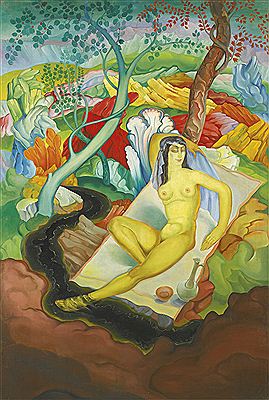
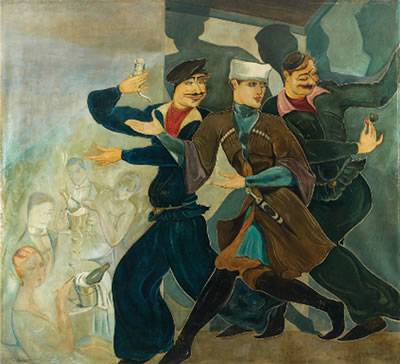
Filled with the charm of Georgian life, the painter's early works combine dramatic grotesque with the charm of poetic mystery (Live Fish, 1920, Art Museum of Georgia). Closeness to the traditions of old Caucasian and Persian art was amplified upon his return to Georgia in 1926. Gudiashvili's colors become warmer, and the perception of the world as a theater grew stronger (many of Gudiashvili's paintings were either inspired by operas and ballets or serve to depict actresses in costumes).
Like his compatriots (Grigol Robakidze, Konstantine Gamsakhurdia), Gudiashvili freely used mythological allegories (The Walk of Seraphita, 1940), the center of which was a graciously beautiful woman imagined as the mysterious "Goddess of the Earth."
Gudiashvili also worked as a monumentalist, painting anew the Kashveti church in Tbilisi in 1946, for which he was expelled from the Communist Party and fired from the Tbilisi Academy of Fine Arts, where he had been teaching since 1926.
In the voluminous "antifascist cycle" of Indian ink drawings Gudiashvili became a kind of "Georgian Goya": beastlike monsters surrounded the ruins of art and naked "goddesses" conveyed the ideas of the death of culture.
Lado Gudiashvili worked also as a book illustrator, cinema and theater decorator. He died on July 20, 1980 in Tbilisi.
Source:
Wikipedia
http://en.wikipedia.org/wiki/Lado_GudiashviliBiography from The Museum of Modern Art (MoMA)
Lado Goudiachvili was a Georgian painter, draughtsman, illustrator and stage designer. From 1910 to 1914 he trained at the Tiflis School of Painting and Sculpture and from 1919 to 1926 at the Académie Ronson in Paris. While in Paris he became closely acquainted with Modigliani, Ignacio Zuloaga, Natal'ya Goncharova and Mikhail Larionov.
His early works, with their theatrically romantic depictions of Georgian national life, fantastic and Symbolist motifs and surreal effects of colour, combine elements of the grotesque with a charming poetic mystery (e.g. the 'Tsotskhali' Fish, 1920; Tbilisi, Mus. A. Georg.). His affinity with ancient Georgian and Persian art, of which he was a connoisseur, intensified on his return to Georgia in 1926; his colours became shimmering and tinged with gold, and, at the same time, the visual link with theatre became even stronger (many of his paintings have opera or ballet performances as their subjects or portray actresses in costume).
He frequently depicted fantastic and mythological subjects (e.g. Serafita's Outing, 1940; Tbilisi, Mus. A. Georgia). Usually the central figure is a gracefully majestic and beautiful Georgian woman representing a mysterious earth goddess. His vast anti-totalitarian series of ink drawings (1942; e.g. Tbilisi, Mus. A. Georgia) recall the images in Goya's work: the chimerical visions that he evoked embody in equal measure Nazism and the tragedy of Georgian history during the years of Stalin's rule. Gudiashvili also painted frescoes, including one (1946) for the Kashveti Church in Tbilisi, a choice of commission for which he was expelled from the Communist Party and dismissed from the Tbilisi Academy of Arts, where he had taught. He illustrated many books, among them Sulkan Saba Orbeliani's Mudrost' lzhi ('The wisdom of falsehood'; 1939), and worked as a set designer for the theatre.
M. N. Sokolov
From Grove Art Online