Page loaded successfully. Showing biography for Lars Lerin.
Lars Lerin BIOGRAPHY

Born 1954 Munkfors, Sweden. Known for: Large scale watercolor painting, graphics, collage, photographs.
The following exhibition review, by Mary Abbe, is from the Star Tribune, Minneapolis, "Variety" Section, 29 Jan. 2016. New watercolors by art star Lars Lerin showcased at American Swedish Institute.... Read full biography
The following exhibition review, by Mary Abbe, is from the Star Tribune, Minneapolis, "Variety" Section, 29 Jan. 2016. New watercolors by art star Lars Lerin showcased at American Swedish Institute. Mural-sized watercolors are featured in a remarkable new show at the Swedish Institute. Dark,... Read full biography
The following exhibition review, by Mary Abbe, is from the Star Tribune, Minneapolis, "Variety" Section, 29 Jan. 2016. New watercolors by art star Lars Lerin showcased at American Swedish Institute. Mural-sized watercolors are featured in a remarkable new show at the Swedish Institute. Dark, brooding and romantic, the watercolors of Swedish art star Lars Lerin have an unsettling, febrile beauty in his memorable new show at the American Swedish Institute. Huge snowflakes drift toward distant... Read full biography
The following exhibition review, by Mary Abbe, is from the Star Tribune, Minneapolis, "Variety" Section, 29 Jan. 2016. New watercolors by art star Lars Lerin showcased at American Swedish Institute. Mural-sized watercolors are featured in a remarkable new show at the Swedish Institute. Dark, brooding and romantic, the watercolors of Swedish art star Lars Lerin have an unsettling, febrile beauty in his memorable new show at the American Swedish Institute. Huge snowflakes drift toward distant farm sheds barely visible through fog and mist in a wintry birch forest. Taxidermied birds perch on wooden pedestals, frozen in the glassy rigor mortis of old-fashioned ornithological displays. A solitary white fox crouches on barren tundra under a... Read full biography
The following exhibition review, by Mary Abbe, is from the Star Tribune, Minneapolis, "Variety" Section, 29 Jan. 2016. New watercolors by art star Lars Lerin showcased at American Swedish Institute. Mural-sized watercolors are featured in a remarkable new show at the Swedish Institute. Dark, brooding and romantic, the watercolors of Swedish art star Lars Lerin have an unsettling, febrile beauty in his memorable new show at the American Swedish Institute. Huge snowflakes drift toward distant farm sheds barely visible through fog and mist in a wintry birch forest. Taxidermied birds perch on wooden pedestals, frozen in the glassy rigor mortis of old-fashioned ornithological displays. A solitary white fox crouches on barren tundra under a brooding sky. Hundreds of postcard-sized apartments stack atop each other in a 15-foot-wide vista of anonymity and decay that Le... Read full biography
Artist Biography
Biography page for Lars Lerin ((Born 1954)), known for Large scale watercolor painting, graphics, collage, photographs. Showing 2 biographical entries and 0 sample artworks.
Lars Lerin - Artist Info
About Lars Lerin
Biography from the Archives of askART
 The following exhibition review, by Mary Abbe, is from the Star Tribune, Minneapolis, "Variety" Section, 29 Jan. 2016.
New watercolors by art star Lars Lerin showcased at American Swedish Institute
Mural-sized watercolors are featured in a remarkable new show at the Swedish Institute.
Dark, brooding and romantic, the watercolors of Swedish art star Lars Lerin have an unsettling, febrile beauty in his memorable new show at the American Swedish Institute.
Huge snowflakes drift toward distant farm sheds barely visible through fog and mist in a wintry birch forest. Taxidermied birds perch on wooden pedestals, frozen in the glassy rigor mortis of old-fashioned ornithological displays. A solitary white fox crouches on barren tundra under a brooding sky. Hundreds of postcard-sized apartments stack atop each other in a 15-foot-wide vista of anonymity and decay that Lerin calls “Civilization.”
Books, chairs, birds, trees, apartments, ships, paintings and even a film get the Lerin treatment in this ambitious survey, his first U.S. show in 30 years. Widely exhibited throughout Scandinavia as well as France and Germany, Lerin has also published more than 50 books and is a popular television personality in his homeland.
“He’s now a superstar in Sweden, loved for his watercolors and books,” said Bera Nordal, director of the Nordic Watercolor Museum in Tjörn, Sweden. The exhibition’s curator, she recently gave an impromptu tour of the show as the museum’s staff completed the installation (it runs through May 22).
Besides his art and writing, Lerin, 61, has earned respect for the candor with which he has addressed troubling personal issues, Nordal said. Withdrawn and introspective when he launched his art career decades ago, he has only recently resolved what she called “a very traumatic life.”
“He had a kind of angst and hated being around people,” Nordal said. “He is homosexual and has had drug and alcoholic problems. Then he decided to come out and talk about it. He speaks from the heart, and that touches people because he’s really talking about things that matter. People feel that honesty. It isn’t fake; it’s just him.”
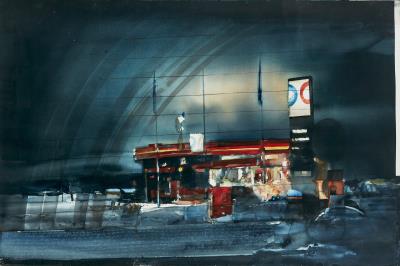
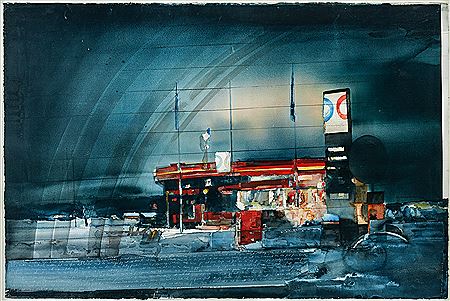
With their drips, stains and splashes of color, Lerin’s paintings seem direct and candid, too, as if he’s reporting on the scene, rather than reconstructing events in the studio. That immediacy is doubtless an illusion, though, since he typically paints on sheets of paper that are 5 feet wide or tall, much too big to set up for plein-air work. He often assembles a dozen or more panels into mural-sized compositions that have the grandeur of 19th-century American landscapes. But they’re suffused with the fretful, postmodern doubt more typical of the crusty canvases of Anselm Kiefer, a contemporary German artist whose work Lerin’s resembles in its psychology.
Lerin favors dark blues and browns, the colors of Nordic winter nights that he uses to theatrical effect. People are rarely present, though their artifice is everywhere: in huge container ships in blue-black voids on restless seas, in buildings whose vaulted corridors and ornate salons dissolve into watery miasmas, in featureless modern apartment buildings shimmering in opalescent light.
The Swedish Institute has smartly dispersed the paintings throughout its building which is a deft mash-up of contemporary minimalism and baronial castle. Lerin’s nature paintings hang in a modern gallery adjacent to ASI’s popular Fika restaurant. There, close-ups of birch trunks, rocks, leaves and cliffs crowded with puffins introduce him as a naturalist, though that’s not quite what he is.
Look closely at, for example, a big painting of skiers zipping down alpine slopes toward chalets nestled in pine-clad ravines. It’s a fetching image, filled with winsome charm, odd sepia-toned light and strange reflections. Pay attention to the light and reflections. They’re the giveaway that the scene depicts a diorama spied in a museum or shop. It’s art about art, not about nature.
“He’s not really doing nature,” Nordal said. “It’s nature as a manifestation of something else, his own melancholic temperament.”
Lerin’s vignettes of culture are hung in nooks throughout ASI’s castle. The attic ballroom is a perfect setting for his impressions of grand buildings, including the hall of mirrors at Versailles. The pretty nursery houses his lively pictures of stuffed birds, while the library holds a big, unexpectedly arresting painting of neatly shelved books in other libraries.
Strolling through the castle’s carved and paneled rooms, it’s startling to encounter his riff on Alfred Hitchcock’s murder mystery Rear Window. Like the classic 1954 film, the 6-foot-wide painting turns viewers into voyeurs windowpeeping at life in an apartment building. There’s a couple embracing, a lonely woman, a solitary man, shadowy figures in darkened windows. Each little scene implies a larger drama of love, despair, unfinished business in lives cut short like those of the taxidermied birds, or the quizzical fox staring into the darkness.
The lovely downstairs breakfast room holds a special treat — a half-dozen Lerin portraits of traditional Swedish chairs. Surrogates for the people who’ve sat in them over the decades, the chairs are revealed as companionable couples, a gossiping threesome, pretentious grandees, a passive-aggressive mismatch, a lonely single.
Paired with period chairs from the mansion itself, the intimate little pictures are sly, witty and insightful meditations on Swedish life and soul. Surely Lerin is pictured there, too, in spirit if not in face.
Where: American Swedish Institute, 2600 Park Avenue South, MinneapolisBiography from the Archives of askART
 Lars Lerin was born and raised in Munkfors, Värmland. He studied at the school of Gerlesborg 1974-75 and at the Department of Fine Arts, Valand 1980-84. Lars Lerin is considered to be one of Scandinavia’s leading artists in watercolor technique. He has had solo exhibitions and group exhibitions in art museums and galleries in Sweden, Denmark, Finland, France, the Faroe Islands, Iceland, Germany, Norway and the United States. Lars Lerin’s work is exhibited in County Councils and Municipalities in Sweden and Norway.
Lars Lerin is also a prolific author and has since his book, Utpost (1983), he has written and released more than fifty books.
The permanent exhibition of his work in Karlstad, Sweden at Sandgrund Lars Lerin, shows different themes from Lars Lerin’s 30 years as an artist. Sandgrund contains watercolor paintings, oil paintings, graphic art, collages and photographs from many places in the world, for example Värmland, where Lars Lerin was born and currently lives; Lofoten which was Lars’ home for several years during the 90’s; and a lot of work and reports from Lars’ travels to the Arctic and Antarctica, Siberia, Iceland, Scotland, The Faroe Islands, India, Egypt and Iran.
Sandgrund is privileged to be able to show Lars Lerin’s dark and pale colors in his work, and how they reflect the artist’s own emotional and artistic life from the early 70’s to present. Sandgrund also has a room called The White Room, which is reserved for a guest exhibitors. Every year four different artists will show their work in The White Room.
“Watercolor technique is a powerful tool in the searching hands of artist Lars Lerin. He is a master of its potential and submits to its capricious temperament. The subjects for his works he finds in the places where he makes his home. He grew up in the Swedish province of Värmland, close to the thick forests and where the long summer nights and the darkness of winter are a part of existence. On the Norwegian Lofoten Islands he discovered the sea and horizon. He has a feeling for the grandeur of natural scenery and sympathy for the tough conditions under which people work there. In his paintings he returns time and again to how people live and work in home and factory. Memories, words, sentences and fragments of images recur frequently in his paintings; together they form a puzzle of memories which capture impressions of life and warmth such as perhaps no longer exist. It is a nostalgic, existential longing common to us all.”? Bera Nordal, Nordic Water Color Museum
Sandgrund was founded on initiative by Paul Jardeby and opened for the first time in 1960. One year earlier the former classic restaurant Stadsträdgården was burnt to the ground by a pyromaniac. The architect Uno Asplund working at Wästlunds architect office got the task to create a new and modern restaurant located at cape Sandgrund.
The building was projected and built in record time. With its modernistic architecture and large landscape windows facing Klarälven, Sandgrund was noticed internationally. In the beginning of the 70s Sandgrund was considered to be one of Sweden’s largest and most modern restaurants. Sandgrund soon started hosting dancing nights and became a dance palace with visitors from entire Sweden and Norway. During the glory days in the 90s, Sandgrund hosted dancing evenings five times a week and many of Sweden’s most popular bands gave guest performances.
Today Sandgrund is the permanent exhibition hall of Lars Lerin.
Source:
"Sandgrund Lars Lerin," Web, 29 Jan. 2016