Page loaded successfully. Showing biography for Laszlo Feher.
Laszlo Feher BIOGRAPHY
Born 1953 Székesfehérvár, Hungary. Known for: Hyper-realist painting, social commentary, Jewish themes, landscape.
Born March 17, 1953, Székesfehérvár, Hungary. Lives in Budapest, Hungary. Lives in Tác, Hungary. László Fehér is a Hungarian painter and visual artist, a graduate of the Academy of Fine Arts, and a... Read full biography
Born March 17, 1953, Székesfehérvár, Hungary. Lives in Budapest, Hungary. Lives in Tác, Hungary. László Fehér is a Hungarian painter and visual artist, a graduate of the Academy of Fine Arts, and a recipient of many research fellowships abroad (including Rome). He is a representative of... Read full biography
Born March 17, 1953, Székesfehérvár, Hungary. Lives in Budapest, Hungary. Lives in Tác, Hungary. László Fehér is a Hungarian painter and visual artist, a graduate of the Academy of Fine Arts, and a recipient of many research fellowships abroad (including Rome). He is a representative of hyper-realistic painting whose attributes he has modified to include current topics: reflection on social themes, Jewishness etc. In 1990 he participated in the Venice Biennale. Eighteen years later the... Read full biography
Born March 17, 1953, Székesfehérvár, Hungary. Lives in Budapest, Hungary. Lives in Tác, Hungary. László Fehér is a Hungarian painter and visual artist, a graduate of the Academy of Fine Arts, and a recipient of many research fellowships abroad (including Rome). He is a representative of hyper-realistic painting whose attributes he has modified to include current topics: reflection on social themes, Jewishness etc. In 1990 he participated in the Venice Biennale. Eighteen years later the Liechtenstein Museum in Vienna arranged a retrospective exhibition of his work. He is a winner of a number of awards and was appointed the ambassador of Hungarian culture in 2007. László Fehér attended Magyar Képzomuvészeti Foiskola/ The Hungarian Academy of... Read full biography
Born March 17, 1953, Székesfehérvár, Hungary. Lives in Budapest, Hungary. Lives in Tác, Hungary. László Fehér is a Hungarian painter and visual artist, a graduate of the Academy of Fine Arts, and a recipient of many research fellowships abroad (including Rome). He is a representative of hyper-realistic painting whose attributes he has modified to include current topics: reflection on social themes, Jewishness etc. In 1990 he participated in the Venice Biennale. Eighteen years later the Liechtenstein Museum in Vienna arranged a retrospective exhibition of his work. He is a winner of a number of awards and was appointed the ambassador of Hungarian culture in 2007. László Fehér attended Magyar Képzomuvészeti Foiskola/ The Hungarian Academy of Fine Arts between 1971 and 1976. In the middle of the decade he started focusing more systematically on prov... Read full biography
Artist Biography
Biography page for Laszlo Feher ((Born 1953)), known for Hyper-realist painting, social commentary, Jewish themes, landscape. Showing 1 biographical entries and 0 sample artworks.
Laszlo Feher - Artist Info
About Laszlo Feher
Name variants
Laslo Feher
Biography from the Archives of askART
 Born March 17, 1953, Székesfehérvár, Hungary
Lives in Budapest, Hungary
Lives in Tác, Hungary
László Fehér is a Hungarian painter and visual artist, a graduate of the Academy of Fine Arts, and a recipient of many research fellowships abroad (including Rome). He is a representative of hyper-realistic painting whose attributes he has modified to include current topics: reflection on social themes, Jewishness etc. In 1990 he participated in the Venice Biennale. Eighteen years later the Liechtenstein Museum in Vienna arranged a retrospective exhibition of his work. He is a winner of a number of awards and was appointed the ambassador of Hungarian culture in 2007.
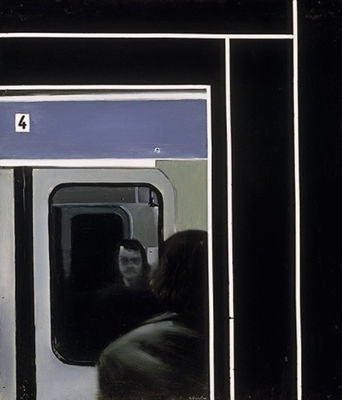
László Fehér attended Magyar Képzomuvészeti Foiskola/ The Hungarian Academy of Fine Arts between 1971 and 1976. In the middle of the decade he started focusing more systematically on provocative photorealistic painting, adding a specific social and critical accent. His series of paintings called Brigade Records (1975) reflected the debility and emptiness of an ID photo. He proceeded in the same way in his works titled Aluljáró I/ Underpass I (1975), Földalatti/ Underground Railway (1976), and Aluljáró II/ Underpass II (1978), respectively, which represened a formally perfect depiction of the triviality of everyday life, the gloominess that was so typical for the second half of that decade.
Studied at Hungarian University of Fine Arts
1977
The formal representation and the topics of Fehér's canvases evoked photographic moments. They were specific due to the atypical cut-outs and shifts in perspective, with the domination of black and white, although some of them copied the radiant chromaticity of ORWO photographic film. In fact, they were an alternative to the family photograph style of the 1960's (Életkép/ Genre, 1979).
[László Fehér] (solo exhibition, Kincsesbánya)
1978
Received grant from Derkovits art scholarship
1979
László Fehér] (solo exhibition, Székesfehérvár)
1980
The series of paintings with Jewish topics was a certain parallel to the family photographs, a reflection of Fehér's personal affiliation. In 1980, Fehér worked on a canvas titled LT/ Diptichon/ LT/ Diptych (1980), a highly contrasting photorealistic painting in a black and blue contrast, depicting a man of Jewish origin, a Jewish flag and a detail of an inscription in Hebrew. Diaszpóra/ Diaspora, the last of his black-and-white paintings in the photorealistic style, originated in 1982
1982
Received award from Studio of Young Artists’ Association
1983
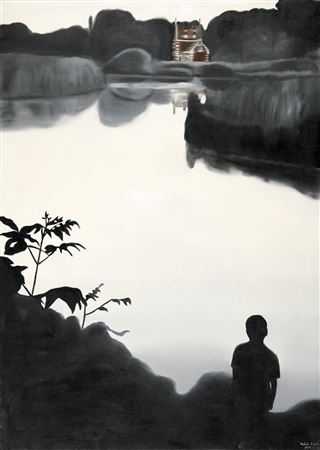
Between 1983 and 1985, Fehér also dealt with stylized landscape painting. For a certain time he more or less gave up photographic concreteness, reducing his palette to the combination of red, black, white and ochre. This reduction abated in the mid decade
[László Fehér] (solo exhibition, Budapest)
1986
In 1986, Fehér won a scholarships and stayed in Rome. The change of environment was manifest in the increased chromaticity of the palette and canvas monumentalization (Róma/ Rome, 1986
The Italian scene with angel (painting)
Received grant from Hungarian Academy in Rome
[László Fehér] (solo exhibition, Székesfehérvár)
1987
Received award from International Festival of Painting Cagnes-sur-Mer
19th International Festival of Painting Cagnes-sur-Mer (group exhibition, Cagnes-sur-Mer)
Nová madarská malba: Fehér, Kelemen, Koncz, Mulasics, Nádler, Soös, Szabados, Szirtes (group exhibition, Brno)
1988
His return from Italy resulted in quite a dramatic reduction of chromaticity. Fehér restricted the range to the triad of basic colours, yellow, black and white. While yellow typically forms the background, black is used for the architectonic and – together with white – also the figural staffage. Fehér's process gradually became strictly codified, it was used in almost realistic variants Presszó (Café, 1988) and Este 1953-ban (Evening in 1953, 1988), as well as in canvases from 1990 and 1991, tending more and more markedly to transcendence (Testvérek/ Brothers,
1990
Képek 1983-1987 (solo exhibition, Graz)
[László Fehér] (solo exhibition, Budapest)
1989
In 1990, László Fehér participated in the Venice Biennnale, where he presented this current collection (Emlékmunél/ Memorial, 1989
Source: Central European Art Database, Olomouc Museum of Art,Czech Republic http://cead.space/Detail/people/42
Submitted by Michael Silverbrooke